Economy
/ news
A review of things you need to know before you sign off on Thursday; FMA warns insurers, Kiwibank profit falls, Heartland profit rises, an Auckland traffic solution?, big bond demand, retail failures up, swaps stable, NZD jumps, & more
Here are the key things you need to know before you leave work today (or if you work from home, before you shutdown your laptop).
MORTGAGE RATE CHANGES
WBS raised its floating rate today. All current mortgage rates are here. And note, you can compare mortgage offers with our unique calculator that takes into account other costs and cashback incentives, here.
TERM DEPOSIT/SAVINGS RATE CHANGES
None here today. All updated term deposit rates less than 1 year are here, for 1-5 years, they are here.
RETAILER STAFF ACTIONS CAN'T SHIELD INSURER'S RESPONSIBILITIES FOR ON-SOLD FEATURES
The FMA has released a review of add-on insurance and extended warranties, highlighting the need for stronger oversight of sales and distribution channels to support fair consumer outcomes. Insurers cannot outsource the responsibility for fair consumer outcomes, they said. “Where products are sold through intermediaries, insurers still need robust systems, controls and monitoring to ensure consumers are treated fairly. We saw a recurring gap between the policies, processes, systems and controls insurers described and how they operated in practice."
TRANSACTION GROWTH BUT LOWER PROFITABILITY
Kiwibank profit fell as it focuses on market share growth in 'very competitive' environment. They reported a -9% lower profit result for the year to June to $174 mln on tighter margins (NIM). CEO Steve Jurkovich says ANZ NZ has been 'very competitive' in mortgage market. He also notes bank mergers are 'quite tricky' to pull off, in a back-hand reference to the Heartland/TSB proposal. Annual Report is here.
INSOLVENCY LEVELS HIGH BUT FLAT, HOWEVER RETAIL FAILURES RISING
The number of retail businesses entering insolvency rose sharply in Q2, even as overall business failure numbers nationally remained largely unchanged. BWA Insolvency's latest Quarterly Market Report shows that retail insolvencies increased from 39 to 68 cases in Q2 2026 out of a total of 760 in the quarter.
'THE SOLUTION IS TRAFFIC MANAGEMENT AND MORE CAPACITY'
The Government has launched an Auckland Motorway Strategic Plan that sets out how the city will cope over the next 30 years. The plan focuses on three core outcomes: Optimising the existing network - making better use of the network we've already got through smarter traffic management, quicker responses to crashes and breakdowns, small-scale improvements, and delivering Time of Use Charging. Targeted increases in capacity - adding extra capacity where bottlenecks are impacting efficiency, progressively delivering rapid transit, closing critical gaps in active mode networks where they interact with motorways, prioritising projects to increase capacity and address resilience risks. Wider system improvements - improving the wider transport system, including public transport capacity, rail network improvements, and local roads/active modes, so fewer trips need to use the motorway network.
UNDERWATER A GROWING TREND
The percentage of residential properties selling at a loss has increased from less than 1% in 2022 to 13% in Q2 this year, according to Cotality's latest Pain & Gain Report.
-->
NZX50 ON HOLD
As at 3pm, the overall NZX50 index was unchanged today, and up +0.8% for the past 5 trading sessions. It is up +4.7% from six months ago. From a year ago it is now up +6.6%. Market heavyweight F&P Healthcare is up +1.1% so far today. Spark, Gentrack, NZX, and Skellerup led the 65 gainers while Auckland Airport, The Warehouse, a2 Milk and Chorus were among the largest decliners (66).
TRANSACTION GROWTH & HIGHER PROFITABILITY
Also reporting its results today was Heartland Group. The trans-Tasman banker said its annual profit beat guidance and jumped to $93 mln, up from $38 mln in the prior year. Margins increased (NIM). They say they are focused on growth in its reverse mortgage portfolio and pursuing its proposed merger with TSB. Annual Report is here.
PAMU DELIVERS 'STRONG' RESULT
PAMU/Landcorp said it has delivered its strongest operating result on record, Net Operating Profit (NOP) of $113 million and Net Profit After Tax (NPAT) of $160 million for the year ended 30 June 2026, compared with NOP of $49 million and NPAT of $120 million in the prior year. It is paying a dividend of $15 mln. Total equity is about $1.9 bln. They are forecasting a full-year Net Operating Profit for the 2026/27 financial year in the range of $77 to $87 million, with a midpoint of $82 million.
SUPER-SIZED IS NOW NORMAL
Super-sized demand is becoming the norm for recent NZGB bond tenders. Today's $450 mln offer drew 94 bids worth $2.14 bln for two maturities. YTM was little different to the prior equivalent events which were quite recent. You might have thought this demand would have depressed the YTM. At least it kept it from rising.
ANOTHER AVANTI SECURITISATION
Meanwhile Avanti Finance has securitised $250 mln of personal and car loans out of its New Zealand business.
WOOL PRICES STILL RISING
PGG Wrightson is reporting that limited volumes coming forward for sale continue to underpin the recovery in strong wool, particularly second-shear and oddment types. Competition remained supportive across these categories. The first offering of merino wool for the new season opened to a strong, competitive bench of buyers, providing an encouraging start to the season. Mid-micron styles also sold well, considering the easing in the Australian market earlier in the week. Overall, the market maintained a positive and confident tone.
AUSSIES DON'T EXPECT INFLATION TO EASE ...
Australian inflation expectations rose by 0.2 percentage points in August to 4.9%. This follows a three-month period of moderating inflation expectations. Wage expectations also rose in August, after remaining static for a prolonged period.
... BUT LABOUR MARKET EASES
Staying in Australia, full-time jobs rose +16,300 in July but part-time jobs fell -32,200 in the month for a new decrease in employment levels. So instead of the expected +15,000 rise in jobs, they had a -15,800 net fall. While this may seem like a big movement, in fact the June positive result was quite elevated so a leveling out is probably to be expected.
JAPANESE EXPORTS HIT NEW RECORD HIGH
Japan said its exports swelled +23% in July from a year ago and to an all-time record high, boosted by AI-related semiconductors and data center equipment. Meanwhile, imports were up almost +28%, boosted by fuel imports which were up more than +53% in value. and total imports also hit a new record high. The net was a small trade deficit on merchandise.
STAYING VERY LOW BUT NOT GENERATING ANY EXCITEMENT
China held its key lending rates at ultra low levels in the regular monthly update. But these very low rates aren't exactly generating a boom, more just holding things together. The People's Bank of China kept its key lending rates at these record lows for a 15th straight month. And that is what analysts were expecting.
SWAP RATES LITTLE-CHANGED
Wholesale swap rates will likely be flattish again today. Keep an eye on our chart below which will record the final positions closer to 5pm. The 90 day bank bill rate was up +1 bp at 2.99% on Wednesday. Today, the Australian 10 year bond yield has dipped -5 bps to 4.99% from this time yesterday. The China 10 year bond rate is up +2 bps at 1.69%. The Japanese 10 year bond is now at 2.84% today and down -7 bps. The NZ Government 10 year bond rate is now at 4.72% and down -2 bps.. (The RBNZ data is now 'prior day' with the Wednesday rate down -3 bps at 4.71%.) And the UST 10yr yield is now at 4.63%, down -6 bps from this time yesterday on the US Treasury buy-back plan after these rising yields spooked them. (How long that can mask natural market shifts is open to question.)
EQUITIES MIXED
The NZX50 is now little-changed from Wednesday's close. The ASX200 has opened up +0.3%. Tokyo has opened up with a +1.0% recovery. The KOSPI has also recovered, up +5.5%. Hong Kong has opened up +0.6% but Shanghai is only up +0.3% at its open. Singapore is down -0.5% in early Thursday trade today. Wall Street ended its Wednesday session with the S&P500 up +0.2% and the Nasdaq composite was also up +0.2%.
OIL PRICES MIXED
American oil prices are down -US$1 from this time yesterday with the WTI benchmark is now just over US$84.50/bbl, while the international Brent price is still just under US$92/bbl and up +50 USc.
CARBON PRICE HOLDS
We see very few trades today but the price has firmed +50c to $53.50/NZU. See our daily chart tracker of the NZU price for carbon, courtesy of emsTradepoint.
GOLD JUMPS
In early Asian trade, gold is up +US$136/oz from yesterday, now at US$4489/oz. Silver is up +US$4 at US$67/oz. These sharpish moves are mostly about the falling USD.
NZD JUMPS AGAINST ALL-COMERS
The Kiwi dollar is up +80 bps against the USD from this time yesterday, now just on 59.5 USc. Against the Aussie we are up +60 bps to just under 83.6 AUc. Against the euro we are up +30 bps at 51 euro cents. This all means the TWI-5 is now just on 63 and up +70 bps.
BITCOIN JUMPS
The bitcoin price is now at US$69,166 and up an elevated +7.6% from yesterday. Volatility has been very high at just on +/- 4.4%. Trump is making moves to benefit the industry (and himself).
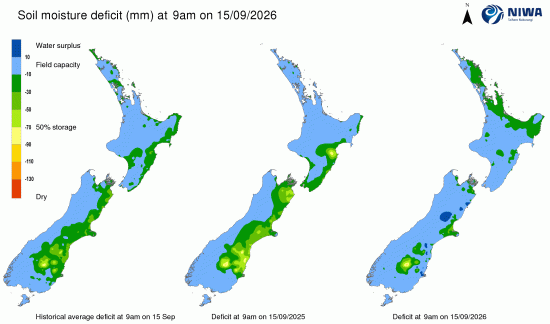
This soil moisture chart is animated here.
Keep abreast of upcoming events by following our Economic Calendar here ».


We welcome your comments below. If you are not already registered, please register to comment
Remember we welcome robust, respectful and insightful debate. We don't welcome abusive or defamatory comments and will de-register those repeatedly making such comments. Our current comment policy is here.