
sign up log in
Want to go ad-free? Find out how, here.

A review of things you need to know before you sign off on Friday; FHBs prop up housing market & willing to scrimp, asking rents up, GDP Nowcast firm, rural prices hesitate, ANZ eyes cutbacks, swaps up again, NZX flat, NZD dips, & more

Economy / news
A review of things you need to know before you sign off on Friday; FHBs prop up housing market & willing to scrimp, asking rents up, GDP Nowcast firm, rural prices hesitate, ANZ eyes cutbacks, swaps up again, NZX flat, NZD dips, & more

Here are the key things you need to know before you leave work today (or if you work from home, before you shutdown your laptop).

MORTGAGE RATE CHANGES
No changes to note today, so far. But with wholesale swap rates rising still, expect more next week. All current mortgage rates are here. And note, you can compare mortgage offers with our unique calculator that takes into account other costs and cashback incentives, here.

TERM DEPOSIT/SAVINGS RATE CHANGES
ANZ has raised its 1 year TD rate by +10 bps to 4.00%. Finance Direct has trimmed all their rates. All updated term deposit rates less than 1 year are here, for 1-5 years, they are here.

FHBs PROP UP MARKET
RBNZ data shows first home buyer activity steady, with the help of a substantial increase in low equity mortgages. Low equity mortgages are helping to prop up first home buyer activity, the data suggests.

HOW AFFORDABILITY AFFECTS HOME-BUYER BEHAVIOUR
Cotality has released a new five-country review of house-buyer behaviour. It finds New Zealand buyers are the most willing of any market surveyed to take out a smaller mortgage to improve affordability. They are also among the most willing to cut lifestyle spending, with 78% having already done so or planning to, compared with 69% globally.

RENTS TURNING UP?
TradeMe Property surveys its rental listings, tracking asking rents. They say these national median weekly rents rose to $625 in August, up $5 a week on the same month last year. That is the first year-on-year increase since January 2025, ending 18 consecutive months of stagnant or falling asking rents. Although minor they claim it is driven by "a tightening supply pool and rising renter interest". Asking rents on an internet portal is one thing. Actual rents (like we track from the MBIE bond data) will show if that is a real trend. Our next rent assessment from the MBIE data will be released for August about October 17.

WOOL'S RISE OVER?
PGG Wrightson's latest wool sale update shows a decline setting in after the sharp June/July price jumps. A larger-than-expected for-sale volume recently is butting up against more cautious buyers, especially for coarse wools. Things were much better for mid-micron and Merino wool.

UNCERTAINTY ON MEAT PRICES
Lamb prices remain firm, although there is increasing uncertainty around how well current levels will hold once new-season production increases, according to meat processor Prime Range Meats. The lower NZ dollar is helping to support returns and maintain current pricing levels. Demand for mutton remains firm, with Chinese buyers looking to secure product ahead of CNY, which should provide support to pricing in the short term. Beef prices continue to soften in the US, with increased import availability and the temporary expansion of the US quota for lean beef trimmings adding further pressure to the market.

WEALTH TAXES POPULAR - IPSOS POLL
Unemployment as an issue has pushed into being a top four concern facing households and electors according to the latest Ispos political poll. And interestingly, 64% of those surveyed support introducing a wealth tax on assets over $10 mln.

STILL EXPANDING
The latest weekly update of the RBNZ's GDP Nowcast incorporating the latest real-time data shows the Q2-2026 rate up to +0.2% growth, but the Q3-2026 rate unchanged at +0.6% (from the prior quarter).

NZX50 EASES SLIGHTLY
As at 3pm, the overall NZX50 index is down -0.1% so far. But for the past 5 trading sessions it is unchanged. It is up +8.3% from six months ago. From a year ago it is now up +4.3%. Market heavyweight F&P Healthcare is little-changed so far today. Vulcan Steel, Auckland Airport, AirNZ and Sanford gain while Precinct Properties, Infratil, The NZX and Oceania fall.

FROM PE TO PE & K/S
Fisher Funds and Direct Capital are buying New Zealand Health Group from its two major shareholders, the Catley Family and Quadrant Private Equity.

MATOS SHARPENS HIS AXE
ANZ Group is intent on shrinking its workforce, especially in IT. This will likely affect their New Zealand workforce as more than 400 roles will be affected by the restructure, with more than 100 workers expected to be made redundant. It wants to consolidate software testing under a single strategic partner. Undoubtedly the RBNZ will need reassurance that the changes won't affect the ability of its New Zealand operations to stand alone from the parent in the event of a crisis.

MID-AUTUMN FESTIVAL
We should also note that it is a public holiday in China today, so their financial markets are closed (although Hong Kong is open). It is Mooncake season.

SWAPS RISE AGAIN
Wholesale swap rates will likely be higher again today, maybe as much as +4 bps. Keep an eye on our chart below which will record the final positions closer to 5pm. The RBNZ 90 day rate was up +2 bps at 3.21% on Thursday. Today, the Australian 10 year bond yield is up +3 bps to 5.40% and its highest since 2011. The China 10 year bond rate is still at 1.67%. They are on holiday today. The Japanese 10 year bond is now at 3.10% and up +4 bps to a new 30 year high. The NZ Government 10 year bond rate is now at 5.13% and up +4 bps from Thursday and its highest since November 2023. (The RBNZ 10 year rate is 'prior day' and was up +14 bps at 5.07% on Thursday.) And the UST 10yr yield is now at 5.19% and up another +7 bps from yesterday, its highest in 24 years.

EQUITIES MIXED
The NZX50 is now down -0.1% from yesterday's close. The ASX200 has opened down -0.5%. Tokyo is up +1.2%. The KOSPI is closed today. Hong Kong has opened down -1.8% while Shanghai is closed, on holiday. Singapore is down -0.2% in early Friday trade today. Wall Street ended little-changed on the S&P500, ditto on the Nasdaq.

OIL PRICES UP
American oil prices have risen +US$2 from yesterday with the WTI benchmark now at just over US$93/bbl, while the international Brent price is just over US$105.50/bbl and up +US$3.50/bbl. But these prices are actually lower than earlier today on news a phased reopening of Hormuz is being discussed.

CARBON PRICE STILL ON HOLD
There have been very few trades reported again today, so far. The price is still at $52.50/NZU. See our daily chart tracker of the NZU price for carbon, courtesy of emsTradepoint.

GOLD LITTLE-CHANGED
In early Asian trade, gold is down -US$3/oz from this time yesterday, now at US$4283/oz. Silver is also little changed at just under US$64/oz.

NZD LOWER
The Kiwi dollar is down -30 bps from yesterday, now at 56.5 USc. Against the Aussie we are down -10 bps at 80.6 AUc. Against the euro we down -20 bps at just on 49.7 euro cents. This all means the TWI-5 is remains just over 60.4 and down -20 bps from yesterday.

BITCOIN ON HOLD
The bitcoin price is now at US$84,209 and down a mere -0.2% from this this time yesterday. Volatility has been modest at just on +/- 1.1%.

HOW THE GLOBAL ECONOMIC FORCES AFFECT US
If you want to catch up on what happened last night, try our Economy Watch podcast, here.

Daily exchange rates

Select chart tabs

Source: RBNZ
Source: RBNZ
Source: RBNZ
Source: RBNZ
Source: RBNZ
Source: RBNZ
Source: RBNZ
Source: CoinDesk

Daily swap rates

Select chart tabs

Source: NZFMA
Source: NZFMA
Source: NZFMA
Source: NZFMA
Source: NZFMA
Source: NZFMA
Source: NZFMA

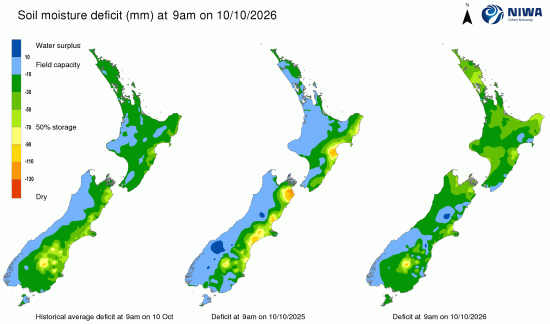
This soil moisture chart is animated here.

Keep abreast of upcoming events by following our Economic Calendar here ».

We welcome your comments below. If you are not already registered, please register to comment

Remember we welcome robust, respectful and insightful debate. We don't welcome abusive or defamatory comments and will de-register those repeatedly making such comments. Our current comment policy is here.

18 Comments

Apollo and Morgan Stanley just did it again. They capped private credit fund withdraws to customers. Approx 15% of customers want to get out of Apollo and 11% out of Morgan Stanley. 

Third quarter in a row this has happened.

Investors asked to pull far more than the funds would pay.

Both capped redemptions at 5%.

https://www.businesstimes.com.sg/companies-markets/banking-finance/apollo-caps-private-credit-fund-again-14-7-look-exit

https://www.investing.com/news/company-news/morgan-stanley-caps-private…

Up
7

And........ its gone.

Sorry this queue is for bank customers only please move along.


Up
5

The real risk of AI....

sure it could hack you, build a virus etc but much more likely it will just make your job obsolete


https://www.afr.com/policy/economy/forget-rogue-robots-ai-s-biggest-thr…

Up
1

I wonder if these AI CEOs claiming that AI is going to kill us have a bit of an ulterior motive. That dude from Anthropic for example, maybe they just want to keep their place at the top. 

Up
1

"prices are actually lower than earlier today on news a phased reopening of Hormuz is being discussed."

Yeah, but who's discussing it? Trump on "truth social"? 

Up
5

maybe they are scared they will be bombed back to the dark ages

maybe     not

Up
6

...and the market still seems to buy these stories, even though they have been proven wrong over and over again.

Up
6

The past doesn't predict the future remember 

Up
0

Perhaps, but then again, the present, which obviously previously once was the future, doesn’t always remember, what the was predicted in the past. Or as per the quote on here this morning - experience is remembering a mistake when you make it again.

Up
0

AI trader bots aren't interested the big picture, just keywords from Trump's brain farts

Up
0

President Trump desperately, really desperately, seeks some form of positive news, any source will do, that his blundering foray into a conflict with Iran is now alleviating itself. Just over five weeks to the mid terms. Time is tight and the Iranians remain as unpredictable and self contradictory as even President Trump himself. Somewhere within the dynamics of all of that is a plot for a Tom Clancy wannabe. 

Up
2

The NZD keeps tanking, now at a 17 year high (since 2009) when measured against the TWI.  We are getting poorer internationally.

Up
5

it signals a financial crash is coming 

Up
5

I thought we were supposed to celebrate a low dollar. Great for exporters! Hooray! (Just conveniently ignore our continual trade deficit)

Up
5

Don't worry, the RBNZ will fix the problem by crashing the economy, I'm sure people will be buying NZD after that. 

Up
0

what I have concluded in NZ , is that if I am 1 order of magnitude wealthier  then the person below me they are somewhat jealous...   this is normal "jealous"    2 or three orders it seems to become radical irrespective of merit 

so comment on deserved ...


Up
0

Regal Partners investment director Charlie Aitken has a simple warning for anyone considering diving into the ASX’s retail stocks – “don’t be a hero”.

The S&P/ASX 200 consumer discretionary index has plunged 23.2 per cent over the 12 months to Friday as the Reserve Bank of Australia embarked on an aggressive rate-lifting cycle to stave off inflation. Only the local tech sector fared worse, down 45.3 per cent.

The ASX retail sector is in a world of pain right now due to rising inflation, higher interest rates, creeping unemployment, and a national housing downturn. But investors warn things could get worse. Eamon Gallagher

And the alarm bells rang louder this week with negative trading updates by Myer, Smiggle’s owner, Premier Investments, and KMD Brands, the owner of the Rip Curl and Kathmandu outdoor and surf clothing brands.

But there is more pain in store for consumers, as financial markets price in a near-certain interest rate rise by the RBA to 4.6 per cent at next week’s policy meeting, followed by another increase early next year. Markets also assign a solid chance of a third increase by the middle of next year, which would take the cash rate above 5 per cent – a level last seen during the global financial crisis in 2008.

Adding to the mix is the fact that the country’s property downturn – home prices nationally are down 4.5 per cent from their peak in April, according to data provider Cotality – has created a negative wealth effect, whereby consumers rein in spending as the value of their assets fall.

Related Quotes

JBHJB Hi-Fi Limited

$66.310 -2.34%

1 year1 day

Sep 25Dec 25Apr 26Sep 2660.00075.00090.000105.00120.00


Updated: Sep 25, 2026 – 3.59pm. Data is 20 mins delayed.

View JBH related articles

MYRMyer

$0.180 -7.69%


Sep 25Dec 25Apr 26Sep 260.1700.2550.3400.4250.510


KMDKMD Brands

$1.520 -2.88%


Sep 25Dec 25Apr 26Sep 260.9501.9002.8503.8004.750


HVNHarvey Norman

$4.150 -0.48%


Sep 25Dec 25Apr 26Sep 264.0005.0006.0007.0008.000


CKFCollins Foods Limited

$7.665 -0.84%


Sep 25Dec 25Apr 26Sep 267.7008.8009.90011.00012.100


Advertisement

The share price of electronics retailer JB Hi-Fi, considered the poster boy for the ASX consumer sector, has sunk 43.4 per cent in the past year.

Others have been sold down even more savagely, with Myer’s share price down nearly 60 per cent in the 12 months, and ARB, which makes and sells bull bars, roof racks and accessories for four-wheel drive vehicles, falling 53.2 per cent in the year to Friday. However, Aitken said he has no intention of picking up any of the heavily discounted retail names.


“The best thing to do in these situations is just be on the sidelines – you don’t need to be a hero because the way the sharemarket works now is if you jump in prematurely you could regret that very quickly,” said Aitken, whose fund has more than $20 billion in assets under management.

“Australia’s mortgage belt is under some real pressure, so we expect consumers to trade down, pull in discretionary spending, and holiday at home. And we’re only in the early stages of this.”

Aitken said a key warning sign that the sector could fall further into a hole would be if the national jobless rate hit 5 per cent. Data from the Australian Bureau of Statistics, released on Thursday, showed it had cracked 4.6 per cent in August, the highest since 2021, up from 4.5 per cent in July.

“If we see the domestic economy starting to really shed labour, that is the biggest headwind of them all, and things could get very nasty,” Aitken said, adding that he believed online retailers and travel agents including Flight Centre, Kogan, and Temple & Webster were the most vulnerable given their business models could be disrupted by artificial intelligence.

Data from the ABS released last month showed that gross profits across the retail industry fell 5.2 per cent in the three months to June, their biggest quarterly decline since March 2024. But pressure on the sector has ramped up even further in September as Cue Clothing Company fell into administration and rival department store chain David Jones has been in trouble with its suppliers over late bill payments.

Meanwhile, KMD on Wednesday said it would consider a range of takeover proposals after plunging to a full-year loss of more than $300 million. On the same day, Myer executive chairwoman Olivia Wirth announced the department store giant had plunged to an annual loss of almost $300 million and reported weak sales in the new financial year.

Up
1

“If we see the domestic economy starting to really shed labour, that is the biggest headwind of them all, and things could get very nasty,” Aitken said,

Crikey, they;re looking at a likelihood of 3x hikes in the midst of coming down from a housing peak fuelled by, just as NZ was, mass immigration and housing speculation euphoria. The housing has popped, now we wait for the unemployment and wonder to what degree the AUS mining sector can soften the economic blow, especially if the contagion spreads form when the AI bubble bursts. My pick is they will not be able to withstand the fallout, and they will have a recession/depression that not many will have remembered having to bear. There's always a demand for their mined ore, gold, and other minerals, but this depends on demand of course, which would wane in a global recession. The next question owuld be, how would the mighty AUS dollar holdup in this scenario.

Up
0