
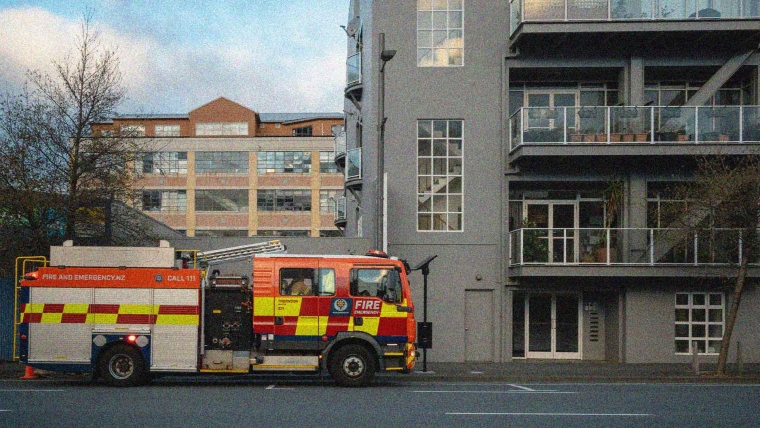
Both the Labour Party and outgoing ACT MP and Internal Affairs Minister Brooke van Velden say alternative ways of funding Fire and Emergency New Zealand (FENZ) beyond the insurance levy system in place for 51 years should be looked at.
Their comments come with National wanting to overhaul FENZ's structure into a departmental agency if re-elected into government while leaving its existing funding arrangement in place, as the Crown Agency faces continued scrutiny over the state of its fleet and leadership.
National’s proposal would mean FENZ’s board, appointed by the Minister of Internal Affairs, which is responsible for the governance and oversight of the emergency service, would be replaced.
On Wednesday National emergency management spokesperson Mark Mitchell and National MP Tim Costley put forward the party’s plan.
This plan would see:
- FENZ becoming a departmental agency directly accountable to the Minister for Emergency Management which would remove the FENZ board
- A turnaround plan be developed
- Extra mental and physical health support for volunteer firefighters
- Ordered appliances getting into service, and the establishment of funded fleet replacement and training programmes
“This reset will put responsibility where it belongs. Fire and emergency professionals will continue making operational decisions, but there will be a clear line of accountability for whether FENZ is delivering for firefighters and communities," Costley said.
Meanwhile Mitchell said the reset had no fiscal cost to it as everything would be delivered within baselines for FENZ.
“They’ve had a substantial rise in funding over the last decade and everything that’s been costed will be delivered within baseline.”
Currently, FENZ is funded through an insurance levy system. A FENZ levy is part of a person’s premiums if they have insurance cover for property against the risk of fire. The levy also applies to motor vehicle insurance policies.
According to the Insurance Council of New Zealand (ICNZ), the lobby group for general insurers, FENZ currently raises around $800 million annually through the levy. And on its website, ICNZ has provided a broad example showing the FENZ levy makes up about 5% of a house insurance premium.
This levy was introduced in 1975 and has remained the same while FENZ’s services have expanded beyond fires to also include medical emergencies, maritime incidents, severe weather events and disasters.
Asked about FENZ’s funding model, Costley said the issue wasn’t about how much money FENZ is getting in, it’s what they’ve been doing with it.
“It’s not a funding issue here, it’s an operational issue.”
Mitchell said: “But in relation to that, of course, you should be looking for continual improvement in identifying where the services are most needed and who is getting those services.”
Those within the insurance sector have called for changes to how FENZ is funded with ICNZ chief executive Kris Faafoi saying last week: “We believe the time has come to move beyond an insurance-based levy and adopt a funding model that shares the cost of emergency services more fairly across the community.”
Embattled FENZ
This comes as last week, Brooke van Velden, who is the minister that oversees FENZ told RNZ she no longer had confidence in the organisation’s chief executive Kerry Gregory, saying FENZ were acting “in breach of their own law”.
She said FENZ had been referred to the Serious Fraud Office.
"It is important that every public agency that has taxpayer or levy payer money going into it is acting transparently and has accountability going to senior levels of officials."
"It is a clear breach of trust when the public service is not allowing that information to flow,” she told RNZ.
Labour promises independent review
Labour, on the other hand, said if elected into government, it would launch an independent review into FENZ’s funding and operations.
Labour’s internal affairs spokesperson Lemauga Lydia Sosene said: “Our firefighters put their lives on the line every day to keep communities safe. Being properly backed to do their jobs is the least they deserve.”
“The situation at FENZ is untenable. Equipment is failing, upgrades have been delayed and firefighters are feeling devalued. It is high time action was taken.”
The party also promised to extend presumptive occupational cancer cover for firefighters, and to extend ACC cover to volunteer firefighters through a Member’s Bill from Labour MP Kieran McAnulty.
Labour leader Chris Hipkins told reporters simply replacing the FENZ board was not going to cut it.
“It needs to go deeper than that.”
Hipkins said the situation at FENZ was unacceptable.
An independent review was needed to get to the bottom of what’s been going on there and to ensure that FENZ was being set up to succeed in the future, he said.
While Hipkins is usually critical of reviews, he said in this case, a proper review was warranted.
How FENZ is funded sustainably in the future was something we needed to look at, he said.
“And that does include the role of government here as well, recognising that government relies on FENZ to be there for schools, for hospitals, for other public agencies, so we have a responsibility there too.”
Outgoing ACT MP and Internal Affairs Minister says National’s proposal raises more questions
The Department of Internal Affairs (DIA) has been looking into whether there are better ways to fund FENZ, with van Velden, as Internal Affairs Minister, in June saying it was important that revenue collected to fund FENZ was “reliable, fit for purpose and future proof.”
Asked about National’s policy, van Velden, who is also an outgoing ACT MP, said National’s proposal to bring FENZ under the leadership of the Minister for Emergency Management had raised more questions the party needed to answer.
“Is it appropriate if they do go down the avenue of making it a departmental agency to still have it funded through the insurance industry, I personally don’t believe that’s appropriate," van Velden said.
“So I’d like to ask the National Party: Will they find up to $850 million extra in potentially new taxation, or if not, where else will they get that money from?"
“Because the questions that I’ve been raising throughout this term with my officials has been: Is it actually appropriate that it is funded by insurance levies? I personally don’t believe so.”
She hoped that the work she had done on this issue would leave the next government in “a great spot of having all the details and options on the table for what an alternative could be”.
We welcome your comments below. If you are not already registered, please register to comment
Remember we welcome robust, respectful and insightful debate. We don't welcome abusive or defamatory comments and will de-register those repeatedly making such comments. Our current comment policy is here.