

1) Spending and Savings:
Add chocolate to your list of endangered indulgences. Canadian cocoa expert John Mason is predicting chocolate will become the next commodity caught in the eye of the perfect storm that's brewing with peak oil, climate change and agricultural imbalances caused by First World farming exploits.
According to Mason's assessment, chocolate is set to become as rarefied a luxury as caviar. This report in the Globe and Mail is a bit stale now, but it's still a tear jerker and a bleak reminder of how badly we've stuffed up our food system through shrewd commercialisation.
2) Credit and Debt
As a newbie to interest.co.nz, I'm still getting acquainted with all the amazing tools and resources on this site. For newcomers who haven't yet mined the data, I would recommend a thorough comb through the calculators section. Savers will delight in the term deposit calculator where you can weigh up the difference of a 30 basis points spread, or what have you, between banks competing for your money.
As a prerequisite, check out credit ratings explained as more often than not it's the bank with the shabbiest institutional rating that's offering the highest rate. On the debt side, there's a vast range of information on comparative credit card rates. But wait, there's more....our in-house data trackers also chart a range of commodities and indices including monthly statistics on credit card spending.
Charts may not be everyone's cup of tea but they tell a story in and of themselves. For instance, take a gander at this one tracking the ebb and flow of our nation's credit card addiction going back to 1981. It would appear that consumers were detoxing in March but the addiction and interest persists.
3) Home & real estate
Should you continue to pay premiums on a Christchurch house that is fated for demolition? Seems a bit cruel given there's nothing left to protect but insurers in Christchurch insist you need to continue paying to ensure EQC coverage kicks in, if there is another quake and you sustain further land damage.
It's unlikely insurers will be advertising the discounted rates but some have reduced them and not by an insignificant amount either.
Worth making a call. The trouble is, you could be paying for nothing. Technically speaking, EQC doesn't cover bare land. (See EQC frequently asked questions for more).That wasn't a huge issue previously but now with as many as 20,000 homes to be destroyed, homeowners are left on even shakier ground in the event of the unthinkable.
In the intervening months and years between a home being raised and rebuilt, any subsequent land slips or liquefaction will be at the expense of the hapless now homeless homeowner. It's an unenviable position for financially fragile folk to be it and one that EQC will hopefully provision for if it happens.
4) Death & Taxes

Buddhists espouse contemplating death on a daily basis so that we are better prepared to face it but also so that one learns, through meditation, to value life more fully. I've always struggled with this one but morbidly suspect its come easily to ex.
Whatever your spiritual beliefs - or status - death is a subject that shouldn't be ignored when it comes to personal finance. For one, it'll remind you of the importance of having a will done, something which I'd managed to avoid (most likely because of the mental exercise that it entails) until quite recently, despite having dependents.
The consequences of dying intestate (i.e. without a will) aren't so hot for loved one's left behind who have to sort through the legal red tape on top of the emotional mayhem.
For one, bank accounts can be frozen for months pending legal applications to free up whatever cash may be in them. Also, in the absence of a will, the state will carve up your estate according to a pre-set formula with partners and children at the front of the line.
Given modern family dynamics, it's not a prescription that will suit all. For more on the laws that kick in when you kick the bucket, see the NZ Public Trust website.
And keeping with the cheery subject of death and wills, the NZ Law Society has set up a service to help Christchurch residents and their lawyers track down wills that may have been lost or buried in the rubble by the Feb.22 earthquake. For details, see the Law Society's website.
5) Books
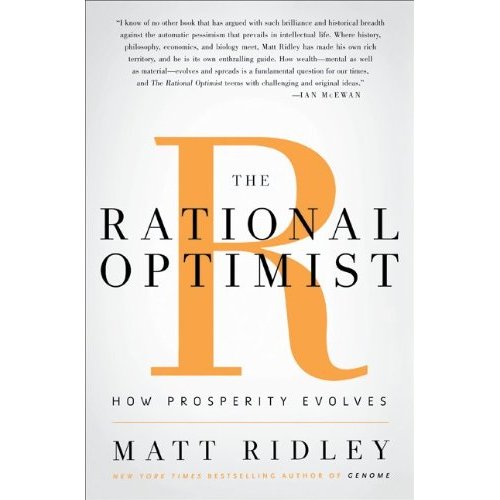
Prophets of doom have an easy job of it these days. Global warming, accelerated species annihilation, festering financial markets, gargantuan oil spills...all convincing reasons that humanity is headed to hell in a super-sized logo engraved handbasket.
Amid that backdrop, Matt Ridley offers an alternative and far more optimistic view that puts humanity in a better boat.
In his recent book, The Rational Optimist, Ridley tells pessimists to get a grip - on reality.
Using an arsenal of facts and figures from the Stone Age to present, Ridley makes a rather convincing case that mankind is far from damned.
He claims we are richer, smarter, taller, healthier and happier on average than any other point in history. Furthermore, Ridley maintains we are ably equipped to deal with present and future challenges, however ugly and expensive they may be. The solution? In a nutshell, Ridley believes our salvation will boil down to sex: between people and their ideas.
Ridley is an interesting study. Trained as a zoologist, he pursued as a career in journalism and ended up an editor at The Economist for a time. He was also "non-executive" chairman at Northern Rock before it tipped over during the financial crisis. It was during his stint of forced unemployment that he wrote The Rational Optimist.
His interests are obviously far-reaching as this You-Tube video attests.
Here's Ridley musing with Richard Dawkins (of the God Delusion fame) about what extraterrestrial life would look like.
>
29 Comments
Hey Westminster..this one's for you...all part of your learning curve..haha
"Last week, an unusual event happened in the money markets that should not escape the attention of investors."
http://www.marketoracle.co.uk/Article27656.html
Darn it, chocolate grows at less than 20 degrees lat. Can't grow it.
Uncle grows cacao in his backyard , and his sister processes them into chocolate . How much do you need ? ............ Word of warning , it ain't the smooth and sugary muck 'like Cadbury manufacture , far far from that product !
............ Cacao are weird looking trees , the way the pod just sprouts straight out of the trunk .......
Alot is being planted in Queensland , Australia . One guy has 100 hectares in ...... now wait 10 years for the first crop ........ wait ......... a bit more ........ waiting ............ c'mon , pod you little feckers , pod dammit !
Great stuff Gummie
Send us just enough to make a special Interest.co.nz chocolate bar that we give to the Commenter of the Year in this year's Interesties
Here's the 2010 version
http://www.interest.co.nz/opinion/51820/interesties-our-awards-best-and…
Here's the 2009 version
http://www.interest.co.nz/news/42622/interesties-our-awards-best-and-wo…
Looking forward to the 2011 version
cheers
Bernard
Bernard- I’m not sure - the way they comment - if Wolly or Iain really like chocolate ?
.... I'd forgotten that Infometrics had predicted ( 2009 ) a 24 % increase in NZ house prices ....... Still one year to run , how's their prediction tracking so far ?
And do you remember how irrate the author was, when his predictions were questioned! Was it a chap called Gareth Keirnan...I can't quite recall.
answer - they are going terrible like most economists' predictions!
We are still slightly lower than 2009, even a 5% increase in the next year and they would be circa 20% wrong!
Need? None, it's bad for my waist line so I rarely eat it now but I just love the stuff! That and bread.
Want, now that's different...
I agree, they're weird looking but I think I read they live to a hundred. Imagine if you could grind your own hot chocolate the rest of your life. :) Ahhhh.
Edit: That chocolate photo is just pure evil.
In moderation , chocolate is good for you ........ in moderation !
........ and having pushed the bounds of moderation myself , with choccies from around the world , our own Whittakers 70 % cocoa bars are as good in taste and quality as any of the best .
Yes but "in moderation" medically means about a thimbleful and of dark chocolate at that. Have you EVER managed to eat that little chocolate? Barely fills a cavity.
I like it all sorts of ways...truffles, brownies, chocolate pie (one of my all time favourites), oreo cookies, milk shakes, ice cream, chocolate sauce, chocolate cake, chocolate mousse, on sundaes, over almonds, on Turtles, as bars, dipped over strawberries or vanilla ice cream...the list is endless. Sigh.
Have you ever looked up the calorie count of ONE single chocolate coated almond?
Wow , JD , you really are the King of Chocolate Consumption !
............ I thought that " moderation " implied less than a kilo of choccies at one sitting , but not that much less , a thimbleful ! ......
Chocolate fudge ......... Thick hot chocolate drink in winter ............ Ben & Jerry's super chocolate fudge ice cream ............ Chocolate tiramasu ........... Tim Tams ........... ahhhhhhhh , slurp , yummy gummy chocolate bears .......... and lest we forget : Easter Eggs !
Gummy, if you are a fan of chocolate, I'll send you my chocolate book http://www.christelle-leru.com/SiteEn/eshop/samplepassionchocolat.html Got copies taking up space in my garage (anyone else interested?)...
Thanks for the offer , Elley .... Superb books you've authored .... As my little Boss is a keen cook , I'd love to get copies , but we're O/S until December ... Back to Rangiora then .
....... Brillaint website . ... But of all places in the world , why Oxford ? ..... Jo Seager's choice too !
Thank you for the kind comment Gummy :) You have my email address on the website so just drop me a note with your postal address when you are around and I'll send them to you. The first one will always be my favourite, it brings back so many childhood memories!
As for Oxford, we actually looked for a section in Christchurch for about 3 years from 2005 but the prices were rising madly so we ended up looking further around. We had started our family and were keen to have space outside but sections around 1500-2000m2 in town are far and few between (and expensive), and in fact, sections in general are on short supply. It turns out my book distributor, who had become a good friend, purchased a lifestyle block in Oxford in 2006 and we thought we'd go and check the place out and we really liked it.
We've never liked big cities (even moved from Manchester to a tiny Welsh-speaking village while in the UK because we were so sick of the crowds!) so a small village with a nice community feel where we would know lots of people by their first name is something that we knew would suit us perfectly. When we found a lifestyle block we liked, we seized the opportunity. It's a beautiful spot, about 3kms from the village and with just a few neighbours (just enough not to feel isolated). Been here just over a year and just loving it.
Oh no!! Big mistake to look! Ach! (female here btw, not that it matters I guess)
Yum, now I'm hungry! I take in moderation to mean 100g or slightly less a day of a 70% cocoa block. So far it's worked for me, and I've been following this very strict diet for about 25 years :) But I reckon Lindt 70% is the best, yummy... Happy Easter!
We go for Lindt too , and one is restricted to 100 g. per day because of the price ! ....... The Belgium shells choccies are super smooth and morish too . .......
........... as for poor old Cadbury ....... oh dear , how sad ....... how do they even stay in business ?
Swiss Lindt - hmm ?? As Swisskiwis - our favourite chocolate is Whittaker’s dark 50% Coco Rum & Raison or the 70% coco dark. But definitely Belgium and Swiss soft centred pralines.
Yes, actually it doesn't come cheap! I always buy it on sale, 25 blocks at a time to last me the month :)
Here's the recipe for what I just baked. No name for this because it was improvised:
125 g butter
1/2 cup sugar
1 egg
vanilla
1 1/2 cups flour
1tsp baking powder
About 3 rows of segments from a bar of Whittakers dark with almonds
Cream butter and sugar, beat the egg and vanilla in, mix in sifted flour and the chocolate chopped into small chunks. Roll into balls and put on a baking tray. Bake at 180 for 15 minutes-ish. Is really best raw, but fresh out of the oven and all warm and melty is pretty good too.
" Kakapo Cookies " ? ........... yum !
Just don't get the feathers stuck in your teeth.
Oh gummie, so sweet and savvy. Cadbury is junk, please send samples our way from uncle cocoa's patch. Will pay Fair Trade prices:)
Humorous Friday. H/T paraphrase of Catweasle at Yahoo! re: 'PM to wear 'greenstone' suit for royal wedding'
" He should take Nandor Tanczos ( who famously wore a hemp suit in parliament) with him, to represent a pair of New Zealand politicians. That would be : One stoned, in a clown suit. The other, a clown in a stoned suit
haha, you have to read the book:) but you might disappointed on that front. A naked focus on the breeding of ideas through human exchange, platonic or otherwise. Still worth reading though.
Looking through Ridley's reference and notes page I can see where he is coming from: all our numbers look pretty good. Global statistics reflect a general uptrend in being better off.....on average.
I look forward to reading the book. But whether it looks at the distribution of "new wealth" and better stats will be interesting. Also whether he examines the problem that a lot of our great advances (cheaper ways of doing and making) have been sucked into the speculative whirlpool thus canceling out the feel good perception.
And on that note I am devastated to report that my local chocolate shop in Christchurch (the best in NZ) has been done in by the shaking and my chocolatier has upped sticks and gone to Oz......the tragedy!!!
My whisky supplier , Whisky Galore , bit the dust too ...... As did Johnson Grocers .
........ the photos of all those single malt whiskys laying on the floor made me weep copiously into my Gummy sporran ....... fortunately , only a few of them were broken ...
......... oh , and none of the staff were hurt , neither .
My condolences Raf..all my favourite chch haunts were destroyed as well. Mostly on High Street and Lyttleton. So tragic. Fair Trade shop in chch sells amazing dark chocolate, and I hear they're one of the businesses to stage a resurrection, as they were formerly located on Cashel.
Happy Easter.
We welcome your comments below. If you are not already registered, please register to comment
Remember we welcome robust, respectful and insightful debate. We don't welcome abusive or defamatory comments and will de-register those repeatedly making such comments. Our current comment policy is here.