
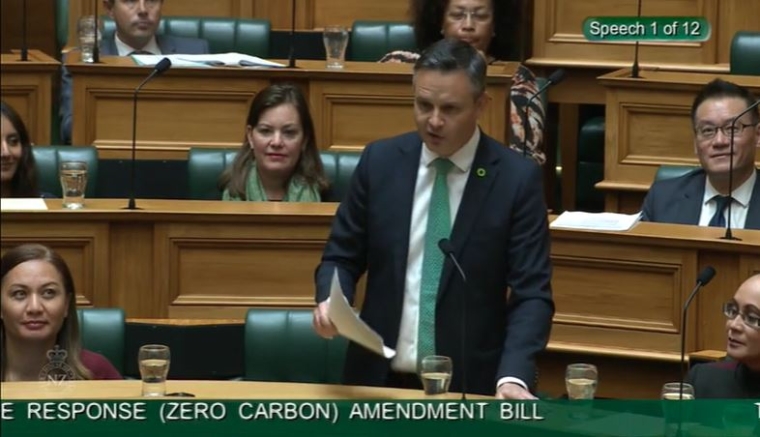
The Government’s flagship climate change Bill has passed its third and final reading in Parliament with the support of all political parties, except for ACT.
Climate Change Minister James Shaw’s Climate Change Response (Zero Carbon) Amendment Bill will receive royal assent in coming days.
The Bill sets up an independent Climate Change Commission to advise governments on how to meet emission reduction targets set in law.
These include reducing all greenhouse gases (except biogenic methane) to net zero by 2050, and reducing biogenic methane emissions within the range of 24–47% below 2017 levels by 2050 (and 10% below 2017 levels by 2030).
The Bill requires governments to set emission budgets every five years, and make plans to meet those budgets.
It also creates a requirement that the government understands the risks of climate change and produces plans to address these.
The commission will be chaired by Rod Carr - a former Reserve Bank Chair and Deputy Governor, and University of Canterbury Vice-Chancellor with expertise in insurance and risk management.
The 'product of compromise' to be tweaked under National
After negotiating with Shaw for about a year, National supported the Bill, but said it would implement the amendments it couldn’t get the Government to budge on, if elected in 2020. It will make these changes within the first 100 days of taking office.
The major change sought is for biogenic methane targets to be set by the independent commission.
National will also change the law to specifically require the commission to consider economic impacts when providing advice on targets and emissions reductions, and ensure greenhouse gas reduction doesn't occur in a way that threatens food production.
Prime Minister Jacinda Ardern said the Government didn’t support these tweaks, detailed in standing order papers submitted by National on Wednesday, as the issues of concern are essentially already addressed in the Bill.
'Some things are too big for politics'
The Government didn’t need National's support to pass the Zero Carbon Bill, but Shaw has always maintained it would be stronger if it had bipartisan support.
“Some things are too big for politics, and the biggest of them all is climate change,” he said in Parliament.
National Leader Bridges said the Bill was the “product - not as much as he wanted - of compromise”.
Responding to Ardern saying New Zealand will not be a “slow follower” on addressing climate change, National MP Judith Collins said New Zealanders “don’t want to be first and fast and furious; they want to have a fair go”.
In addition to the tweaks mentioned above, National wants the ability for targets to be adjusted to ensure New Zealand remains in step with other countries, the Commission to be specifically required to appropriately use of forestry offsets, and the law to include a greater commitment to investment in research and development to find new solutions for reducing emissions.
NZ First takes credit for 'balanced' legislation
New Zealand First supported the Bill, further to this being in its coalition agreement with Labour.
Leader Winston Peters took credit for a “balanced” Bill.
“A reigned-in Climate Commission mandate, split gas targets for carbon dioxide and biogenic methane and a predictable methane reduction path from 2020 to 2030 are among the key changes to the bill New Zealand First negotiated,” Peters said.
ACT Leader David Seymour expressed his disappointment in National for supporting the Bill.
“Yesterday, ACT proposed an amendment which would have allowed New Zealanders to achieve emissions reductions at the lowest possible cost by purchasing overseas units as well as domestic units,” he said.
“It shouldn’t matter if trees are planted in Northland or in the Amazon. The requirement for emissions to be offset using only domestic units will have a significant impact on the cost of living, including higher fuel and food costs.”
Shaw said: “This is a historic piece of legislation and is the centrepiece for meaningful climate change action in New Zealand.
“We’ve led the world before in nuclear disarmament and in votes for women, now we are leading again.
“The Bill had nearly 11,000 written and oral submissions."
We welcome your comments below. If you are not already registered, please register to comment
Remember we welcome robust, respectful and insightful debate. We don't welcome abusive or defamatory comments and will de-register those repeatedly making such comments. Our current comment policy is here.