
Here's our summary of key events overnight that affect New Zealand, with news a China:US trade deal might be close.
Wall Street rallied earlier this morning on American claims that the trade deal is very close. But the US is only offering to cut "some" tariffs, it seems. And China doesn't want to put its ag buying promises in the deal document. It is since lost some steam however, losing half the jump on those comments to be up a more modest +0.4% in afternoon trade. But it does seem like a deal of some sort could be close.
In the US, the growth of household net worth actually fell in the third quarter, down to +3.4% from +4.9% in the June quarter. That was because the value of holdings of equities fell by -US$300 bln in the quarter. This is a slowing that was more than expected and comes as household debt rose +6.3% pa in the same period, historically a high increase; in fact the second highest increase in at least the past ten years.
The number of Americans filing applications for unemployment benefits jumped to more than a two-year high last week.
At the same time, American producer prices rose just +1.3% pa, also the fastest slowing of producer output prices since late 2006.
In China, steel output is expected to it almost 1 bln tonnes in 2020, a rise of more than +6%, driven by their domestic stimulus plans. This has seen the iron ore price turn up recently, and metallurgical coal prices will likely follow. They need that stimulus - carmakers there said their expect yet another year of declining sales in 2020.
And there are more bond defaults for Chinese companies that earlier binged on debt. Corporate bond defaults are now common. The latest is unique because it is the first offshore default by a SOE in more than twenty years.
And its not only China; Canadians are defaulting on non-mortgage debt at highest third-quarter pace since 2012.
In Australia, rebounding demand for their minerals in China will give their Federal budget a boost.
The ECB, at its first meeting under Christine Lagarde, has kept it key policy rate at +0.0% and its deposit rate at -0.5%. Lagarde struck an optimstic note about the 2020 prospects for the EU economy.
In the UK, voting is underway. Currency markets are nervous as most pollsters say the result is "too close to call" and the UK currency is falling.
The UST 10yr yield is at 1.88% and up +7 bps overnight. Their 2-10 curve is more positive at +22 bps. Their 1-5 curve is also more positive at +15 bps. Their 3m-10yr curve completes the trifecta, more positive +34 bps. The Aussie Govt 10yr is up +4 bps at 1.21%. The China Govt 10yr is unchanged at 3.21%. However, the NZ Govt 10 yr is down -1 bp at 1.52% since this time yesterday.
Gold is now at US$1,469/oz and down -US$2 overnight.
US oil prices are just over US$59/bbl. The Brent benchmark is back just over US$64/bbl. The IEA says that global oil inventories could rise sharply despite OPEC output cuts and fast-slowing American production growth.
The Kiwi dollar is marginally higher again today at 65.8 USc. On the cross rates we are slightly lower at 95.5 AUc. Against the euro we are unchanged at 59.2 euro cents. That puts the TWI-5 firmer at 70.9.
Bitcoin is a little-changed at US$7,197. The bitcoin rate is charted in the exchange rate set below.

The easiest place to stay up with event risk today is by following our Economic Calendar here ».
Daily exchange rates
Select chart tabs
21 Comments
My book
Just ordered Anarchy by Dalrymple
https://www.amazon.com/Anarchy-Relentless-Rise-India-Company/dp/1635573…
Thomas Sowell
https://www.amazon.com/Conflict-Visions-Ideological-Political-Struggles…
https://www.amazon.com/Barbarians-inside-Controversial-Institution-Publ…
The corporate debt bubble
https://wolfstreet.com/2019/12/12/is-the-corporate-debt-bubble-ripe-yet/
It's going to be really interesting when fund managers try to sell off corporate bonds that are illiquid. Then when people start realising there is a major collapse US investors will do what they always do and sell off their entire pension for cash. The gap down in price will be something else.
In the mean time the repo market appears to be dealing with an issue larger than the GFC. I've heard speculation that it's big banks, then I've heard experts point out that the big US banks have plenty of cash but they don't want to lend which would mean several parties are holding rubbish collateral. More recently someone has suggested that their might be multiple LTCMs happening right now. Highly leveraged junk is a great way to destroy a financial system.
It may be the European banking system in imminent crisis mode. The tremors before the earthquake. The big US banks refuse to lend them $$$ overnight despite high rates. The ECB and EU have done a first rate job of destroying the profitability of their entire banking system, typical central planners. Not for nothing is it refererred to as the EUSSR, by those who have stopped drinking the socialist/corporatist/bureaucrats know best kool-aid.
Just in 2018, US corporations spent more than a trillion dollars in share buyback schemes, these transaction have mostly been financed with corporate debt.
In simple words, future generations will be severing a part of corporate incomes for repaying a debt used to finance these cash handouts given to wealthy shareholders at all-time high share prices.
Actually, it is all about hiding the management rort. Share options are granted at the same time as share buybacks are made. Smoke and mirrors.
https://www.epsilontheory.com/when-was-i-radicalized-boeing-edition/
The ECB, at its first meeting under Christine Lagarde, has kept it key policy rate at +0.0% and its deposit rate at -0.5%. Lagarde struck an optimstic note about the 2020 prospects for the EU economy.
ECB, translated: "We'll keep pretending we're aiming at economic stimulation by lowering rates, although we know this doesn't help, as it busts the banking system. But it will allow us to introduce central bank digital currency, get you all microchipped & under our total control. Link
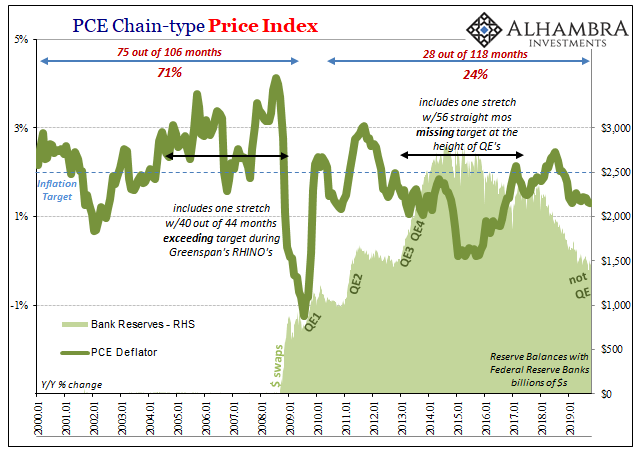
Bond buyers are hardly threatened by the Fed's claims to attain 2% plus inflation by whatever means at it's disposal - graphic evidence
Les autorites n'est pas en commande? Quelle Horreur!
Re Retail Sales....
Who's bought and 'tried' to get goods delivered from The States via "YouShop" - NZ Post's delivery service from there, for items not ordinarily posted outside the USA?
What a carry-on! It's not the added GST that going to kill that service ( that was seamless), but the form filling and Proof of Purchase that now has to be provided. Maybe, that's the idea! Bore us to death to make us shop on-shore....Will I? Nope. I just won't shop for those goods at all! (NB: Even with GST offshore levy, they're twice the price here)
I have used them in the past, but the post costs are extraordinarily high compared to Chinese alternatives.
where has all the cash gone?
https://www.wsj.com/articles/the-worlds-cash-is-disappearing-bankers-ar…
Exit Polls have Johnson by 86.
I’m amazed that media bother to report this trade deal close nonsense. The fact markets respond just show how rigged everything has become.
Yes, the dopey media still haven't realised that Mr Trump is a tactician. He dodges and weaves, seeking to confuse and distract the enemy. Classic OODA loop. It is how Mr Putin completely out played Obama in Ukraine and Syria and how the German army overran the French Grande Armee in WW2. Strategists are just so laughably predictable.
Trump likes to wait until his opponents are under pressure, hold out the hope of a deal, see what gets offered; then choose to turn up the heat or close the deal, as he sees fit. He is under no pressure to accept a deal, but his opponents are.
Who would have thought.
Boris looking good!
JC, not so much.
Exit poll @ 11:52.
Tory: 368
Labour: 191
LD:13
SNP: 55
BREX: 0
Green: 1
Pound up 2.5%
What has really struck me over the last decade or so has been the collapse of anything worth while politically left of centre. Look at us, not only the last 2 years, but the last 11. Look at the Aussie election this year. Look at the Democrats in the US, they're embarrassing to watch & have added no value to the great USA for a decade. And we may be seeing a similar trend in the UK. Corbyn the communist is the best their leadership can provide. In fact, he's in the wrong century. But this just shows the lack of depth the left of centre people have, especially in the English speaking nations. Sure Canada's a bit different, but they're half French. But the greatest failure of the left is Europe. The EU will really struggle from Brexit. Already is. I think they'll be worse off than the Brits, who will at least have their sovereignty back & can create their own destiny once again.
There is definitely a global swing (in western nations anyway) away from the left.
Next year could be interesting. Unlike the other nations, we don't have a viable right to swing to.
Or a viable left either.
One tweet and it's all on for a trade deal.
We've been here before, I very much doubt it is going to happen unless China and the States had a behind closed doors agreement to play us all along.
We welcome your comments below. If you are not already registered, please register to comment
Remember we welcome robust, respectful and insightful debate. We don't welcome abusive or defamatory comments and will de-register those repeatedly making such comments. Our current comment policy is here.