

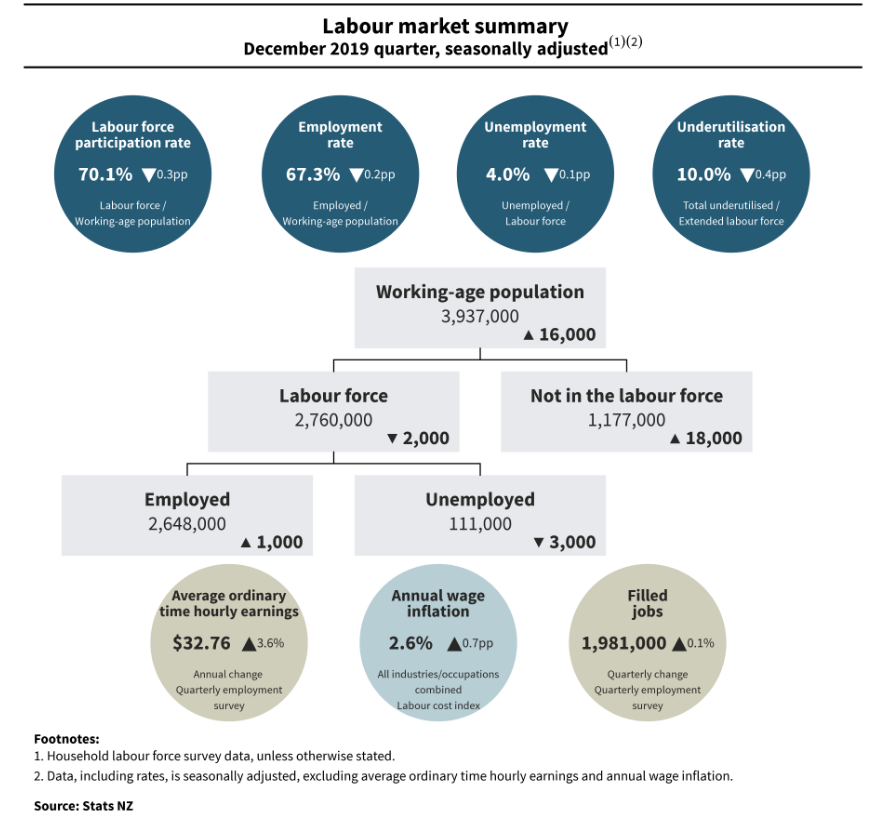
The Reserve Bank's seen as definitely putting interest rates on hold after the latest labour market figures from Statistics New Zealand have shown unemployment falling to 4% and annual wage growth hitting 2.6%.
The RBNZ's making its first interest rate call of the year next week (Wednesday) and the labour market results appear to all but confirm that it will leave the Official Cash Rate unchanged at 1%, where it has been since the 50 basis-point 'double cut' in August of last year.
And with the labour market continuing to appear firm, it's looking increasingly like that there will be no further interest rate cuts this year - although the coronavirus scare and how long-lasting the impact of that might be is a crucial factor.
The latest labour figures beat economists's forecasts of an unemployment rate of 4.2% and wage increases of 2.3%.
However, the economists' forecasts were based on the previous Stats NZ labour market figures, but these have been revised, with the September quarter unemployment rate now being shown as 4.1% down from the originally released 4.2%.
And the drop in unemployment was assisted by a fall in the labour force participation rate from 70.4% to 70.1% - with the participation rate dropping to its lowest level since 2017.
Ben Udy, Australia and New Zealand economist for Capital Economics said the decline in the unemployment rate "all but ensures that the RBNZ will keep rates on hold in February" and he thinks our central bank is "now done" cutting rates.
Udy said the "standout" in Wednesday's labour data was wage growth.
"The labour cost index rose by 0.7% q/q in Q4 following the 0.8% rise in Q3. That was enough to cause the annual pace of growth in labour costs to rise to 2.6% y/y, the fastest pace of growth in more than 10 years. The 16% increase in the minimum wage over the past two years has almost certainly played a role in supporting that pace of wage growth. But with the biggest percentage increases in the minimum wage now behind us, we suspect that wage growth is close to its peak."
The seasonally adjusted unemployment rate was 4.0% in the December 2019 quarter, down from 4.1% (revised) last quarter, Stats NZ said in its Wednesday release.
“The unemployment rate has largely been tracking down since late 2012, but has remained stable at around 4.0 percent throughout 2019,” labour market and household senior manager Sean Broughton said.
The fall in the unemployment rate this quarter reflected 3,000 fewer unemployed people, driven by 3,000 fewer unemployed women.
The unemployment rate for women dropped to 4.3% in the December 2019 quarter, down from 4.5% last quarter. For men, it was unchanged at 3.8%.
The seasonally adjusted employment rate fell to 67.3% in the December 2019 quarter, down from 67.5% last quarter.
For men, the employment rate fell slightly to 72.2%, down from 72.3% last quarter. For women, it fell to 62.5%, down from 63.0% last quarter.
In the December 2019 quarter, there were 1,000 more employed people, up to 2,648,000. This reflected a rise of 6,000 more employed men, which was offset by 5,000 fewer employed women.
The fall in the employment rate this quarter reflected the number of employed people (up 1,000) increasing at a slower rate than the working-age population (up 16,000).
The labour cost index (LCI) salary and wage rates (including overtime) increased 2.6% in the year to the December 2019 quarter. This is the largest increase since the June 2009 quarter, when it increased by 2.8%. Private sector wage growth was 2.4%.
Average ordinary time hourly earnings, as measured in the quarterly employment survey (QES), increased by 3.6% over the year to reach $32.76.
Average weekly earnings (including overtime) for full-time equivalent employees (FTEs) in the QES also increased – up 3.6% over the year to the December 2019 quarter to reach $1,272.12.
We welcome your comments below. If you are not already registered, please register to comment
Remember we welcome robust, respectful and insightful debate. We don't welcome abusive or defamatory comments and will de-register those repeatedly making such comments. Our current comment policy is here.