
Here's our summary of key economic events over this holiday weekend that affect New Zealand, with news the combination of bad pandemic policies and a coming winter look worrying for northern hemisphere economies.
First up today, Wall Street is falling rather sharply, and is down -2.7% in mid afternoon trade and getting worse by the hour. Overnight, European markets were also down sharply with Frankfurt down -3.7%, Paris down -1.9% and London down -1.2%. There was no indication these markets would drop from Asian trading yesterday; Shanghai was off -0.8% but Hong Kong was up +0.5% and Tokyo was flat. The ASX200 ended yesterday down a minor -0.2%.
But terrible European pandemic developments are setting back the European economy in a major way, and it threatens to be is just as bad in the US.
However, looking back, the American National Activity Index released by the Chicago Fed shows a small improvement from August, but it just seems to be the final bounceback echo from the huge March and April dive.
The latest Fed regional factory survey to be released is from Texas and that reported expanding conditions. New orders are rising, but employment growth seems to have stalled there.
Although new home sales dipped in September and the August data was revised lower, the 2020 levels are still very high and very much higher than the same level a year ago. This part of their housing market is booming just like the existing home market as the demand for 'more space' rises in the pandemic.
At the end of this week, the first estimate of the US Q3-2020 GDP is due to be released. Analysts see a +32% rise from Q2, making back much of the -31% fall in Q2. (It's an intricacy of arithmetic, but to make back all of the Q2 fall, the Q3 rise would need to be up +46% - so they will still be running very much slower than the year-ago level.)
In Singapore, their September industrial production came in surprisingly positive. After rising a sharp +15% year-on-year in August, they were expected to hold that increase with a modest +2.5% rise in September. But in fact the September gain was a spectacular +24% leap and largely driven by their drug industry ("biomedical manufacturing").
China's full-year crude steel output in 2020 is expected to jump above 1 billion tonnes for the first time ever.
In China iron ore prices are staying high (+40% in 2020) but have stopped increasing. However, steel making coal prices are back rising fast again (+16% in 2020). And prices for corn are racing higher as the local grain harvest is late (+30% in 2020) even if officials claim it will be a full one.
Chinese import demand is causing shipping rates to stay high.
In Hong Kong and Shanghai, the world's largest IPO is about to take place, bigger even than the US$29 bln Saudi Aramco listing. Alibaba's Jack Ma is floating his Ant fintech company and it is expected to value the enterprise at US$35 bln.
More data out of Taiwan is impressing. Their September industrial production rose by more than +10% compared with the year-ago levels, and much faster than the good +4% growth in August. Export orders are driving this. By comparison, their nearly +3% rise in retail sales looks tame.
In India, onion and potato prices have suddenly risen, doubling in ten days. Rains damaged crops and now their government has imposed stock limits on traders. India's festive season demand is also driving prices up.
In Australia, their housing market is surging, with last weekend's auction clearance rates exceeding 80% in Sydney and 73% in Melbourne. Victoria is now set for a pandemic re-opening and that will bring an economic rebound which will no doubt include housing.
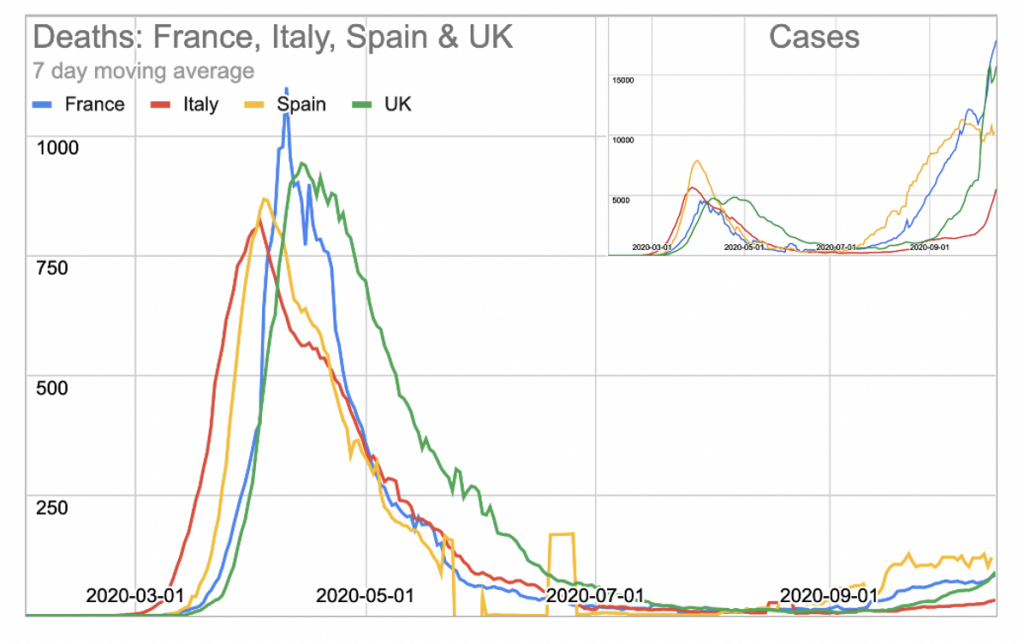
The latest global compilation of COVID-19 data is here. The global tally is 43,216,000 and up +386,000 since yesterday. It is first-world countries that seem to be having the most difficulty containing the new wave. It is raging in France, the UK, Spain and Italy again, and Belgium also has a very bad outbreak. Authorities in all these countries have lost control and it is hard to know how they will regain it. Italy and Spain have reintroduced sweeping new curbs. Global deaths reported now exceed 1,156,000 (+4,000).
The largest number of reported cases globally are still in the US, which rose +46,000 since yesterday to 8,899,000 as a weekend tally. The number of active cases is higher at 2,887,000 so many more new cases more than recoveries. Their death total is nearly 231,000 and still rising at about +1000 per day.
In Australia, they are not getting any resurgence. There have now been 27,527 COVID-19 cases reported, and that is +7 more cases than we reported yesterday with zero in Victoria. Reported deaths are unchanged at 905.
The UST 10yr yield is down -5 bps today at just on 0.79%. Their 2-10 rate curve is much flatter overnight at +65 bps, their 1-5 curve is also flatter at +22 bps, along with their 3m-10 year curve, now flatter at +72 bps. The Australian Govt 10 year yield will start today down -3 bps at 0.81%. The China Govt 10 year yield is up +2 bps at 3.22%. But the New Zealand Govt 10 year yield is unchanged at just under 0.61%.
The price of gold has had a slight rise, up +US$3 to US$1904/oz. And that is little-changed from the same level it was this time last week.
Oil prices are very much lower today, down -US$1.50/bbp to now at just on US$38.50/bbl in the US, while the international price is now just under US$40.50/bbl.
The Kiwi dollar is still at 66.8 USc and little-changed. Against the Australian dollar we firmed yesterday to 93.9 AUc. Against the euro we at 56.5 euro cents. And that means our TWI-5 is now at 70.
The bitcoin price starts today a little softer at US$12,919 with a -0.8% slip. The bitcoin rate is charted in the exchange rate set below.

The easiest place to stay up with event risk today is by following our Economic Calendar here ».
We welcome your comments below. If you are not already registered, please register to comment
Remember we welcome robust, respectful and insightful debate. We don't welcome abusive or defamatory comments and will de-register those repeatedly making such comments. Our current comment policy is here.