
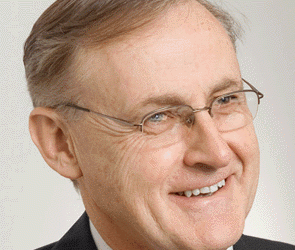
Reserve Bank governor Alan Bollard has warned business groups, unions and consumers not to use October's GST hike as a "veil" to lift prices and wages, suggesting doing so will see interest rates rise and the economic recovery slowed down.
In a speech to the Taranaki Chamber of Commerce, Bollard cautioned that price and wage hikes under the "veil" of the pending GST rise would spread inflation and harm the fragile economic recovery underway.
Bollard said price and wage setting behaviour of firms and households would be watched for evidence of indirect and second-round effects on inflation.
"Monetary policy would need to respond if inflation expectations and prices were ratcheted up significantly. The result would be higher interest rates and a dampening of the economic recovery."
Last month Bollard said annual consumer price index (CPI) inflation had been near 2% for the past five quarters.The Reserve Bank is tasked with keeping inflation between 1 and 3% on average over the medium term.
The Reserve Bank has increased the Official Cash Rate by 25 basis points at both its last two reviews, lifting it to 3%. The next review, and Monetary Policy Statement, is due on September 16. GST will be increased to 15% from 12.5% on October 1.
Click here to read Bollard's full speech.
Here's the Reserve Bank's press release:
Given the fragile economic recovery, it is important that firms base their pricing decisions on low underlying inflation, not the upcoming temporary spike, Reserve Bank Governor Alan Bollard said today.
Speaking to the Taranaki Chamber of Commerce, Dr Bollard had a particular message of restraint for those public and private sectors that have a record of increasing prices by more than the rate of economy-wide inflation.
He warned that if businesses, labour groups and households use the upcoming GST increase as a veil to increase margins and wages, they will simply spread inflation and harm the recovery.
Dr Bollard said inflation has been well contained recently, with consumer prices increasing 1.8 percent in the year to June. Although the recovery is certainly not a fast or robust one, underlying inflationary pressures are expected to increase somewhat as the economy moves into its second year of recovery.
“We expect growth to continue, led by exports as household and business spending remains subdued. This outlook and associated policy implications will be reviewed over coming weeks as we prepare the September Monetary Policy Statement.”
As the economy grows, employment levels will increase, and plant and equipment will be worked harder. But consumer price inflation is forecast to remain comfortably inside the target band in the second half of the Bank’s forecast horizon.
“However, the most significant event is the increase in the rate of GST on 1 October. This will push headline inflation substantially higher. Our current expectations of the peak in inflation are around 5 percent. But we expect that spike in inflation to be short-lived, and the inflationary effects should be largely out of the system by later next year.”
Dr Bollard said that while higher headline inflation would pose a challenge for monetary policy, the Bank’s Policy Targets Agreement with Government allows it to “look through” temporary inflation spikes. “The degree to which monetary policy can ‘look through’ temporary inflation spikes depends crucially on the extent to which New Zealanders’ inflation expectations are impacted by such spikes. The price and wage setting behaviour of firms and households will be monitored for evidence of indirect and second-round effects on inflation."
For now, it is assumed that the coming policy changes will have only limited impact on perceptions of future inflation.
“However, there are examples of persistent price increases in sectors such as energy and local authorities that have not suffered persistent cost increases, and these have an inflationary effect. “Monetary policy would need to respond if inflation expectations and prices were ratcheted up significantly. The result would be higher interest rates and a dampening of the economic recovery. We are hopeful this will not need to be the case, so that monetary policy can play as full a part as possible in supporting economic growth.”
We welcome your comments below. If you are not already registered, please register to comment
Remember we welcome robust, respectful and insightful debate. We don't welcome abusive or defamatory comments and will de-register those repeatedly making such comments. Our current comment policy is here.