
By Bernard Hickey
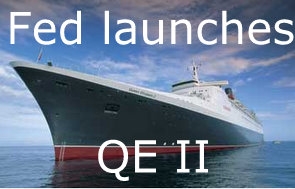
The US Federal Reserve has announced plans to buy US$600 billion worth of longer term US Treasury bonds in an attempt to lower long term interest rates and fire up borrowing and spending in the world's largest and most indebted economy.
Many fear however that this monetisation of US government spending will simply fire up inflation and devalue the world's reserve currency, sparking a series of tit-for-tat devaluations, trade sanctions and capital controls by economies desperate to protect their export industries from rises in their own currencies vs the US dollar.
Others worry this attempt to pump money into the US economy will fail because households are already heavily indebted and won't want to borrow more, or that banks are still too weak and risk averse to lend out money. A failure of this latest round of money printing would trigger further attempts to stoke economic activity with more easings, they argue.
The announcement at 7.15 am NZ time was broadly in line with expectations for a second round of Quantitative Easing (QE II) worth around US$500 billion. The New Zealand dollar initially surged to over 78 USc, its highest point since June 2008. But in the following following minutes it dipped back to 77.2 US cents before rebounding again to stand around 77.9 USc by 9 am.
"The Fed will also reinvest the proceeds from maturing bonds, bringing the Fed’s total Treasury purchases to US$850b-US$900b," BNZ's Mike Jones said in his morning currency report.
"Importantly, the Fed promised to “adjust the program as needed” and “employ all policy tools necessary” to support the US economic recovery," Jones said.
"We wouldn’t be surprised to see markets speculate on the need for even more QE from the Fed in coming months, should US data disappoint," he said.
The US Federal Reserve's two day meeting of its Open Markets Committee (FOMC) has been the most anticipated in its history. Over the next two days the Bank of England, the European Central Bank and the Bank of Japan will all announce their own monetary policy decisions.
Weak economy
The Federal Reserve said the pace of economic recovery continued to be slow.
"Household spending is increasing gradually, but remains constrained by high unemployment, modest income growth, lower housing wealth, and tight credit," it said.
"To promote a stronger pace of economic recovery and to help ensure that inflation, over time, is at levels consistent with its mandate, the Committee decided today to expand its holdings of securities."
Initial NZ reaction
The New Zealand Manufacturers and Exporters Association (NZMEA) said New Zealand policy makers could choose to influence the value of the New Zealand dollar.
“Singapore has faced similar pressures to New Zealand from the quantitative easing in the United States, but they have limited its effect,” NZMEA CEO John Walley said.
“While the NZ Dollar has gone up 16 percent since June and bounced around all over the place, the Singaporean Dollar has appreciated 10 percent with a steady climb. Ironically for those who claim that New Zealand does not have the foreign reserves to manage the currency Singapore will have increased their foreign reserves significantly in this process," he said.
“If we look at the long-term trend it is not difficult to see why exporters in Singapore have thrived while those in New Zealand have struggled. Total control of a currency is not possible, but a pragmatic approach to the issue can deliver better results. This is what our exporters need to see from the Government and the Reserve Bank.”
The Federal Reserve released its statement after the FOMC meeting at 7.15 am NZT. Here's the full statement below and here in full.
Information received since the Federal Open Market Committee met in September confirms that the pace of recovery in output and employment continues to be slow. Household spending is increasing gradually, but remains constrained by high unemployment, modest income growth, lower housing wealth, and tight credit.
Business spending on equipment and software is rising, though less rapidly than earlier in the year, while investment in nonresidential structures continues to be weak.
Employers remain reluctant to add to payrolls. Housing starts continue to be depressed. Longer-term inflation expectations have remained stable, but measures of underlying inflation have trended lower in recent quarters.
Consistent with its statutory mandate, the Committee seeks to foster maximum employment and price stability. Currently, the unemployment rate is elevated, and measures of underlying inflation are somewhat low, relative to levels that the Committee judges to be consistent, over the longer run, with its dual mandate. Although the Committee anticipates a gradual return to higher levels of resource utilization in a context of price stability, progress toward its objectives has been disappointingly slow.
To promote a stronger pace of economic recovery and to help ensure that inflation, over time, is at levels consistent with its mandate, the Committee decided today to expand its holdings of securities. The Committee will maintain its existing policy of reinvesting principal payments from its securities holdings.
In addition, the Committee intends to purchase a further $600 billion of longer-term Treasury securities by the end of the second quarter of 2011, a pace of about $75 billion per month. The Committee will regularly review the pace of its securities purchases and the overall size of the asset-purchase program in light of incoming information and will adjust the program as needed to best foster maximum employment and price stability.
The Committee will maintain the target range for the federal funds rate at 0 to 1/4 percent and continues to anticipate that economic conditions, including low rates of resource utilization, subdued inflation trends, and stable inflation expectations, are likely to warrant exceptionally low levels for the federal funds rate for an extended period.
The Committee will continue to monitor the economic outlook and financial developments and will employ its policy tools as necessary to support the economic recovery and to help ensure that inflation, over time, is at levels consistent with its mandate.
Voting for the FOMC monetary policy action were: Ben S. Bernanke, Chairman; William C. Dudley, Vice Chairman; James Bullard; Elizabeth A. Duke; Sandra Pianalto; Sarah Bloom Raskin; Eric S. Rosengren; Daniel K. Tarullo; Kevin M. Warsh; and Janet L. Yellen.
Voting against the policy was Thomas M. Hoenig. Mr. Hoenig believed the risks of additional securities purchases outweighed the benefits.
Mr. Hoenig also was concerned that this continued high level of monetary accommodation increased the risks of future financial imbalances and, over time, would cause an increase in long-term inflation expectations that could destabilize the economy.
(Updated with NZMEA reaction, detail, background, NZ dollar reaction, Mike Jones comments and interactive chart below)
No chart with that title exists.
We welcome your comments below. If you are not already registered, please register to comment
Remember we welcome robust, respectful and insightful debate. We don't welcome abusive or defamatory comments and will de-register those repeatedly making such comments. Our current comment policy is here.