
By Alex Tarrant
The New Zealand government ran an operating deficit before gains and losses (OBEGAL) of NZ$10.167 billion in the nine months ended March 31, almost 15% worse than forecast in December, as earthquake costs and a weaker than expected economic recovery hit the government's books.
Also, Treasury said GST receipts were lower than expected and the impact of income tax cuts were not flowing through as expected. Treasury announced last week it would borrow NZ$20 billion this year or 10% of GDP. See our earlier article.
The latest accounts to March are the last to be released before the government's budget on May 19, which is expected to include no additional spending from the previous budget. The government has signalled its intention is to get its books back to a "meaningful surplus" in 2015/16 to begin paying down debt, by tightening spending on schemes like KiwiSaver and Working for Families.
Treasury's Debt Management Office is set to borrow NZ$20 billion in the year to June to cover an expected government OBEGAL deficit of NZ$16 billion for the year, and to cover half of next year's expected NZ$8 billion deficit. The government faces a potential credit rating downgrade from Standard and Poor's unless it can convince the credit rating agency that it can control its deficit and spending. The Crown's net debt was NZ$39.4 billion, or 20.2% of GDP at March 31.
Finance Minister Bill English this morning said the deficit could hit NZ$17 billion.
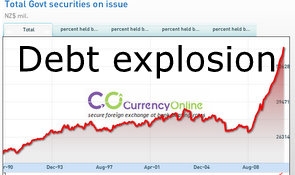
See our interactive chart showing NZ government debt on issue.
Tax package not delivering yet?
Core Crown tax revenue in the nine months to March was 0.1%, or NZ$19 million, above forecast, Treasury said. However, the government's tax package introduced on October 1, where it raised GST to cover for income tax cuts, does not seem to have been as successful as forecast.
"Revenue from source deductions was NZ$242 million (1.6%) higher than forecast because it appears the impact of the October 2010 income tax rate cuts has not been as large as anticipated," Treasury said in its commentary in the financial statements.
This was offset by GST revenue at NZ$263 million (2.6%) below forecast.
"This [GST] result reflected underlying weakness in private consumption and residential investment, contributed to by reduced household spending and the delay of rebuilding activity in Christchurch due to the earthquake on 22 February." Treasury said.
Expenses down
Meanwhile, core Crown expenses were NZ$422 million lower than forecast over the nine months to March, Treasury said.
"This was mainly due to underspends across a number of areas, partly offset by a NZ$331 million revision in the estimate of recoveries relating to the deposit guarantee scheme which was not forecast," Treasury said in relation to losses stemming from South Canterbury Finance related party loans last month.
Meranwhile the Earthquake Commission’s (EQC’s) estimated net costs for the 22 February earthquake of NZ$1.5 billion were unforecast in December and had adversely impacted the operating balance before gains and losses deficit, which was NZ$1.3, or 14.8%, billion higher than forecast, Treasury said.
"However, when unforecast gains are included, the operating balance deficit was NZ$3.8 billion lower than expected at NZ$3.3 billion. These unforecast gains primarily related to equity investments in the NZS Fund and ACC and actuarial gains on ACC and GSF liabilities," Treasury said.
The government's gross debt was NZ$2.5 billion higher than forecast at NZ$66.7 billion (34.3% of GDP) at March 31.
"March was a record month for bond issuance with NZ$2.8 billion of bonds sold, taking the year‐to‐date issuance total to NZ$13.9 billion. In response to strong demand from investors, on 30 March the NZDMO increased the 2010/11 bond programme by NZ$1.5 billion (to NZ$15 billion) to allow for continued issuance over the fiscal year," Treasury said.
"Net debt was NZ$174 million lower than forecast at NZ$39.4 billion, or 20.2% of GDP. Despite the higher than expected increase in gross debt, net debt was similar to forecast because the proceeds from the bond issuances were largely invested in financial assets," Treasury said.
Corporate tax receipts half a billion below forecast
The core Crown residual cash deficit was close to forecast at NZ$12.4 billion, with the two main features being corporate tax receipts NZ$488 million lower than expected; offset by purchases of physical assets NZ$435 million lower than forecast, due mainly to delays in defence and education capital projects (NZ$175 million and NZ$71 million respectively), Treasury said.
The financial impact of the AMI support package was not yet included in the government's financial statements, Treasury said.
Deficit could be NZ$17 billion
Following the release of the statements, Finance Minister Bill English said the operating deficit before gains and losses would "be somewhere around NZ$16 to NZ$17 billion, which will be the largest deficit New Zealand’s had".
"That...will be contributed to by the way we account for the earthquake costs. And that why it’s important that the budget shows a track back to surplus, because that NZ$16 billion means we are effectively borrowing over NZ$300 million a week, and we need to get that down,” English told media in Parliament.
“ACC and New Zealand Super investment returns have been pretty strong in the last 12 months. They haven’t yet clawed back the losses from the earlier financial crisis, so that’s the business of being in investments sometimes – it can drop fast," English said.
"In the long run though we believe those returns will come back to normal,” he said.
When government returned its books to surplus it would resume making contributions to the Super Fund.
Asked what year the government was looking to return to surplus, English replied: “You’ll have to wait for the Budget. It’s a bit of a challenge, managing the government’s books, particularly with the extra costs of the earthquake of around five-and-a-half billion."
(Updates with comment on cash deficit, corporate tax revenue, chart, Bill English comments.)
No chart with that title exists.
We welcome your comments below. If you are not already registered, please register to comment
Remember we welcome robust, respectful and insightful debate. We don't welcome abusive or defamatory comments and will de-register those repeatedly making such comments. Our current comment policy is here.