
By Bernard Hickey
Reserve Bank Governor Alan Bollard has delivered a speech lauding the resilience of New Zealand's economy through 2011 in coping with the twin shocks of the Canterbury Earthquakes and the European financial crisis.
However, in the speech to the Canterbury Employers' Chamber of Commerce in Christchurch Bollard said the earthquakes that hit Christchurch just before Christmas had delayed the Reserve Bank's forecast for the main rebuild into 2013.
The bank now also estimated the total claims from the earthquake at NZ$30 billion. Before the December quakes the bank had estimated NZ$20 billion worth of damaged property would be rebuilt. The much higher claims cost relates to business interruption costs, relocation costs, claims processing costs and other non-rebuild costs.
Bollard said the later start to the rebuild may mean the contstruction is compressed into a shorter time frame, worsening inflationary pressures.
"Our working assumption before the December 2011 aftershocks was that around NZ$20 billion (in current dollars) of damaged property would be rebuilt. This would be equivalent to around 10 percent of GDP – a very large shock indeed," Bollard said.
"The nominal cost of rebuilding could be higher as construction costs and prices for materials may well increase over the coming years, and as reconstruction incorporates quality improvements. Furthermore, we estimate that the total cost of claims stemming from the earthquakes could be much higher – around NZ$30 billion – as this includes claim handling expenses, claims for business interruption, temporary accommodation, consequential loss and other non-rebuild related costs," he said.
"Recent aftershocks are likely to have added to nominal insurance costs, but the costs of the rebuilding in real terms may not be significantly affected (i.e., you only rebuild a house once). In addition, the longer the delays to rebuilding, the greater the human cost and the risk of leakage of businesses and residents from Christchurch to other centres. Delays could also mean the rebuild is done more quickly, albeit starting later, so exacerbating inflationary pressures."
Yesterday the Reserve Bank held the Official Cash Rate at 2.5%, as expected, and said inflationary pressures were reassuringly low. Economists said the Reserve Bank's relaxed stance on inflation and a slow domestic economy, caused partly by quake rebuilding delays, meant the Reserve Bank was likely to hold the OCR until the final quarter of this year. See our article on the RBNZ decision.
Rebuild delays
Bollard said the Reserve Bank had continuously updated its reviews of the Official Cash Rate to take into account the impact on economic activity and inflationary pressures of the earthquakes.
"We cut the OCR in March 2011 as an “insurance cut” following the February 2011 aftershock. The deepening Euro crisis and ongoing aftershocks in Christchurch have led us to leave the OCR unchanged over seven successive reviews," Bollard said.
"Reconstruction, is projected to eventually provide a boost to demand similar to the mid-2000s housing boom. Residential and non-residential investment will lift growth sharply. Spare capacity and labour will be absorbed rapidly, and inflation pressures will pick up from current low levels. We will need to keep monitoring this to judge whether the level of the OCR continues to be appropriate," Bollard said.
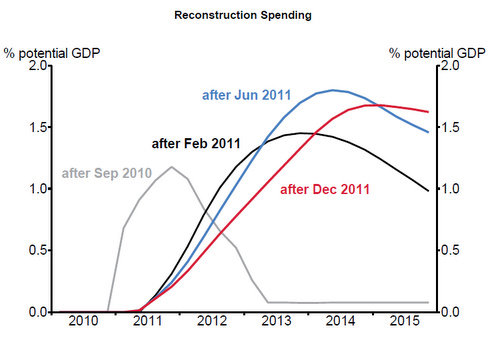
"The outlook for rebuilding in Canterbury remains subject to a high degree of uncertainty. In the January OCR Review, we took account of the latest aftershocks and pushed out our assumption of the rebuild by a few months, with a gradual lift in activity over 2012, consistent with demolition and repairs to housing and infrastructure getting underway, with reconstruction getting underway in earnest in 2013," he said.
See here a chart published in the speech showing the Reserve Bank's projections of earthquake rebuild spending over time.
We welcome your comments below. If you are not already registered, please register to comment
Remember we welcome robust, respectful and insightful debate. We don't welcome abusive or defamatory comments and will de-register those repeatedly making such comments. Our current comment policy is here.