
By Alex Tarrant
The next five to ten years will be make or break for New Zealand, ANZ chief economist Cameron Bagrie says.
He urged the government to leverage off New Zealand’s strategic advantages, which included natural resources and renewable energy prospects, and the New Zealand Inc brand. However this shouldn’t be done at all costs, and the environment needed to be kept in mind.
New Zealand ranked eigth in the world in terms of its natural resources. The top seven were oil-producing nations and Australia, the so-called 'lucky country', was thirteenth, according to the World Bank. On top of that, New Zealand ranked number one in terms of renewable energy prospects, Bagrie told a post-Budget breakfast in Wellington on Friday.
“I think the next five to ten years are generally going to be enlightening in terms of where New Zealand heads. The next five to ten years is truly going to make or break us," Bagrie said.
“Four years after the global financial crisis what has really changed? Not much, to be perfectly honest.”
Bagrie said he was upbeat about New Zealand’s prospects because he was a big believer in New Zealand’s natural endowments. New Zealand also had a solid political framework and was on the doorstep to the growing part of the world.
Renewables, natural resources
“In a world where you’re getting depleted from non-renewables, if you want to be world class at one thing, it’s the renewables," Bagrie said.
Singapore was outdoing New Zealand in terms of economic performance, but had no capabilities in terms of renewables. It was important for New Zealand to “get it together” and get the arrangements in place to leverage off its capabilities.
However New Zealand needed to respect the economic challenges to getting ahead like contagion from the European Sovereign debt crisis. There were no magic bullets, Bagrie said. New Zealand needed to get back to basics and pull multiple levers.
“We do need to see austerity, but the more we can pull a growth lever, the less intense that austerity lever is going to be," Bagrie said.
This did not mean growth levers should be pulled at all costs.
“If New Zealand decided to mine the Mackenzie country, that great drive down through Twiziel, Tekapo, those sort of places, I’d be there with a placard,"Bagrie said.
“But let’s be honest, a lot of New Zealand’s coal reserves are down around Ohai/Nightcaps, those sort of places. And they’re not exactly a tourism mecca.”
Finance Minister Bill English, the MP for Clutha Southland, later told the audience he was the MP for Ohai/Nightcaps.
Bagrie also noted how highly New Zealand ranked in terms of ‘feel-good’ measures like work-life balance, safety, health, environment, education, and housing.
Grumpy growth, Euromess
Meanwhile, Bagrie said he was still talking about his ‘bathtub with waves’ approach to economic growth, which was "grumpy" in New Zealand.
Three to four years after the global financial crisis, there was now more debt in the world economy than before the crisis. The difference was it had been shifted from the private sector to the public sector.
“And what global markets are now directing their attention towards, is the entire solvencies of governments. What we need to see today is true global leadership to sort the problems out. Until we see that global leadership, and we are talking about European politicians here so there’s reasons to be nervous about that one, markets are going to remain on edge," Bagrie said.
There were massive swings from euphoria to where the bears had "the upper paw.” The latter was when markets saw a lack of political leadership, or when people focused on the fundamentals like debt levels. Euphoria set in as people looked for the sugar pill – “the central bank solution, the so-called put, more liquidity injections.”
Tensions between the fundamentals and euphoria led to the waves in the bath – the ups and downs.
“We’re going to be here for a while yet," Bagrie said.
Bagrie said he thought the UK and Europe were headed for a ‘hail-mary’ moment like New Zealand’s 1984 experience which demanded fundamental reform.
“We’re not there yet in Europe. I think they’re heading that way. And they will see that same eight years of extremely difficult times that follow," he said.
How to get out of it
There were five options for getting out of a debt fuelled consumption jam.
“Option one, default. Greece at the moment is still broke. They’ve gone from being bankrupt to being insolvent. And accountants will tell you when you’re insolvent, you normally become bankrupt again," Bagrie said.
If there were defaults in the eurozone, the European banks would take a haircut, which would be a 2008-style moment.
“So we don’t want to see that.”
Deleveraging was number two. That meant cleaning up the act at the government level - higher taxes and less spending
“Well the Greek and French elections just gave the big middle finger salute to that, so that one’s not around the corner," Bagrie said.
The third solution was to inflate debt away.
“Print money. Well, printing money’s not inflationary if people don’t want to borrow it. Japan’s tried this one for twenty years. Hasn’t worked."
Repression – caps on interest rates and capital controls - was number four. However when this had been practiced it “pretty well stuffed capital markets for twenty years.”
The final option was, seeing as debt-GDP ratios were too high, getting that ratio down by raising GDP.
“If you’ve got some difficulties, if you can get the revenue line firing, that’s the way to fix your problems. If you start moving down the cost-line in an overly aggressive manner, the risk is you can tip the revenue line as well," Bagrie said.
The six C's
In terms of New Zealand's ability to emerge from its grumpy growth track, Bagrie said he was watching the six C’s: Contagion risks, Confidence, Commodity prices, Cost of Funds, China, and the Currency.
‘Contagion risks, or in particular the credibility or the competency of the government. At the moment because global investors are flexing their muscle, your government needs to be whiter than white. We need to be doing the right things," he said.
“What we saw in yesterday’s budget was precisely that. It was fiscal austerity, which presents challenges. It was responsibility. But there were also some tweaks there in terms of adjusting the Fiscal Responsibility Act, which I think is going to cement the current government as one of the most pro-active fiscal managers out of any country around the globe."
Confidence was holding up despite depressing news every night which had the potential to lead people to wrap themselves in cotton wool. However, New Zealanders were getting on with business.
Commodity prices were under a fair bit of pressure, while the cost of offshore funds was another to watch.
“Credit markets at the moment are becoming somewhat dislocated. That’s making it more difficult to borrow money internationally. That said, the New Zealand banking system I think is tremendously strong," Bagrie said.
"You’re seeing deposit rates come down as opposed to go up, which tells you banks are pretty flush with liquidity. You’re seeing pretty aggressive competition in the mortgage market, which tells you, once again, that banks are in a pretty good space," he said.
Wholesale interest rates had also come down “massively.”
“A precondition to Alan Bollard moving rates up will be the European scene stabilising. And to be honest I can’t see that for a very long time," Bagrie said.
In China, New Zealand’s second biggest trading partner, and Australia’s largest, there was a property bubble unfolding.
“We need to be careful here. I do not think New Zealand is going to suffer directly from a China slowdown, which is occurring, it’s the indirect channel via Australia that worries me," Bagrie said.
The currency was up and down like a yo-yo.
"At the moment it’s down, until we see central banks give us the put. Then it’ll be risk on, it will be equities up, currency up. But it’s a safety valve, and it’s a safety valve a lot of other countries would love to see," Bagrie said.
75 Comments
Productivity and growth is likely to be affected by issues around Insurance and vast amounts of capital $2b p.a flowing offshore to the re-insurance market..... Govt needs to address this drag !
Video in there now. Have a good weekend all.
Cheers
Alex
...... does Cameron Bagrie normally look like that .... or had he been sitting next to Bernard during the budget lock up ?
He may well be right, my thinking would be he is - but good luck - you can't even build a Dam in the South Island anymore.
Not so, Solid Energy has consents to build a hydro scheme on the Stockton Plateau which also cleans up mine water and which will make the West Coast an energy exporter. See http://stocktonhydro.co.nz/
It is just that the Buller mayor and the head of Meridian forgot to mention this when ranting about the Mokonui dam proposal Meridian walked away from (perhaps necessary to make the books look good for sale?).
NZ's largest and best asset is........................clean abundant water. And what are we planning and currently doing to that great "resource?
polluting the hell out of it and fighting over who in the future will "own" it. NZ is well of track for the new 3rd world status by 2020 AS PREDICTED.
As long as people, governments,banks, businesses refuse to deal with the 2 huge 'elephants in the room'.
1: A completely bogus, dodgy monetary system based on pertetual debt classed as "growth"
2: A property bubble that is so out of whack with real incomes that there is no future for anyone INCLUDING NZ EXPORTERS until it is addressed.
@Justice
"NZ's largest and best asset is clean abundant water".....correct, we have to scream this fact from the rooftops!
From a Chris Martenson link:
All the water on planet Earth
How much of planet Earth is made of water? Very little actually. Although oceans of water cover about 70% of Earth's surface, these oceans are shallow compared to Earth's radius.
http://apod.nasa.gov/apod/ap120515.html
NZ should put all the effort into repaying debt (forget WFF and all the handouts) to make sure, we never ever need an IMF loan.
One of the first things the IMF requires from a country is the privatisation of it's water resources. Just google IMF and see what this practice has done to countless states, particularly in Africa.
Pleasing to see Bagrie say this.
He urged the government to leverage off New Zealand’s strategic advantages, which included natural resources and renewable energy prospects, and the New Zealand Inc brand. However this shouldn’t be done at all costs, and the environment needed to be kept in mind.
Hydro is THE renewable energy source. So how is the problem raised in the correspondance below to be solved? For example if the Waitahora (Contact Energy), Castle Hill (Genesis) and Mighty River Power's Turitea and Puketoi wind farms are built, approximately one third of the country's hydro system would have to be on standby for when the wind stopped blowing, if hydro alone was the back up. Since hydro is the cheapest form of generation this is not realistic and fossil fuel generation will have to be on hot standby, ie burning fuel but not contributing. In this situation what is the point of these wind farms? Has nobody thought of this? Looks like a giant cockup. This wind rush dressed up as "green" leads to exorbitant frequency keeping costs / standby back up generation costs, which will be passed on to hapless consumers. No one has been told about this.
Source
http://turiteadocuments.wordpress.com/
The problem seems intractable as during winter peak demand the country is usually covered by high pressure systems and wind farms are contributing next to nothing. This is the experience in the Manawatu and likewise the wind grab in the Wairarapa. Many turbines in calm conditions which appear to be generating are in fact rotating so their gearboxes are being lubricated. Meanwhile hydro lakes and thermal generation are being used to meet demand.
I found all this linked here.
http://nzwindfarms.wordpress.com/
Nice work OMG.
Generation time isn't the same as out put, which itself is highly variable. Wind farm production never comes anywhere near nameplate capacity. Take those power company statements that X wind farm can power XXX number of houses with an articulated truck load of salt. These charts provide useful examples. Tararua wind farm http://2.bp.blogspot.com/_blnN-QHR9C4/SVXPAnCgyhI/AAAAAAAAAF0/Vbxj-_akJ0s/s400/windfarm-output-graph.png The German experience. http://4.bp.blogspot.com/_blnN-QHR9C4/SV7xAkqZGTI/AAAAAAAAAGk/WzulBQobBy0/s400/windEonFig4.gif The British experience. http://4.bp.blogspot.com/_blnN-QHR9C4/TJKB-9h8nnI/AAAAAAAAAo0/x2GeRvIUOxE/s1600/britainwind_img_assist_custom. jpg http://1.bp.blogspot.com/_blnN-QHR9C4/TRdaOq9oa-I/AAAAAAAAAqM/Si_ikfpBvTI/s1600/wind%252520-750.jpg NB: Wind farm operators are very coy about giving out statistics. This is from a Taranaki stuff article, which is now deleted ( surprise, surprise ), but you can search for it as it is quoted on other sites. The PTB don't want you to know this.
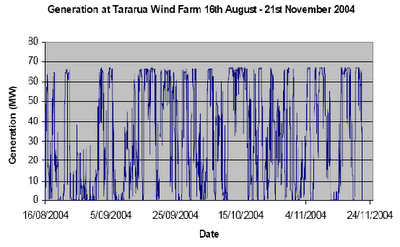


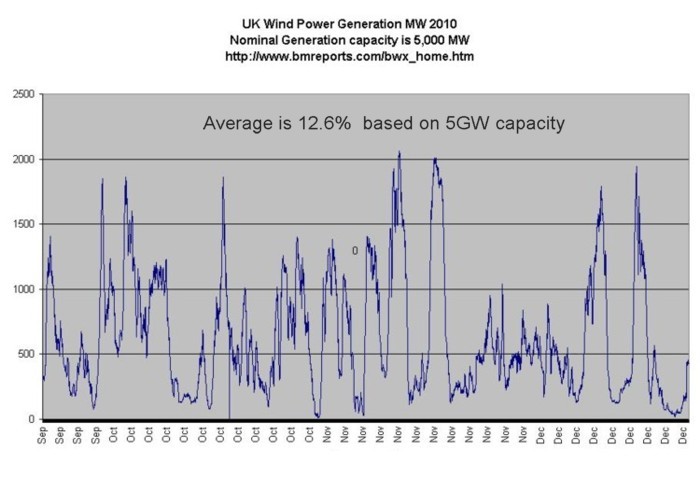
"Transpower system operations manager Kieran Devine says the country’s three major farms, clustered around the Manawatu Gorge, supplied less than one per cent of their capacity during peak load periods during the past three winters, 2005-07.
The highest peaks occurred in the North Island on cold, still weekday evenings, for three to four hours, starting between 5.30pm and 6.30pm.
This is when the electricity price also hits a peak. There was not enough wind blowing at those times to turn the blades fast enough.
The apparently flawed peak winter performance of existing wind farms has come out of the first three years of a 10-year wind generation investigation project.
Mr Devine says turbines on the Manawatu wind farms all behaved similarly, running up and down the generation scale together.
“Either there was insufficient wind at that time, or the current farms are all in the wrong locations and there’s not enough wind system diversity,” he says.
“We have real concerns about the large amount of wind generation planned in the lower North Island, because the preliminary information is that they will all have very similar characteristics to the Manawatu farms and that won’t help with winter peaks. We’d prefer they were spread around so that when one’s up others will be down and it would balance itself out."
You are making sensible suggestions re conservation measures efficiency gains and distributed systems. Unfortunately none of this is ever debated in public. You correctly state that all the power companies are interested in is selling more units. Ideologically driven green thinking does not understand this and so inefficient, very costly and environmentally damaging wind farms have become their totem poles. We need rational, informed open discussion on the country's energy needs and that should include whether current immigration policy and economic growth targets are really in our best interests. Do we really want 8 million people here living in shared energy poverty?Here is some extra data
NZ: Contact Energy shows wing generation SCADA and yes the power seems always there at the wrong time, must be a network management nightmare...
http://www.asx.com.au/asxpdf/20120521/pdf/426cqwdl5c203p.pdf
see the CEN reports posted to Origin - ORG
http://www.asx.com.au/asx/research/companyInfo.do?by=asxCode&allinfo=&a…
Here is the USA/OZ wind power co, ex B&B:
http://www.infigenenergy.com/media/docs/Interim-Result-Presentation---S…
Take a look at the turbine r&m once turbines out of warranty
Excellent resource, Henry. The claims that turbines will last 20 plus years don't stack up. Already West Wind is having severe maintenace issues, laminating blades, bearing and gearbox problems and a surge blew up a substation. Wind will have a very minor place but it is absolutely nothing like what is envisaged in NZ. Would I invest in a wind farm - not a chance! Leave that to romantics with no clue.
Your welcome, and yes and yes.
Wind development over the past 10 years has been driven by Babcock & Brown types (now moved to the energy coys) gearing up the government subsidy revenue/certificates and the other wheezes ..... debt all round...
No thought for operations, no thought for network issues etc, etc.....
Now everybody must pay more to make up for the financing issues of wind dev's and network reliability ...
Well mist42nz, Glaxo didn't plan to stick 40 story turbines right over residential property and for those affected by the likes of Mighty River Power's Turitea it certainly is their f' business. Glad to be out of Palmerston North now and I know a lot of local people who wish they were able to sell up and head to OZ, but are unable to find a bigger fool. You seem to have fascist tendencies.
Well said indeed! Now read this, put your money where your mouth is, and load your rifle.
... someone may be able to confirm this , but I'd heard that some of the metals required for wind towers can only be sourced from a part of Mongolia ... and that the extraction process is causing massive environmental damage , acids leaching into pristine lakes and the like ..
The things we do to please the Greens : Destroy the planet in order to save it .
Confirmed, GBH
Half of steven's relatives are Chinese, did you know that? He posted this info a while back. I wonder if they live near this disaster.
Steven, please confirm.
Wow ! ...... glad I'm not a Greenie ..... I'd rather do things that actually are good for the environment .....
:-)
Good on you tomato !
Thats the trick, while many say "look at me green", rather than pea green they really are watermelon green - green on the outside, red on the inside.
Its not greenies doing the damage though but libertarian types.
"Yan Man Jia Hong is a dedicated Communist. At 74, he still believes in his revolutionary heroes, but he despises the young local officials and entrepreneurs who have let this happen.
‘Chairman Mao was a hero and saved us,’ he says. ‘But these people only care about money. They have destroyed our lives.’
Vast fortunes are being amassed here in Inner Mongolia"
So actually if this was a green process.....for a green solution.....
regards
Oh for christ sake, when will the greenies ever acknowledge the unintended consequences of their misguided actions. Much easier to invoke the "libertarian-type" strawman which you do on a daily basis...
mist42nz that would be right.
Now is anyone thinking about the suggested population growth of the country and the impact on renewable electrical energy? If say NZ one day has 8 million people to supposedly make us more "competitive", would that not halve the current renewable contribution? We appear to be at or near the limit of renewable , unless we go nuclear.
We are not living within our means on any metric.
Agree with your list, entirely doable. The better off can afford the latest generation of energy efficient light bulbs and double glazing - I visited friends in a huge house with double glazed windows while it was being built. There was only building paper on the outside, it was winter and it was unbelievably warm. If we were all energy efficient - and more of us manage to get off the grid, the next issue would be how to fund grid upgrades etc!
The US is actually [re-]starting production...they have found that they need these rare metals for weapons and uh...only the chinese output them...
oops...
In terms of extracting, what we are seeing is china is only achieving 10% grwoth by seriously degrading their land....
Note they have no RMA so if they actually did they wouldnt be doing such damage, but thier GDP growth would be halved.
regards
Funny thing but if we had a libertarian society there would be no RMA and the land owner could do anything they wanted with their land....and those around would have no recourse....
The property boom not going well in Palmy it seems...and the fools that bought in now are stuck....sorry for them....cant lose on property eh!
uh no.....greedy fools....
Strikes me that those who claim they are affected seem inflicted with mental health issues and Nimby-itis......so they want to run away to OZ where things are "better"....uh huh.....
regards
Hmm, well you would have to show in a civil court that there was noticable and significant damage I would hope. Something considerably more than oh look some wind turbnines on the skyline lets sue.
regards
Interesting point(s)....and I think correct. The only proviso is when does the loss become trivial or miniscule......can I then counter sue for costs and my time wasted? I would hope so.
Whats your take on anarchy?
Personally if you are going to go as far as libertarianism I cant see why you just dont go the whole hog.....
regards
Funny thing but if we had a libertarian society there would be no RMA and the land owner could do anything they wanted with their land....and those around would have no recourse....
That is a complete bastardisation of libertarian philosophy, ie you get (and overstate) the first part and ignore the second.
The land owner could do anything he wants with his property, provided it doesn't cause harm to the neighbour. That is why we have the rule of law, to have recourse to a judiciary when such harms occur. The argument is over whether the RMA is effective or not.
You continually create a strawman to then knock it down.
Well said.
regards
Really you are so bigoted...funny really you get something you do not like and go rabid on it without doing your homework.
Hydro has a limited volume and its a one time (until we get rain) use, it is a battery in effect...wind has no storage so has to be used as its generated or lost (or say refil the header hydro lakes, I think nuclear generated energy in the UK is used to do that)....so the two should get linked to give resiliance something a nation should care about...and yes that means hydro sits there unused when there is wind........The problem with hydro is we cant do much more of them, so we have to conserve water and wind is ideal....that and tide....
Hydro is the cheapest form so not realistic to leave it un-used.......in terms of profit margin, yes....but then you cannot focus on just one aspect of a problem......
Hot standby, actually have you never heard of gas turbines? doesnt NZ have quite a lot of gas?....
Wind wasnt put in for peak loads but for base lopping when available but simply as an alternative renewable source....
"which will be passed on to hapless consumers. No one has been told about this."
like I said its do your homework....wind isnt without its issues....but overall NET its EROEI is about 14 to 1.......energy is going to get more expensive its a Q of deciding who you pay....we's need more fossil plant instead and tat needs coal/oil/gas which is getting hard to find hence expensive and might even be rationed...
How do you feel about backouts? I remember those in the 1970s....not funny.
regards
Your usual nasty garbled uninformed opinions passing for fact, steven. If it took ₤10 to get you here, there are plenty willing to pay your return trip.
..... London-to-a-brick that as soon as he arrived he hightailed it down to the WINZ office and claimed the 10 pounds back !
Fair do's to steven & PDK though , I've watched that show on TV which they endlessly witter on about , and it is very funny , " My name is EROEI "
It is you who are short on facts...
regards
GBF? Try 'what did he get right?. Shorter list by far.
:)
Looking at tide, I see the suggestion it would return very well....possibly better than wind and given the cook straight is the tide to use and its right outside Wellington in the right place to do. There was a company looking at it and they were supposed to be online in 2012, but their website seems quiet.
http://en.wikipedia.org/wiki/Cook_Strait#Tidal_power
regards
Of course many of these tidal schemes have been delayed while the correct blessings from kaumatua etc are sought and 'koha' paid etc ...
http://www.3news.co.nz/Local-Maori-vow-to-stop-turbines-in-Kaipara/tabi…
One noteable omission from the Budget was revenue from our mineral resources which we have been told are considerable.
We can't believe that govt has been frightened into immobility by the "rent-a-mob" protests which occured last time mining was raised and then dropped like a hot potato;perhaps govt needs a little more courage this time around!
Liberte
Plenty of us objected who wern't rented by any one. Maybe your out of sinc with how many nz's feel about our land and country.
A week end read:
http://werewolf.co.nz/2011/06/the-case-for-corporate-reform/
“I first started talking to John Key when he was chosen to be opposition finance spokesperson, and I always found he knew surprisingly little about the economy, and it was very superficial…he just doesn’t get it. He thinks that if you just increase the irrigated land in Canterbury by 40% then that this is economic growth. Even though the Cabinet papers have shown an internal rate of return [from irrigation] of 6.4% . That’s a lousy investment. They just don’t get it. The government is solely focussed on the incremental growth of existing business.”
Such an approach cannot conceivably succeed in lifting New Zealand’s standard of living. Treasury, ... is forecasting little change in the rate of growth all the way out to 2015. “The underlying rate is still stuck under 2%. Our net international liabilities get a lift with re-insurance money coming in for Christchurch. But by 2015, Treasury shows that they’re back to 85% of GDP, which is where they were in 2007. How are current economic policies changing this? Answer : They’re not.” The current government, to the extent it has an economic plan at all, appears to be driving in a direction where failure is all but guaranteed."
“You load up with debt, you go hell for leather to pay that off, you don’t pay much tax along the way….but the problem is, easy money comes along, as it did before the global crisis and ... farmers increased their debt fourfold in then years, to $43 billion dollars. And all that did was drive up the price of land. So not only then can you really struggle to keep your head above water – just to make that work economically, but you’re entirely dependent on somebody to come along to pay more, to take it off yur hands.
Enter the Chinese, with an entirely different business model. They’ve got much lower capital than us ... “Some Chinese companies are selling infant formula directly to the consumer in China. Therefore if the New Zealan d operations actually don’t make money at all, they couldn’t care less. Because they have a captive supply of infant formula which they can sell for a profit in China. And the corporate tax rate in China is 25% – compared to 30 % here.”
Therefore, any such theoretical Chinese operative might well want to minimize their profits here…and maximize them in China. “By dint of that completely different business model, the Chinese investor can afford to pay more for the land than a New Zealand farmer ever could.” And wear any losses, or only marginal levels of profit from their operations here. Hardly an ideal springboard for growing and maximizing the profit potential of the New Zealand end of the operation."
Henry Tull: nothing much changes around here .. go back and have a close read of these two articles here on interest.co.nz and the posts that followed ..
27 January 2011
http://www.interest.co.nz/node/52033/rural%20news
Henry Tull or Mist42
A question posed some months back with regard to milk-suppliers and milk-processors and exporters. No answer. Would like an answer. To do with GST.
When a dairy farmer supplies milk to Fonterra or any other processor, is the farmer responsible for GST on the payout from the processor?
When a milk processor exports product overseas are those exports GST exempt?
Thats as I understand it, with adjustments for FOB, CIF terms and dock charges.
Mist42
(2) if the export customer is based overseas and manufactures the goods in NZ then GST is at 15% [as the raw material supplied by Fonterra was consumed in the manufacture process, within NZ].
To make sure I understand that:
If Synlait.NZ manufactures in NZ and exports/sells to Bright Dairy (the Parent) in China, you say their export sales are GST liable and not Zero Rated?
Now you're into the black arts or transfer pricing and international invoicing vehicles ....
There is often a Synlait bod talking of $80 to $90 a can (assuming its the 900g can), but the amount that gets in the tin at Dunsandel well........
And Synlait directors have meetings/shopping trips in Manila
http://www.nzherald.co.nz/business/news/article.cfm?c_id=3&objectid=107…
But Richardson says real camaraderie is now building, pointing to the shopping expedition she enjoyed with Ke Li after a board meeting in Manila.
She credits Bright Dairy president Guo Benheng as being the "Godfather of the project".
Guo's own DNA includes a strong insistence on profits.......
Note to self: profits for whom?
.
http://www.business.govt.nz/companies/app/ui/pages/companies/1600872/sh…
Shareholders in Allocation: Allocation 1:26021658 sharesBright Dairy Holding Limited The Grand Pavilion Commercial Centre, Oleander Way, 802 West Bay Road, Grand Cayman, KY1-1208 , Cayman Islands Allocation 2:25001200 shares
SYNLAIT LIMITED 1028 Heslerton Road, Rakaia, Rd 13, 7783 , New Zealand
Note to self: Good luck getting a cheque from West Bay Road..... or finding anyone there...
swiss cheese... who says they have to sell for more than they paid .... profits may be taken somewhere else ...... IRD could be paying/giving credits/acc.losses to them when thinking of all taxes....
fact that board meetings are off shore is classic ....
Henry: Yes that's what I was getting to. International Transfer Pricing. It's all about shuffling the dollars around to make the profits in the least taxing jurisdiction. The local operation can be run at zero profit and make the profits up the line. In nz's case the cream on top is the siphoning of the GST clawback to the overseas parent. NZ is being gamed.
gamed ha, more hung, drawn &q ...... profit-wise why stop at zero, keep moving to the left on the number line ......
and if you think like that, what is the "local" 49% really worth, if your Cayman Island majority owner is marching in that direction.... no wonder all the warm tones...
Yes...unless it is rental income given how rental receipts are defined in the Act. As an aside this is why rental property/investment has a key advantage over other business activities in NZ.
Yes but each draw has a differing projection - you try and find the board minutes/papers from a meeting in Manila...... or West Bay Road...
If companies/industries had to make profits how would IRD look at meat processing - any time series...
IRD/Corp law provide a framework/criteria, its the intent of the bods running the show that "makes things happen"
Look at diary, and the recent Open Country losses, who is to say the losses are not due to the major shareholder of Singapore also a major customer paying less than otherwise or not .
Same with Synlait, where is the $80 to $90 dollars a can going, assuming a can of powder can be put on a supermarket shelf anywhere for >$40 with "full supply chain" profit margin.
Synlait and Open Country have put on record (in written parliament subs) that the milk price they pay is 50 cents too high, whatever the fonterra fram gate milk price. Are they are painting a picture whereby nobody need expect them to make a profit (nor should the IRD one would argue etc etc).....
The farms were placed in receivership in October 2009, owing close to $200m, a debt that has since ballooned to $256m.
Crafar has the right to take control back, provided he repays the debt and costs associated with the receivership.
http://www.stuff.co.nz/business/farming/6996139/Crafar-to-battle-for-fa…
maybe they didnt know how bad it was....and keep un-covering nasties
regards
Mentioned to me off line, could be penalty interest, once banks moved in.
Seems OTT....but the debt is owed to the banks, so to themselves.....
regards
yes, confirmed it with the accountant this morning, he said once a company gets tipped up, all the rules change.
Thinking through the NZ daires example, it looks like the farmer suppliers owed the $30m odd are facing an uncertain future. Word is that whatever the factory is sold for will all the $ will go to the Russian bank, and there may not be enough to repay their debt....
Not sure if the farm suppliers supply contract have any credit enhancements or provide a claim against milk that has been processed, for otherwise they are unsecured creditors.
as posted here before the credit risk, or counterparty risk that independent processors pose has been discussed, appears to be real.
not happy days.
comments re synlait above have not included the farm side of the operation, which has locals scratching their heads as most have been having a triffic growth season the expectation is that its case for a loane ranger and toto riding by.
loans being blend of Oz banks? and shareholder lender Mitsui - Jap.
will be interesting to see if group make good the year long exercise of thinking of buying NZDairies. Seems tuff without an equity contribution, the magic fairy dust seemingly in short supply all round (The Bright Inv. term sheet posted earlier comments Bright used debt to fund their first "equity share" inv as well).
He had his chance and it looks like he was amazingly awful at it....let other would be (NZ) farmers have a go.
regards
He urged the government to leverage off New Zealand’s strategic advantages, which included natural resources and renewable energy prospects, and the New Zealand Inc brand.
Good luck with that one in New Zealand, Cameron! Lol. You forget Poverty Action and the Greens don’t want jobs in this country, just welfare and taxes and NOOOO mining.
In the years to come, GE will likely have a defining role in renewable energy, e.g., biofuels, through the genetic modification of unicellular organisms such as algae and yeast with genes that have been discovered with directed evolution. But NOT in New Zealand! Again, the bewildered, the poor, the confused, the suspicious, and the superstitious will sacrifice this country’s participation in technological advancements on the altar of their ignorance, arrogance and left-wing-green political dogma. In other words, once again this nation will end up paying at considerable cost too, I might add, for other people’s technology because we are simply not allowed to innovate and establish these industries and technologies here and sell them abroad.
So good luck again, Cameron, with leveraging off of New Zealand’s strategic advantages in natural resources or renewable energy in this country, you’re gonna have (and by definition the country) a hard row to hoe while the fields are being smothered by Green weeds.
Somebody needs to understand the difference between renewable and extractive, before he splurges spin.
Of course, if his income depends on the spin................
Bagrie is one of the more astute of the economic fraternity - if not the most astute. Read between his lines, and be very worried.
No sustainability person - like me - nor conventional greenie, will have a problem with us living within our ecological means. What DavidB advocates is living beyond (extraction of finites is 'beyond') our means. Not only that, but that he wanst us to accelerate the rate of beyondness.
That's theft from future generations.
I marvel at the fantasy world that you inhabit.
...... just take a peeksie at Tasmania , to see an economy truely screwed by the Greens ..... these fat-heads don't want any progress , nor any new jobs ..... even the union movement ( the ACTU & the AWU ) have slammed the Greens for policies that favour insects & arachnids above humans ....
I have long pointed out here, that Left is as stupid as Right.
They are fighting over who gets what portion of the cake.
An obsolete argument when you're half-way through a finite cake. Tasmania's resources are a classic example of a finite cake. Just a miniature of the planet, of course.
yep, if i wanted $ I could have stayed in london...though coackroaches and rats abound....so depends on the "wildlife" you want i guess.
;]
regards
"Maybe our economy and the global economy will never get back to "normal". Bernard in the Herald today...
Welcome to the real world Bernard!
By the way..this is the 'normal' as you put it.....if we are to see any change it will be for a further decline.
As you rightly point out...the govt has been spewing the same BS for four years. They will not change their tune. Look to see the consequences of the fall in commodity prices bash into the 'normal' economy later this year...just in time for the piigs fiasco to blow.
Don't spit the dummy when Bollard cuts the ocr again in a silly effort to pork some fake growth numbers.
In the same Herald issue we can read all about the rising real unemployment rate and the attitude of job applicants.
Wolly - I just watched “The Nation” B. English, the government, is dreaming about growth and growth rates. In many countries we will see a different scenario – recession. To deal with unemployment, poverty and riots will be on top of many nations (incl. Asia region) agenda.
-----
I wrote this comment into B. Hickey Herald -column.
Something new – something special for NZ !
Of course the world is changing fast. In most countries industries sectors in many fields are polluting humans and environment. Industries are corrupt and greedy. People in most countries have enough – want changes – a healthy, honest environment. Therefore why not make New Zealand special in the world and adapt the “NZ100% Clean and Green” strategy ? Quality Branding worldwide of our economy would generate great revenue/ assets for our remote and small country.
I , for one , am heartened by Bernard's newly found optimism ! ...... bloody good outlook that things won't get back to " normal " .... we wanna do better than the past , not just equal it ...
.... in the last month alone we have witnessed extraordinary breakthroughs in medicine ... two research teams in England alone have given great hope to millions of people around the globe ... one group with 3 mm. silicon chip implants which has given partial sight to two men blinded for 2 decades by ocular disease .....and another team who've discovered that breastcancer has as many as 10 different strains , and that treatment can be pin-pointed to each particular varient ......
This tells the Gummster , that the course of human progress is advancing well ....... and good on you Bernard , for slamming the door firmly shut on the tired old models of the past ( goodbye Twiggy , 'bye Naomi ) ....
Well it is no bad thing to discover better ways of treating cancer but why we spend so many resources looking at treatments we miss looking for the causes. So while looking the other way the death rate from cancer has doubled over the last century....oops. A lifestyle disease perhaps? Or at least in part.
One issue with normal is giving it context. Seems to me that better is, in the contemporary sense, quantitative rather than qualitative.
or maybe we have stopped dieing from preventable deseases before cancer got us?
In victorian times the typical life expectancy was something like 36?, now its roughly double that....
regards
The problem is we need to be clean and green but actually we are not.
Some of the early minutes into this shows where NZ is on the chart. It isnt pretty, we are amongst the worst.....well done NZ....not.
http://www.youtube.com/watch?v=-5bVbfWuq-Q&feature=g-vrec
NB its maths and energy and very much worth watching...
regards
Yep.....I know the other numbers.......the point is we are not clean and green except our pollution is dispersed, so its not due to our good behavior or systems. Though grass fed meat / dairy is a big plus (ignoring the damage it causes for a moment)....hence i think the fart tax crazy....should be dumped as long as countries with grain fed herds dont pay that as well.......
Yep fully aware we are dispersed and pay the cost to transmit out of proportion to our numbers.
Little centralisation, again yes and in fact there is indeed some good research showing that we can never catch OZ because of this lack of "mass" cities scale well, think it was 0.75 or something....we smply odnt have the ppl or density...but I didnt come here for to be squashed......
regards
Yes I agree....the problem is we wont get intelligent design.......that almost by defination means centralisation, ie say the likes of Works Consultancy....and then that assumes they have the right vision and focus, I cant see it....look at the Pollies for god sake.
HC's for me was simply as dogmatic and dont rock the boat as JK is proving (but that might be a good thing, ie he's hog tied from making right wing lurches). If HC had had any vision to see the future and she certainly has the intelligence to figure it out. Then she's a failed leader and big time.....She had 9 years of govn and really wielded enormous personal power to do the right thing, yet did little.....Maggie Thatcher for instance could see the AGW issue 30 years ago....I cant believe she was that unique....I find it strange.
There is an excellent piece on TED on watts per person....The UK uses 125kwh per day per person and that is a lot of land area to use to replace fossil fuels....
http://www.youtube.com/watch?v=-5bVbfWuq-Q&feature=g-vre
NZ has 4 million v 70million for the same land area...."solar[water]" also tidal flows score very high and we have the cook straight.....I do wonder why so little has been done in this area, its better than wind. Solar im nervious on as its a very complex to manufacture technology and needs a lot of transport fuels....hence tide, wind and geo seem our best bets...hydro has I think mostly been done.....
So yes I think if you look at the fundimentals NZ has the best chance of weathering this amongst any other nation...but like a lifeboat we could get swamped....Lots of useless ppl like say Doand Trump with vast fortunes buying their way in at one end and boat ppl and "hijacked" 747s at the other...
"Financially viable", I think that will give way to survival...it will be done because we have no option....
regards
It wont, Peak oil is past....
regards
We welcome your comments below. If you are not already registered, please register to comment
Remember we welcome robust, respectful and insightful debate. We don't welcome abusive or defamatory comments and will de-register those repeatedly making such comments. Our current comment policy is here.