
By Bernard Hickey
The Reserve Bank of New Zealand has held the Official Cash Rate (OCR) at 2.5%, as expected, but it has lowered its forecast track for the 90 day bill rate because of a worsening in the outlook for global growth and commodity prices.
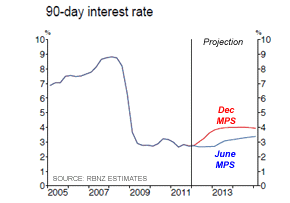
The Reserve Bank now expects the 90 day bill rate to be stable at 2.7% until mid 2013 before rising just 60 basis points to 3.3% by the end of 2014, and a peak of 3.4% in early 2015.
The 90 day bill rate is typically 20-30 basis points above the Official Cash Rate.
Although the Reserve Bank’s forecast is not a forecast of the OCR, its 90 day bill rate forecast implies the OCR will remain on hold until June 2013 at least and that the first OCR hike is not expected until then, or the September quarter of 2013.
Before today’s June quarter Monetary Policy Statement (MPS) bank economists had been forecasting the Reserve Bank would increase the OCR in the March quarter of next year.
The Reserve Bank lowered its forecast 90 day bill track significantly from its March quarter MPS. That forecast saw the 90 day bill rate rising from the December quarter of this year and peaking at 3.6% by the December quarter of 2014.
Today’s forecast implies a six month delay in OCR hikes and a peak that is around 20-30 basis points lower than the last forecast.
“New Zealand’s economic outlook has weakened a little since the March Monetary Policy Statement,” Governor Alan Bollard said in his second-to-last MPS as Governor. He is due to retire at the end of September.
“Political and economic stresses in Europe, along with a run of weaker than expected data, have seen New Zealand’s trading partner outlook worsen. Furthermore, there is a small but growing risk that conditions in the euro area deteriorate more markedly than projected in the June statement. The bank is monitoring euro area developments carefully given the potential for rapid change,” Bollard said.
“Increased agricultural production and the weakened global outlook have driven New Zealand’s export commodity prices lower. The resulting deterioration in export incomes, although partially offset by depreciation in the exchange rate, will weigh on economic activity in New Zealand,” he said.
“Offsetting these negative influences, housing market activity continues to increase, supported by recent reductions in mortgage interest rates. In addition, repairs and reconstruction in Canterbury are expected to substantially boost construction sector activity in coming quarters. Aggregate GDP growth is projected to pick up slightly to just over 3% next year.”
“Given this economic outlook, inflation is expected to settle near the mid-point of the target range. It remains appropriate for monetary policy to remain stimulatory, with the OCR being held at 2.5%.”
We welcome your comments below. If you are not already registered, please register to comment
Remember we welcome robust, respectful and insightful debate. We don't welcome abusive or defamatory comments and will de-register those repeatedly making such comments. Our current comment policy is here.