
By Alex Tarrant
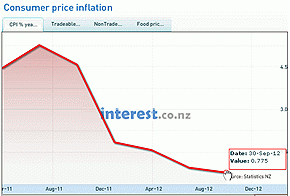
Annual inflation is at its lowest point since 1999, dropping below the Reserve Bank’s 1-3% target band in the year to September.
That has financial markets pricing in a 140% chance of a quarter-point cut in the Official Cash Rate over the coming year, indicating they expect 35 basis points worth of cuts to the baseline rate.
But New Zealand economists say that despite these heightened expectations, the central bank will not cut interest rates in response to the lower-than-expected inflation reading. Figures for the December quarter should show inflation moving back towards the middle of that band.
Higher prices for cigarettes and tobacco, rents, electricity, petrol, newly built houses, and local authority rates, were partly offset by lower prices for telecommunication services and audio-visual equipment over the year.
Figures released by Statistics New Zealand on Tuesday showed general inflation, as measured by the Consumers Price Index (CPI), rose 0.8% in the year to the September 2012 quarter. This was the smallest annual movement since a 0.5% increase in the year to the December 1999 quarter, Stats NZ said.
Economists polled by Reuters had given a median expectation for annual CPI inflation of 1.1%, while a Bloomberg poll gave an expectation for 1.0%. The Reserve Bank had expected a 1% rise in the CPI over the year to September.
In the September quarter alone, the CPI rose 0.3% from June, Stats NZ said. That was about half of expectations for a 0.5-0.6% rise. The Reserve Bank had expected a 0.5% rise over the quarter.
The rise was led by housing costs, including a 17% hike in insurance costs, and a seasonal rise in vegetable prices, including a 57% hike in tomato prices.
These were partly offset by lower prices for second-hand cars, domestic air fares, petrol, telecommunication services, and milk.
OCR cut, or lower for longer?
The lower-than-expected reading will fuel expectations the Reserve Bank could cut the Official Cash Rate from its record low 2.5%, or at least could lengthen out expectations for how long the rate will be left on hold.
The majority of economists at New Zealand banks and economic forecasting agencies are still picking the next move for the OCR to be a hike, either in late 2013 or early 2014. They point to price pressures coming from the Canterbury rebuild and housing market activity as reasons for the Reserve Bank not to cut the OCR.
Markets, on the other hand, were yesterday picking about a 90% chance the OCR would be cut sometime in the next year.
The Reserve Bank is mandated to keep CPI inflation between a 1%-3% target band on average over the medium term. The Official Cash Rate is its primary tool for achieving this – it will raise the OCR if it expects future price pressures will push the CPI above 3%, and will cut the OCR if it expects price pressures won’t be sufficient to keep the CPI above 1%.
The OCR is most closely correlated with floating, or variable, mortgage rates. A cut or hike in the OCR should lead to a similar movement in floating rates.
'Risk rather than likelihood'
Following the figures, Westpac economists said the reading did stoke markets' interest in the possibility of OCR cuts.
"The 2-year swap rate fell 5bps, and the exchange rate fell about 20 pips. We view an OCR reduction as a risk scenario rather than a likelihood. The Reserve Bank's target is framed in terms of its inflation forecast, which will still be lingering close to 2% on average after today's CPI data," Westpac economists said.
ASB economists said they had changed their pick for the next move for the OCR - a hike - from June to September 2013. ASB had been an outlier with its June 2013 pick, and still holds the earliest expectation for a hike.
"The slow pace of Eurozone crisis resolution, coupled with dim Eurozone growth prospects, and likelihood of further RBNZ caution over persistent NZD strength all argue for a much later start than June. But we remain wary about the housing market in an environment where mortgage rates are likely to remain very low well into 2013 and risk further boosting demand in a supply-constrained market (notably in Auckland)," ASB economists said.
"We expect that ongoing strength in the housing market, coupled with gradually rising domestic inflation pressures (some of which were evident in today’s release), will push the RBNZ to start gradually tightening in the closing stages of next year," they said.
Infometrics economist Benjamin Patterson said the forecasting agency was sticking with its pick for the next move in the OCR to be a hike at the end of 2013.
"Instead [of cutting,] the Bank will sit tight, knowing that inflationary pressure is contained and they have room to move should financial conditions abroad deteriorate markedly. We expect inflation to rise back towards 2%pa during 2013, although we are cautious about how quickly cost pressures associated with the Christchurch rebuild will show up in the CPI," Patterson said.
JP Morgan Australia analyst Ben Jarman said the annual figure was dragged down by a low reading in the December 2011 quarter. That would not influence the December figures, which should show annual inflation of about 1.5%, he said.
"There has [also] been no loss of momentum in non-tradables inflation, and the path of the GDP and consumer spending data have been playing to our script of above-trend demand side activity. These facts, of course, also explain why Governor Bollard did not see fit to cut rates over the last eighteen months," Jarman said.
"At least initially, we feel Governor Wheeler will be biased to tracing the path drawn by his predecessor, which argues for keeping rates on hold until the economy has garnered sufficient momentum in 2013," he said.
ANZ economists said while the general picture remained benign, compositional (firming construction costs) and regional aspects (Canterbury) were testament to inherent tensions within the inflation portrait.
"With much of the undershooting in inflation over the past year coming from tradable inflation, and the NZD likely to remain elevated given structural challenges for the USD, we are closely watching transmission channels into non-tradable pockets of the economy. Key here are inflation expectations and the labour market. If both show weakness the case for a rate cut will grow," ANZ economists said.
"For now we remain comfortable articulating a “lower for longer” interest rate theme, with our core view centred around the OCR not lifting until 2014," they said.
Housing costs rise
In the year to September the main individual upward contributions to CPI inflation came from higher prices for cigarettes and tobacco (up 13%), rentals for housing (up 2.4%), electricity (up 4.4%), petrol (up 2.6%), purchase of newly built houses (up 3.0%), and local authority rates (up 4.1%), Stats NZ said.
Read the full Stats NZ release here.
The main individual downward contributions came from lower prices for telecommunication services (down 7.5%) and audio-visual equipment (down 18%).
Tradables vs non-tradables
In the year to the September 2012 quarter, the tradable component of the CPI decreased 1.2%, Stats NZ said. Tradable goods and services are those imported, or which face competition from foreign goods and services, either in foreign or domestic markets.
Movements in the tradables component demonstrate how international price movements and exchange rates are affecting consumer prices.
That fall reflected lower prices for dairy products, audio-visual equipment, and meat and poultry. It was the largest annual decrease in tradable inflation since a 2.3% fall in the year to the March 2004 quarter, Stats NZ said.
Meanwhile, prices for non-tradables rose 2.3% over the year, reflecting price rises for cigarettes and tobacco, rentals for housing, and electricity.
Economist reactions
Westpac
The Consumer Price Index (CPI) rose 0.3% in the September quarter, taking annual inflation down to a 13-year low of 0.8%. This was even weaker than our below-market forecast, and follows a string of weak inflation outturns.
The detail of this quarter's report was not quite as soft as the headline. The downside surprise was mainly due to two quirks that are unlikely to be repeated - used car prices fell 2.8%, and domestic airfares fell 7.8%. Apart from these two price declines, this impact of the high NZD on tradables inflation was not as pervasive as we were expecting - for example, household contents and services prices rose 0.4%. Meanwhile, housing-related inflation is starting to accelerate. The cost of building a new house is up 3.0% nationwide over the past year, and rose 1.0% this quarter. In Canterbury, the increase in building costs was 3.4% for the quarter, for a 9.6% increase in building costs over the past year. Our concern is that the Canterbury rebuild will boost housing-related inflation, eventually forcing the Reserve Bank to increase the OCR. This story still looks very much on track.
New Zealand's current low inflation rate is mainly due to low global inflation combined with the high New Zealand dollar. Together, these forces have caused a 1.2% fall in tradables inflation over the past year - the largest annual decrease in tradables inflation since 2004. Low headline inflation has allowed the Reserve Bank to delay its previously-planned OCR hikes.
Inflation once again printing below the RBNZ's forecast stoked markets' interest in the possibility of OCR cuts. The 2-year swap rate fell 5bps, and the exchange rate fell about 20 pips. We view an OCR reduction as a risk scenario rather than a likelihood. The Reserve Bank's target is framed in terms of its inflation forecast, which will still be lingering close to 2% on average after today's CPI data.
ASB
Underpinning the 0.3% increase in Q3 CPI were:
· a seasonal lift in food prices (as expected),
· the increase in annual council rates (although less than we assumed),
· an acceleration in construction costs (as expected),
· an increase in housing insurance premiums (as expected).
Offsetting these prices increases were declines in communication prices (as expected) and transport prices, in particular second-hand cars (-2.8% qoq) and domestic airfares (-7.8% qoq). The elevated NZD also contributed to subdued prices for imported retail goods.
The key surprise for us was the weakness in tradable inflation, largely due to the fall in transport prices. Anecdotes have suggested that unsold inventories of second-hand cars had been relatively high due to weaker than expected demand, which is likely to have prompted discounting over the past two quarters. Vehicle registrations show demand for cars has gradually improved over the past year. However, there appears to have been a shift in preference toward new cars over second-hand cars.
Tradable CPI is now down 1.2% on year-ago levels, largely due to the elevated NZD. With the NZD to remain elevated over the coming year, we expect tradable inflation pressures to remain subdued over the rest of 2012. However, deflation in these areas is masking a lift in domestic inflation pressures.
Construction-related costs are starting to come through, as expected. Construction costs lifted 1% over the quarter, and were led by a sharp 3.4% increase in Canterbury construction costs. Construction inflation in Canterbury is now running an annual rate of 9.6%, although so far the knock-on impact to prices around the rest of the country has been muted, with Auckland construction costs remaining subdued.
The impact of the tight housing market is also evident with rental inflation remaining firm, led by increases in Auckland and Canterbury. This is consistent with housing market indicators which suggests supply of housing remains very low relative to demand.
Insurance premiums for housing continue to increase, with a 17% increase recorded over Q3.
Implications: OCR view change, nonetheless
We now expect the RBNZ will wait until September before lifting the OCR (previously June). Our view shift is largely based on other factors than the muted Q3 inflation outcome.
The slow pace of Eurozone crisis resolution, coupled with dim Eurozone growth prospects, and likelihood of further RBNZ caution over persistent NZD strength all argue for a much later start than June. But we remain wary about the housing market in an environment where mortgage rates are likely to remain very low well into 2013 and risk further boosting demand in a supply-constrained market (notably in Auckland).
We expect that ongoing strength in the housing market, coupled with gradually rising domestic inflation pressures (some of which were evident in today’s release), will push the RBNZ to start gradually tightening in the closing stages of next year.
JP Morgan Australia
New Zealand’s CPI grew 0.3% for the second quarter in a row in 3Q (J.P. Morgan 0.4%q/q, consensus 0.5%q/q), and the tradable/non-tradable split was also little changed, with domestically-determined prices up 0.5%q/q, as in 2Q, and tradables prices flat (from +0.1%q/q). The slight downside surprise through the traded channel pushed annual inflation down to 0.8%oya, and below the RBNZ’s 1%-3% target band for the first time since the late 1990s.
This fact takes on a little more significance in the lead-in to next week’s OCR announcement, the first from the new Governor. Governor Wheeler signed a new Policy Targets Agreement a few weeks ago, which nominates the 2% mid-point as a more explicit focus.
This presumably is meant to project less tolerance for deviations from the band, which carries some weight in the absence of any other information about his policy leanings: he is an external appointment, and we have yet to hear from him outside of the PTA formalities since he took over the reins a couple of weeks ago.
Despite all this, in our view, today’s numbers don’t add much to the domestic economic story, and shouldn’t have policy implications either. The weakness in annual inflation shown today was largely baked-in due to the contraction in prices 4Q11 that accompanied supply normalization in produce prices.
That base effect falls out in the next quarter’s data, such that even maintenance of the current run-rate would see annual inflation jump back to 1.5%oya, comfortably within the band.
Second, there has been no loss of momentum in non-tradables inflation, and the path of the GDP and consumer spending data have been playing to our script of above-trend demand side activity. These facts, of course, also explain why Governor Bollard did not see fit to cut rates over the last eighteen months.
At least initially, we feel Governor Wheeler will be biased to tracing the path drawn by his predecessor, which argues for keeping rates on hold until the economy has garnered sufficient momentum in 2013.
ANZ
Q3 CPI rose 0.3 percent, softer than market expectations and the RBNZ forecast of a 0.5 percent rise. Annual inflation eased to 0.8 percent, a 13-year low.
Core readings were benign. Non-tradable prices rose 0.5 percent in the September quarter, consistent with the directional signal provided by our Monthly Inflation Gauge. Prices in the weighted median measure rose 0.3 percent q/q, and there was a 0.1 to 0.2 percent lift in the various trimmed mean measures.
While the general picture remains benign, compositional (firming construction costs) and regional aspects (Canterbury) are testament to inherent tensions within the inflation portrait. Our (and the RBNZ’s) focus is on the medium-term outlook.
With much of the undershooting in inflation over the past year coming from tradable inflation, and the NZD likely to remain elevated given structural challenges for the USD, we are closely watching transmission channels into non-tradable pockets of the economy. Key here are inflation expectations and the labour market. If both show weakness the case for a rate cut will grow.
For now we remain comfortable articulating a “lower for longer” interest rate theme, with our core view centred around the OCR not lifting until 2014.
BNZ
As expected, today’s Q3 NZ CPI (0.8%y/y) release was below market expectations (1.0%). Indeed it was below our own expectations (0.9%).
The fact annual CPI dropped below the bottom of the target band (1%-3%) for the first time ever, was bound to catch the market’s attention.
Still, the question really is: Does this outcome materially change our view and the RBNZ’s view of inflation over the medium-term? If it does not, the market’s response to the data creates an opportunity to pay swap at the very bottom of its range. If it does, then it suggests ‘the range’ that has held since May this year is no longer.
The market now prices around 35bps of RBNZ rate cuts in the year ahead. We have been here before. Since April the market has fairly consistently priced in some chance of a RBNZ cut. In late May/early June more than 40bps were priced. The catalyst at that point was heightened European concerns that impacted on global risk appetite. A surprise 50bps rate cut from the RBA also contributed, as did a tick up in the NZ unemployment rate to 6.7%.
This time, the triggers are a little more ‘home grown’ in nature. Global sentiment is actually fairly solid at present (though risks certainly lurk). This time the market is more focused on recent uninspiring domestic data, and now a low-side inflation reading.
As laid out in today’s note “Low Inflation Greets New RBNZ Governor”, we still believe there are notable hurdles to an RBNZ cut. We see the chance of a 25bps rate cut at around 40% (not the 140% chance now priced by markets).
So although times of heightened uncertainty make high conviction calls more problematic, it is when uncertainty is highest that opportunities are often presented.
In this light, we stand behind our view expressed ahead of the CPI release, that a lower than expected CPI print would likely create a paying opportunity for short-end swaps. We see 2-year as attractive paying at current levels (2.51%). The stop would be tight at 2.45%, looking to re-enter the trade at lower levels if the market moves to price more than 50bps of RBNZ rate cuts. 5-year swap at current levels (2.93%) is also attractive paying, with a stop loss at 2.85%.
After today’s data, the market will now have its mind clearly focused on next Thursday’s RBNZ meeting. The market in fact, now prices around a 25% chance of a cut at next week’s meeting. We see this as very unlikely. Today’s data may force the RBNZ to probe its convictions on its forecasts for a rising inflation trajectory from Q3.
However, it does not provide any smoking gun for an immediate cut. We continue to believe the meeting will be a fairly low key affair. As the first meeting under the new leadership of Governor Wheeler we expect a fairly neutral statement. If cuts are not directly referenced in the statement, market pricing could rebound from this week’s lows.
We also remain unconvinced by the argument that the RBNZ should follow the RBA’s course lower. Without detailing the differences in the outlooks for each economy it is also worth remembering the starting point. The RBA cash rate remains 75bps above the RBNZ’s. On average since inception the RBNZ’s OCR has sat 40bps above the RBA’s target rate.
An alternative strategy for those who remain somewhat nervous about the OCR outlook, is to position for curve steepening. We recently recommended a 2s-10s steepening position when the curve dipped to 95bps.
At that time, our view was premised on (i) the curve being well below the lower edge of our fundamental ‘fair value’ (130bps) (ii) potential corporate/local authority paying moving out along the curve (iii) expected stable to higher US bond 10-year bond yields (iv) the fact 95bps technically represented a level from which the curve had previously rebounded. These arguments still hold. We expect these drivers should dominate in our central case that OCR expectations rebound from current lows.
Alternatively, if the market prices increased expectations of OCR cuts it will likely be reflected mostly in lower short-end yields. The 2s-10s curve has in fact steepened a few basis points today (103bps currently) post the CPI release. A curve steepening position thereby provides some hedge against the market pricing more OCR cuts.
(Updates with Westpac, ASB, JP Morgan reactions, Infometrics OCR comment.)
We welcome your comments below. If you are not already registered, please register to comment
Remember we welcome robust, respectful and insightful debate. We don't welcome abusive or defamatory comments and will de-register those repeatedly making such comments. Our current comment policy is here.