
Here's my quick summary of the key overnight news you need to start your day.
Firstly from Europe, hundreds of banks are rushing to repay cheap loans they borrowed from the European Central Bank a year ago, in a show of confidence that financial markets are returning to health three years into the region's debt crisis.
The ECB will get back €137 billion (NZ$218 billion) from 278 banks on Jan. 30, the first day that the three-year loans can be repaid - and nearly two years before they are due - the European Central Bank said Friday.
In Japan there has been somewhat of a surprise announcement by The Liberal Democratic party at the weekend when it unveiled a draft budget that for the first time in four years will raise more money through taxes than bond sales. Under the previous government, Japan had relied more on debt than taxes to fund spending, causing the country’s gross borrowings to swell to more than twice the size of the economy.
This new government is trying to give an impression of some degree of fiscal discipline as it tries desperately to extract itself from deflation. So far they have seen the yen fall in value, a key goal.
In the US, the next fiscal crisis battle is looming. Most of us have turned off this endless partisan brinkmanship, but the stakes get higher every time. This time, US$1.2 trillion in automatic annual budget cuts are looming - that's like stopping New Zealand's economy dead; zero activity - for more than seven years.
It's raised-rhetoric time and will be until the drop-dead date on March 1.
Half the automatic cuts will be to the military budget, the other half to essential services like Environmental Protection Agency, Food and Drug Administration, and National Institutes of Health. Even hurricane relief funds would be hit by a sequester. Republicans are saying that if it takes deep cuts to the military, so be it. They are prioritising a long-term fix to the endless federal budget deficits and endless borrowing. There would be significant consequences to no new budget agreement and those consequences will spill over to New Zealand.
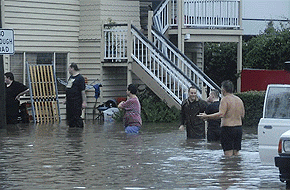
The severe weekend storms in Queensland, and which are moving down to NSW today, are expected to take a big toll on insurers there. That could be a problem for New Zealand too because Australian insurers own most of the domestic market share here, and if they are under pressure from claims levels that aren't covered by reinsurance, it is likely that our premiums will rise as they try to "repair their balance sheets". Affected companies include Suncorp, IAG and QBE. In New Zealand their insurance brands include State, NZI, Vero, AAInsurance, QBE and AMI.
The NZ$ starts the week at 83.7 USc, 80.4 AUc and the TWI is at 75.4 as at 8:30am.
No chart with that title exists.
We welcome your comments below. If you are not already registered, please register to comment
Remember we welcome robust, respectful and insightful debate. We don't welcome abusive or defamatory comments and will de-register those repeatedly making such comments. Our current comment policy is here.