

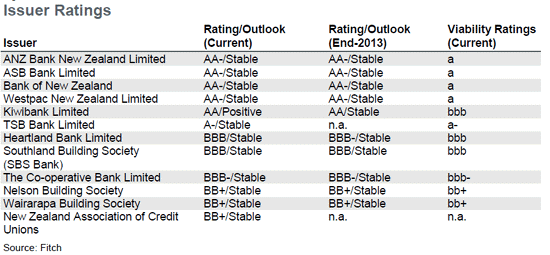
International credit rating agency Fitch Ratings has highlighted New Zealand's high household debt levels in its 2015 outlook for New Zealand banks.
Although saying it expects the performance of the New Zealand banking system to remain sound in 2015, Fitch notes household debt has risen to 156% of disposable income from 152% in 2011 and is "high."
"Fitch does not foresee a significant improvement in this ratio in 2015. In fact, there is a risk that household debt could continue to increase if property prices continue to rise on credit supply," Fitch says.
"A significant correction in house prices and a sharp increase in the Official Cash Rate could pose a risk for the banks' household exposures."
However, the credit rating agency says the stabilisation of household debt levels during 2014 reflects measures such as the Reserve Bank's introduction of high loan-to-value ratio (LVRs) "speed limits" on home loans, and tightened underwriting processes by the banks. It says this helps limit the build up of further risks in the banking system.
New Zealand banks' loan books are dominated by home loans. The latest Reserve Bank sector credit figures show total household claims of $210.881 billion at November 30 last year, a rise of 4.6% year-on-year.
Fitch's comments on New Zealand's high household debt comes after the London-based Lafferty Group recently put this country's consumer credit to personal disposable income ratio at 164%. Lafferty figures for a range of other countries had only Canada ahead of this at 166%.
Key outlook sensitivities
Fitch says key outlook sensitivities for New Zealand banks include an economic slowdown in China, increased risk appetite at the banks, and rising macro-economic risks such as prolonged low dairy prices. It predicts "mid-single digit" loan growth in 2015, and says the dairy sector is likely to withstand one year of weaker milk prices as most farmers have used the previous year's record payout to invest in their business or deleverage.
Meanwhile, Fitch says bank asset quality should stay sound this year in the absence of severe external shocks. It says an improving labour market should support the asset quality of banks' household loan portfolios. The LVR restrictions should help limit bank losses stemming from any sharp house price correction.
"Serviceability testing also provides a buffer (with) a borrowers' capacity to repay usually assessed at an interest rate about 150 basis points to 200 basis points above the best two-year fixed mortgage rate on a principal and interest basis regardless if the borrower has chosen an interest-only mortgage," Fitch says.
'Sound prospects for bank profitability'
The credit rating agency sees sound prospects for bank profitability, noting New Zealand banks are among the more profitable in the developed world, with Fitch expecting them to maintain strong net interest margins. Reserve Bank figures show New Zealand's retail banks had a combined net interest margin of 2.35% in the September quarter of last year.
"Capitalisation is expected to remain strong, while funding and liquidity profiles should remain stable."
"Counterbalancing the banking system's strength are increasing risks to asset quality, although Fitch does not expect these to manifest before end-2015. Sound economic prospects and further improvements in the labour market should help support asset quality within the banks' household exposures. There is however some downside risk to agriculture exposures should dairy prices remain low until mid-2015," says Fitch.
"However, the dairy farm industry finds itself in a better financial position relative to 2009 recession. Further increases in New Zealand's official cash rate (OCR) would also increase repayment pressure on some borrowers, although monetary policy is expected to remain supportive for some time."
"If either scenario were to occur it is unlikely to have a noticeable impact on asset quality until late 2015. The use of buffers in serviceability testing for borrowers provides some offset to this risk," says Fitch.
"Any reduction in asset margins due to fierce mortgage competition is likely to be offset by further funding cost reductions. In addition, cost management should remain efficient. Loan impairment charges may increase, although from a low level."
Overall, Fitch says it forecasts "healthy profitability" supporting internal capital generation.
"Capital levels are likely to remain adequate at current levels although the capital structure for larger banks may alter. Funding and liquidity are likely to remain stable, although some improvements in maturity profiles are possible. Generally, banks are focused on funding lending growth through either customer deposits or long-term wholesale funding."
Fitch also says it expects banks' liquidity positions to stay sound, at least enabling them to cover short-term funding maturities.
39 Comments
"Any reduction in asset margins due to fierce mortgage competition is likely to be offset by further funding cost reductions.
It's comforting for all concerned knowing that bank depositors in their capacity as mortgage underwriters and capital backstop, in case an OBR event is invoked by imprudent lending practices, will suck it up in the form of lower interest rates in return for higher risk.
Will the RBNZ be out to lunch or too busy bathing in the glow of accepting accolades?
So that’s a pretty strong signal to become a borrower, tempered only by the potential for losses when Steve Keens credit impulse goes negative.
Indeed, the saved, lets say its the OAPs are in the demographic of not spending much ie over 50ish. The borrowers are those <50 who then will spend it into the economy, mostly for un-productive consumption it seems. The rest of the borrowing (not spent on toys) is for property gambling.
The Q is I suppose how to not kill the economy with high interest rates but stop the waste and speculation that is the side effect of low rates to keep businesses etc afloat.
and the moral hazard? ie better the depositors lose than an innocent 3rd party sucking up the losses ie tax payers.
Maybe the banks should set aside greater loss provisions if they wish to maximise returns on a low capital base with the full knowlege that NZ domestic depositors are in the main liable to re-capitalise banks if an insolvency event unfolds.
The moral hazard lies in under capitalised banks relying on OBR exempt foreign wholesale lenders to fund credit demand beyond that which New Zealand can source domestically. Bank loan to domestic deposit ratios up towards140% are a recipe for disaster and an RBNZ initiated cease and desist order should be imposed upon the banks to get lending in-line with domestic capacity, rather than singling out the weakest amongst us for pillage.
Oopps another bank drops the rate of return in exchange for higher risk to the nations GDPE underwriters. Things must be looking a little difficult out there for the over indebted - poor darlings.
So why are all these NZ under-writers so petrified? inept? that they cannot go elsewhere?
I'll agree that the risk v return is un-acceptable though from what Ive seen of the OAPs writings they dont see the substantial risks now (and growing) just they are not getting paid as much as they think they should be/deserve.
petrified? not at all ! opportunistic !
after all they've got to get profit from elsewhere until the NZD cycles back up to release some hedges
Exactly - you are on the money Mr Hulme.
isnt "singling out the weakest amongst us for pillage." that the dog eat dog, shark infested pool of a free market at work though?
Yes, despite our arguments/disagreements, for me I still consider that the banks are being allowed to get away with murder by the Govn just because there is no obvious body today. That then of course comes back to the voter, beginning to look somewhat circular.
"Maybe the banks should set aside greater loss provisions" yes I guess so, or can they get insurance from say Lloyds of London? ie be forced to [re-]insure? though on a truely global event I wonder who will have the $s for the payout.
"OBR exempt foreign wholesale lenders" but these are limited to 10%? by the RB?
Im curious how that (ie lack of enough funds) is got around? oh wait maybe less ppl borowing stupidly. Which brings us back to another aspect, of "moral hazard". What about the [NZ] property speculators who are gambling on the NZ housing market going up for ever more and doing it with others money?
Maybe allowing ppl to do anything thay want isnt such a great idea after all.
.
isnt "singling out the weakest amongst us for pillage." that the dog eat dog, shark infested pool of a free market at work though?
I wish it were so - the bank insolvency resolution process is a two tier process.
"OBR exempt foreign wholesale lenders" but these are limited to 10%? by the RB? This exemption applies to covered bond holders, but also extends to the wholesale foreign lenders by exclusion of swap arrangements from OBR prepositioning - a cute trick since all foreign borrowing proceeds undertaken by local NZ banks are swapped into NZD and remain beyond the grasping intentions of OBR adherents - it's the non-corporate private citizens' assets that are targetted.instead.
It is the same two tiered process that co-exists in proposed and actual nation to nation trade deals.
If a government proposes to abandon one of the fundamental principles of justice, there had better be a powerful reason. Equality before the law is not ditched lightly. Surely? Well, read this and judge for yourself. The UK government, like that of the US and 13 other EU members, wants to set up a separate judicial system, exclusively for the use of corporations. While the rest of us must take our chances in the courts, corporations across the EU and US will be allowed to sue governments before a tribunal of corporate lawyers. They will be able to challenge the laws they don’t like, and seek massive compensation if these are deemed to affect their “future anticipated profits”. Read more
TPP would be a disaster
http://robertreich.org/post/107257859130
If you haven’t heard much about the TPP, that’s part of the problem right there. It would be the largest trade deal in history — involving countries stretching from Chile to Japan, representing 792 million people and accounting for 40 percent of the world economy – yet it’s been devised in secret.
Lobbyists from America’s biggest corporations and Wall Street’s biggest banks have been involved but not the American public. That’s a recipe for fatter profits and bigger paychecks at the top, but not a good deal for most of us, or even for most of the rest of the world.
I agree HT.
Everything about TPP smells bad.
And are we seriously meant to trust the Politcians?
Surely if it was good for the public the Politcians would disclose the details - but nope, they'll show us after the deal is done. Awesome!
All public feedback in every country re: TPP is bad.
Don't worry though our police state will see than New Zealand citizens obey.
...
And in other news...
http://www.theguardian.com/business/2015/jan/12/dairy-farmers-go-unpaid…
Definitely Stephen H. The banks must set aside more loss provision, and / or increase their capital base. The Aussie banks in particular extract enormous profits and pass it to shareholders. There is enough cash, for now at least, for them to really convert such into reserves, rather than pay it out.
But they won't until they are made too. It's suits the interests of the management and shareholders both to extract all that cash now, and not worry about an imminent crash. Compulsion is required.
An honest start would be informing the general public about the existance of OBR in NZ. Most people have no idea what it is or that the banks are already pre-positioned for it's execution if required.
I've spoken to many bank staff and even they have no idea what OBR refers to.
If it's so positive then why was it's implementation kept so quiet.
Yet the OBR seems to have been well discussed so I cant see how its seen as quiet.
Well discussed, where?
Maybe on this site...
How well has it been discussed in the mainstream media?
Why is it when i asked at my local ANZ bank after OBR pre-positioning was implemented, their staff had no idea what i was refrring to? Funny that... the bank didn't even inform their own staff.
If you told Joe average about OBR they would be surprised.
However, the reality appears to be that most people are in debt so they don't really care about OBR as they have almost zero savings.
I guess you would have to go looking, but I recall comments on Stuff and NZHerald I think. it is quite simple really you should be taking personal responsibilty to be informed and know what is going on and risks to your money to my mind. If you are too lazy or not competant enough well pay for professional advice.
I agree with you to some extent.
There were some small articles in the Herald but they were worded in a way that the reader had to be pretty vigilant to get the real gist of what was being implemented... there were no big scary headings to catch our attention like other newsworthy topics.
The interesting thing was when I sought professioanl advice my lawyer (and the other partners at that firm) and my accountant (also a partner of a large firm), seemed to know less than i did about OBR. They were'nt particularly helpful - and that is being kind.
I would have thought an ethical political leader would encourage the inhabitants to save - however it appears the people in power do the opposite, they encourage their subjects to be in debt. Good stuff for the banks.
I personally do not think savers should be penalised via OBR for living within their means. There are other options which must work for other countries.
I work as a professional advisor and have had a number of clients restructure liquid assets to avoid OBR, the majority now hold their liquid assets overseas in entity structures which meets residenency requirements (in that country) to gain the government guarantee. There are actually few option within NZ. All really require more than a few 100k to be cost effective so not that practical for the majority of people. Forex risk has to be activity managed.
Hi Speckles,
Someone recently posted that Kiwi bonds are an option to avoid OBR.
Would you agree?
Yes that is my understanding in that they provide a government guarantee, people with larger funds have the tradeoff of accepting what is a lower rate of return with kiwibonds rather than overseas, also many clients like the addded advantage to diversify away from home and a small country.
Good stuff. Thank you Speckles!
Why should one person enjoy a risk free rate of return, an income that in the event it goes wrong someone else pays the losses? (lets not consider in effect others are getting it, 2 wrongs does not make a right)
Lets be clear here for me there is the saved and savers and non-savers (those to poor to save much). Their financial situation I'd suggest is hughely different and especially in an OBR triggering event ie bankrupt/insolvent bank.
So the saved only income in effect is from interest from investments. The savers/non-savers will be workers paying PAYE mostly saving money. In an OBR like event without the OBR the savers/non-savers carry all of the costs as the banks will be bailed by the Govn which is the tax payer, the savers/non-savers pay, costs to the saved, close to nil. The savers but especially the non-savers, the poor in effect pay but they enjoyed no benefits, I just dont see that as fair.
"ethical political leader" beauty is in the eye of the beholder as they say, in my case I see no such thing, but thats becasue my context is way different to yours. Ethically we are destroying our planet and consuming its resources by over-breeding yet not one political party says a thing about it, its taboo.
"personally" well personally I dont see why I should pay the cost of you investing incompetantly.
If your lawyer didnt understand the OBR then frankly you need a better lawyer. On the bright side you are fortunate enough to know you dont know enough and can tell your lawyer isnt competant either. I know I dont know enough so if I had money and not a mortgage I'd go to a professional and explain my limits of investment to them ie position for maximim security of the capital to avoid all or major possibilities of loss and see what their advice is, then go away and see if it makes sense to you.
"getting money out" and indeed that is the issue. Your money in effect is trapped in the system/game. As said before short term Govn bonds should be very safe. As they expire within a short time frame they should be honoured as its unlikely a Govn will defualt unless it has no other choice. So lets say you do that, 2 years from now the Bonds mature but the Govn's debt is out of control and defaut looks pretty certian, so you dont want more bonds. What do you do then? Banks will have gone bankrupt already? and been re-capilatised, when the Govn defaults what happens to them? if they have not then the money gets dumped into a bank about to go insolvent.
Just how do you steer a path through this?
Crystal ball stuff.
If it even happens of course.
As I've said before, I'm not a banker and have no expertise in this area but don't some countries have insurance to cover depositors funds? We were told that it would be too expensive in NZ but i was never told how much it would cost? So no option was given.... plus the information made public seemed very limited.
If depositors funds are at risk from OBR, then dont you believe every depositor should be made aware of this risk? Why are they not told this when opening a savings account? Why do bank staff not know about this risk???
Steven, you say the risk is fair for savers but how many of the older savers would even know this risk exists? Do they deserve to be informed? Or do you just think stuff them, if they lose their life savings then tough luck?
Of course my lawyer understood OBR (just like my accountant) - it's a very simple concept. But they did not know how to best avoid it's implications.
BTW - my barrister is an ex-president of the Auckland Law Society so he's no fool. However OBR and banking in general is not his area of expertise. That in no way makes him incompetent as a lawyer. I'm not sure if you understand the way consultant's (like myself) work Steven, we have to hold indemnity insurance (for at least $1M, usually more) to cover ourselves if we make a mistake and are sued. In simple terms - if we dont know exactly what we're talking about then we shut up! I imagine my lawyer and accountant took that position.
The majority of bank depositors are likely to be unaware of the OBR. The Government is (intentionaly?) not spreading the info as strongly as it could. All of that is bad / wrong, as it makes people take on risks that they are unaware of.
Those who are aware of the OBR risk should take appropriate risk mitigation measures. The latter depend on one's assessment of how high the risk is. It may change, but at the moment the risk is low.
Other countries have implemented, to varying extent, Government guarantees for bank deposits. In Australia, for instance, the guarantee covers $250k per depositor per institution. So, depending on how much one has to invest, it may be possible to spread one's funds through several banks. This is, by the way, not a bad option for Kiwis given where the NZD/AUD exchange rate has been sitting lately. If the OBR-related info was propagated more strongly by the NZ Government, we would see bank runs / funds flow from NZ to OZ right now.
I would place any deposit through an australian resident entity..if pushed into a corner I would suspect the Aussie government may try to side step non-residents...at best they would hold you up and therfore you would lose liquidity. It is generally agreed in financial circles politically all countries will look after their residents first.
Just something to consider, I agree the cross rate does off a unique opportunity to diversify away from jthe NZ economy.
Hi speckles,
What options does a Kiwi residing in NZ have when organising an australian resident entity?
I would assume that any insurance costs would result in a lower interest rate paid? would savers accept this?
Sure some countries guarantee banks funds, but what that amounts to is the tax payer and their children guarantees the funds? (mostly?) unless some countires insist on private insurance? On top of that if the policy is say per month or the insurer ocan I assume change the cost on 30 days notice? ie in effect it can be canceled at short notice?
Surely as an adult you read the terms and conditions of any contract before you sign/accept it? Also how do I as a tax payer opt out for insuring you by the way? (apart from leaving NZ?) Why in effect am I being forced to insure you?
Older savers, the banks publish terms and conditions, if you dont read and understand them, just who's fault is that?
Youngsters cant vote, yet in effect older voters can and are forcing risk and costs onto younger people, yet that is OK? I mean in any actual private (say HP) contract a youngster is protected under law as they are considered not competant yet but cannot vote to defend themselves how is that fair? Now if we took away the voting rights of OAPs at 65, yes OK, but we do not. So competant enough to vote til the day you die but not to read a contract?
yeah right.
"stuff them" older savers have used up the world's easy to get resources, over-bred, over-consumed and finished the cheap fossil energy and now there is little left for future generations so just who is stuffing who here?
You complained/commented your lawyer didnt know, if he/she does not then obviously you need to find someone else. Fine, he/she may well be a competant lawyer but he/she/you admits he cannot advise, so you move on to someone who does and can.
Yes as an ex-consulting engineer I understand the PI insurance problems, hence why I dont do private work.
Mind you I am not surpised he cannot advise, I cant see how simple advice will work. ie in terms of strategy I'd suggest that putting the capital in one place (or class of investment) for the duration of this is not going to work. I'd think that you will have to stay highly liquid and be prepared to move in and out of investments at the right moment, fast. To do that I'd assume you lose much interest, maybe hand over fist, I suspect that isnt acceptable to you.
As a hedge fund manager (Hugh Hendry) is worth watching (on youtube). He comments on being a giant amongst dwarfs.
https://www.youtube.com/watch?v=0ChKzQ3vZhw
(1 min40secs)
from the implosions of the "free market" but its all worth it.
So we have an event up until which (Peak oil) where for 10,000 years humanity has always had more and more energy, and now it is goign to reverse.
As Hugh H says all you need to be is a giant amongst dwarfs.
Steven, you seem like a smart guy, and i have spent much of my life working closely with Engineers (mostly Civil and Council Development Engineers) and my experience in general is, Engineers are cautious and astute.
But i have to say i think you are so far off the mark blaming baby boomers for todays problems. You need to understand who is making the money and it's not baby boomers, it's banks!!!!!!
The name of their game is debt and the benefits which baby boomers have recieved as a result (i.e. capital gains on their homes or renters) is merely a side consequence of the big players succeeding in their agenda (e.g. the baby boomers only benefited from the sharks leftovers).
The banks don't tell line staff things because "it's technically above their paygrade" and "bank policy hasn't been finallised on the matter yet".
In reality it stops staff trying to explain things to a ignirant public (especially if the bank staff aren't certified) and more importantly it gives plausible deniability to the banks interactions with customers... just like nasty executives have PA's to run interference for customers and staff.
DP
I wonder how important is that private debt anyway? Steve Keen thinks domestic credit to GDP ratios are really important but what about this.. From 2011 to 2014 house values in NZ increased by about 125 billion NZD according to RBNZ. I think that money could have only come from three places.
1. Domestic mortgage lending
2. Existing cash deposits
3. Foreign Money (Chinese oligarchs, property syndicates, ZIRP NIRP carry traders etc.)
with respect to point 1, Domestic debt has increased but probably not to the tune of 125 billion? It seems that future domestic credit creation will be severely limited by the baby boomers retiring (and deleveraging). I saw somewhere the growth rate of age 65-85 is five times that of any other 20 year age demographic. With respect to point 2, existing cash deposits have been going up not down so that cant account for house price inflation. That leaves number 3, foreign money. So to what extent does the health of the Auckland housing market depend on those three sources of liquidity? Just thinking out loud.
You missed,
4. ponzi scheme.
So the value of my house is twice what is probably a fair price for it in terms of wages. That value is only realised when the house is sold, if no one wants to buy the price drops until someone does.
"foreign money" seems around teh wrold there are a lot of foreigners buying in the capital citoes of the world, my Q is where is all this $ coming from? Even if it is say 10% and you remove that by having NZers only owning that would I think quench the market. No one however wants to vote for stopping of the only game in town.
Oh yes you're right. that RBNZ figure probably includes implied capital gains doesnt it. Hang on, I have athe actual individual house sale data on my computer (but not 2014). Here's the sum of "Net Sale Price" for every individual house sale in New Zealand by year.
2010 -> $26.695 Billion
2011 -> $29.999 Billion
2012 -> $38.261 Billion
2013 -> $36.862 Billion
Thats 131 Billion in net sales from 2010-2013. Kind of calls the RBNZ figues into question doesnt it. Now to my question. How much of that come from overseas and went into the Auckland market? you think only 10%
Come to think of it, liquidity source 4 would be finance derived from the sale of another NZ house. Both sales would be bundled up in the sum of net sales. oh that's complicated. Perhaps the RBNZ figures are accurate after all.
Yes of course foreigners are hovering up all the residential property. its an asset with no counterparty risk with > 0% return. The plutocrat / National party is reckless /selfish / short sighted enough to sell off the next generation's equity and earning potential for a few bux.
We welcome your comments below. If you are not already registered, please register to comment
Remember we welcome robust, respectful and insightful debate. We don't welcome abusive or defamatory comments and will de-register those repeatedly making such comments. Our current comment policy is here.