
By Bernard Hickey
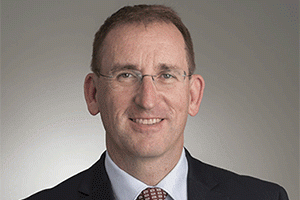
Reserve Bank Assistant Governor John McDermott has delivered a speech on the inflation outlook and monetary policy that talked in more detail about the conditions that might force the Reserve Bank to cut the Official Cash Rate.
McDermott told the Waikato Chamber of Commerce and Industry and the Waikato branch of the Institute of Directors in Hamilton that the Reserve Bank would ensure monetary policy remained stimulatory to support growth above its potential, "to help lift inflation back to target."
The tone of his comments are more dovish than those made by Governor Graeme Wheeler on March 12. Since then inflation data has shown annual inflation of 0.1% in the year to March, which is well below the Reserve Bank's 1-3% target band, and the New Zealand dollar has risen 4% on a Trade Weighted Index basis.
McDermott said in the speech titled "The dragon slain? Near zero inflation in New Zealand" that the near-zero inflation rate was mostly due to low tradables inflation, caused by the slow global economic recovery, the high exchange rate, and the recent sharp falls in oil prices.
"Is this another slain dragon?" he asked about the low inflation currently. "I do not believe so; the dragon is merely sleeping," he said.
McDermott said there was little the bank could do in the short term to influence inflation and some of the factors would prove temporary, including lower oil prices.
“At present, the Bank is not considering any increase in interest rates," McDermott said, echoing the formal outlook adopted on March 12, but the commentary around that was more conciliatory towards rate cuts, and less aggressive about rate hikes.
"Before considering any tightening in monetary policy we would need to be confident that increased capacity utilisation and labour market tightness was generating, or about to generate, a substantial increase in inflation," he said.
“Evidence of weakening demand and domestic inflationary pressures would prompt us to consider lowering interest rates. There are some areas of uncertainty surrounding the outlook for capacity pressures, including the lingering effects of the recent drought in parts of the country, fiscal consolidation, lower dairy incomes and the impact of the exchange rate on export and import substitution industries."
McDermott said the bank was also assessing the outlook for tradables inflation that is being dampened by global conditions and the high exchange rate.
"The fact that the exchange rate has appreciated while our key export prices, such as dairy, have been falling, is unwelcome," he added.
The bank remained vigilant in watching wage bargaining and price-setting outcomes.
"Should these settle at levels lower than our target range for inflation, it would be appropriate to ease policy," he said, adding future adjustments in the OCR would depend on the evolution of inflationary pressures in both the traded and non-traded sectors.
Flatter Phillips Curve?
McDermott went on to discuss whether the Phillips curve, which looks at how inflation pressures pick up as the amount of spare capacity in the economy reduces. The size of the 'output gap', which measures the speed of economic growth above or below the economy's potential output, is a key determinant of the direction of longer term inflation. McDermott said the output gap was currently positive at around half a percent of potential output.
"Monetary policy is currently supportive, which should help to drive the output gap higher in coming quarters and generate the additional inflation to return to the target midpoint," he said.
However, the bank had noticed some indicators, including unemployment, were consistent with a negative output gap and hence lower inflationary pressure.
"The subdued nature of the actual increase in domestic inflationary pressure raises the question of whether the output gap is having a smaller influence on actual inflation than it has in the past. In other words, has the slope of the Phillips curve become flatter?," he asked.
The anchoring of inflation at low levels represented a success for New Zealand's monetary policy framework, but was also a challenge.
"With a flat Phillips curve it becomes more difficult for the Reserve Bank to influence inflation by affecting the demand for resources and the size of the output gap," McDermott said.
"The current flatter Phillips curve could mean that the positive output gap is exerting less inflationary pressure than we currently believe, slowing our eventual return to target midpoint," he said.
Watching inflation expectations
McDermott then pointed to falling inflation expectations and that the wage setting and price setting behaviour was closely linked to current and past inflation experiences, rather than future expectations.
"If price and wage setting is very backward looking, the temporarily low headline inflation from falling petrol prices could become more widely entrenched," he said.
Longer term measures of expectations were currently consistent with the mid-point of the Reserve Bank's 1-3% target, but market based measures had fallen sharply.
"The level of these other measures are consistent with inflation expectations at or just below the target midpoint of 2 percent, but all highlight the downward direction over the past year," he said.
Economist reaction
ASB Chief Economist Nick Tuffley said the speech did not indicate any change in the Reserve Bank's approach, but reinforced the risks of a change were more for a cut than a hike. Tuffley saw a 25% chance of a cut this year.
"The RBNZ doesn’t have a lot of leeway left with its inflation target: if a return to the 2% inflation target mid-point came under question then a lower OCR has a green light," Tuffley said, pointing in particular to the bank's comments about the 'unwelcome' rise in the New Zealand dollar despite falling dairy prices.
"We see the NZD as the more immediate catalyst for an OCR cut, particularly if it was to lift further and materially change the inflation outlook," he said.
Westpac Chief Economist Dominick Stephens said his first impression was the speech was more dovish.
"The case for rate cuts was more fleshed out," Stephens said.
"As well as the risk of consumers and businesses falling into a low-inflation mindset, the speech noted that signs of weaker domestic demand and inflation pressures could prompt a cut," he said.
"This included a menu of factors that are already on the horizon - drought, low dairy prices, fiscal consolidation, and the high exchange rate."
Stephens said the Reserve Bank could scratch the 'up' part of the 'up or down' phrase from its monetary policy statement when it next announces its decision on April 30.
(Updated with more details, reaction)
We welcome your comments below. If you are not already registered, please register to comment
Remember we welcome robust, respectful and insightful debate. We don't welcome abusive or defamatory comments and will de-register those repeatedly making such comments. Our current comment policy is here.