Content supplied by the OECD
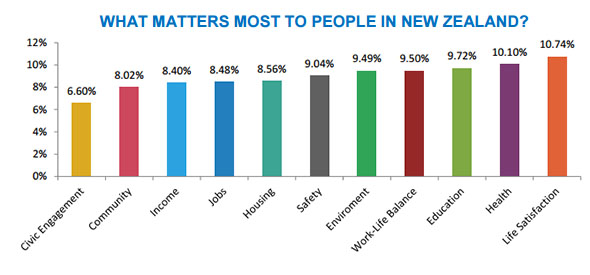
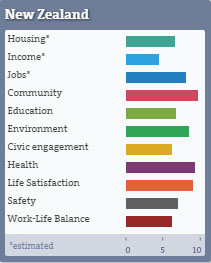
New Zealand performs well in many measures of well-being relative to most other countries in the Better Life Index.
New Zealand ranks at the top in health status and social connections. It ranks above the average in income and wealth, environmental quality, civic engagement, personal security, housing, subjective well-being, education and skills, and jobs and earnings, but below average in income and wealth.
Money, while it cannot buy happiness, is an important means to achieving higher living standards. In New Zealand, the average household net-adjusted disposable income per capita is lower than the OECD average of USD 29 016 a year.
In terms of employment, 74% of people aged 15 to 64 in New Zealand have a paid job, above the OECD employment average of 66%. Some 80% of men are in paid work, compared with 69% of women. In New Zealand, around 14% of employees work very long hours, more than the OECD average of 13%, with 20% of men working very long hours compared with 7% of women.
Good education and skills are important requisites for finding a job. In New Zealand, 74% of adults aged 25-64 have completed upper secondary education, close to the OECD average of 76%. This is truer of men than women, as 75% of men have successfully completed high-school compared with 73% of women. In terms of the quality of its educational system, the average student scored 509 in reading literacy, maths and science in the OECD's Programme for International Student Assessment (PISA). This score is higher than the OECD average of 497. On average in New Zealand, girls outperformed boys by 5 points, lower than the average OECD gap of 8 points.
Concerning the public sphere, there is a strong sense of community and high levels of civic participation in New Zealand, where 99% of people believe that they know someone they could rely on in time of need, higher than the OECD average of 88%, and the highest figure in the OECD. Voter turnout, a measure of citizens' participation in the political process, was 77% during recent elections, higher than the OECD average of 68%. Voter turnout for the top 20% of the population is an estimated 86%, whereas the participation rate of the bottom 20% is an estimated 75%. This difference is lower than the OECD average difference of 13 percentage points.
In general, New Zealanders are more satisfied with their lives than the OECD average. When asked to rate their general satisfaction with life on a scale from 0 to 10,New Zealanders gave it a 7.4 grade, higher than the OECD average of 6.5.
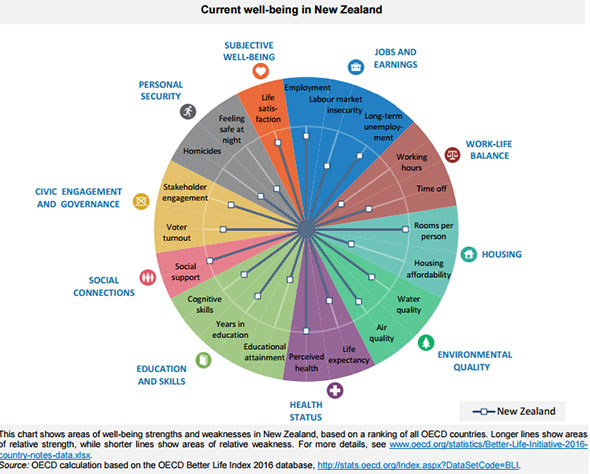
This commentary appears in the latest update of the OECD Better Life Index. The full review of New Zealand is here.
We welcome your comments below. If you are not already registered, please register to comment
Remember we welcome robust, respectful and insightful debate. We don't welcome abusive or defamatory comments and will de-register those repeatedly making such comments. Our current comment policy is here.