
Here's our summary of key events overnight that affect New Zealand, with news both China and Germany are adjusting to live with the US tariff challenge.
But first in the US, gradually rising interest rates have yet to dent Americans’ appetite for borrowing, with the total stock of household debt climbing to a record $13.3 tln by the end of the June quarter, up +3.5% in a year - which incidentally is less than the nominal growth in US GDP which grew +5.4% over the same period. Mortgages are more than two thirds of the total and these grew +3.5%. Student loans are a bit more than 10% of the total, but they grew at the rate of +4.5% pa. Car loans represent a bit more than 9% of the total household debt, and grew at +4%. Credit card debt is a smaller proportion (6.2%), but it grew at a +5.7% rate pa. the only component to grow faster than GDP.
In China, consumption is slowing, even if it is still at a high level. Retail sales rose +8.8% in July from a year earlier, but well below the +9.1% growth expected and down from +9.0% in June. And it is more than retail activity that is slowing. China industrial production in July came in at +6.0% growth, also well below expectations and the June levels.
To keep domestic demand up, China is loosening its recent debt rules for banks, and it is raising infrastructure spending, especially on high-speed railways.
China's data is in sharp contrast to that from Japan where industrial production actually fell -0.9% in the year to June.
The German economy grew faster than expected in the second quarter, driven by higher household and state spending, suggesting that it is powering ahead despite the threat of a major trade dispute with the United States. (Germany is also considering more infrastructure spending.)
This data helped the overall EU GDP growth rate, which was revised up to +2.2% real for the June quarter.
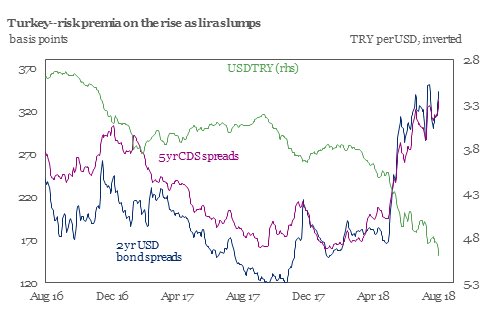
Overnight, the Turkish currency has a small rebound. But Indonesia's currency is the latest to take some depreciation hits, and they are preparing to shore it up.
In Sydney, residential vacancies have hit a 13 year high. Property investors have been hit with falling rents from these rising vacancies as the country's largest city gets an unexpected boost in supply of new dwellings. Econ101 at work. And the change is being reflected in how professional commercial property investors are acting.
The UST 10yr is firmer at 2.90%, with the US 2-10 curve still at just +26 bps. The Aussie Govt 10yr is at 2.59% (up +1 bp), the China Govt 10yr is at 3.58% and down -2 bps, while the NZ Govt 10 yr is at 2.60%, unchanged.
Gold is still down at its 18 month low, holding after its sharp drop yesterday and now a just at US$1,194/oz in New York.
After a small jump late in the day yesterday, US oil prices are softer today and now just at US$67/bbl. The Brent benchmark is now just on US$72.50/bbl. T
The Kiwi dollar is starting today little changed from yesterday at 65.8 USc. On the cross rates we are a little firmer at 90.9 AUc, and at 58 euro cents. That puts the TWI-5 at 70.1, and rising for the first time in a week.
Bitcoin dropped below US$6,000 yesterday but is now just over at US$6,032 which is -1.6% lower than this time yesterday.

This chart is animated here. For previous users, the animation process has been updated and works better now.
The easiest place to stay up with event risk today is by following our Economic Calendar here ».
We welcome your comments below. If you are not already registered, please register to comment
Remember we welcome robust, respectful and insightful debate. We don't welcome abusive or defamatory comments and will de-register those repeatedly making such comments. Our current comment policy is here.