

As New Zealand prepares for the potential of negative interest rates in 2021, the IMF issued an unusually blunt warning in November that the world was in a “global liquidity trap” where monetary policy was having limited effect.
Chief economist Gita Gopinath pointed out that low inflation and low growth has persisted despite 97% of the advanced economies having policy interest rates below 1% and one-fifth of the world with negative rates. In this situation further interest rate cuts will do little to stimulate growth and the only way forward is a coordinated global effort to focus on large government spending programmes rather than monetary stimulus.
Persistently low growth
There were already signs prior to the pandemic that the prevailing economic policy was not working. In October last year the former governor of the Bank of England Mervyn King argued that the world’s advanced countries had failed to address the structural problems which had led to the global financial crisis. As a result they had been stuck in a low growth trap ever since then. Too much borrowing plus too little spending and investing meant the standard economic models were no longer effective.
Indebted demand
In a recent paper economists Atif Mian (Princeton University), Ludwig Straub (Harvard University), and Amir Sufi (University of Chicago) proposed a theory of “indebted demand” to describe the situation the global economy finds itself in.
Looking at data from a group of advanced countries1 including New Zealand, they conclude that since the 1980s, economic growth, investment to GDP ratios, business productivity and inflation has all declined. Meanwhile the average real interest rate in these economies has dropped from 6% to less than zero. The COVID-crisis is likely to accelerate these trends.
Mian, Straub and Sufi argue that since the Global Financial Crisis the top 1% have been saving at an increasing rate resulting in a huge accumulation of income and wealth. At the same time there has been an explosion in borrowing from the bottom 90%. This imbalance has led to a permanent transfer of wealth in the form of debt service payments from borrowers to savers, depressing demand even further.
Low interest rates had worked for a while in propping up demand, but once interest rates hit their lower bound it is impossible to encourage the bottom 90% to consume more. Once interest rates moves close to or below zero, the economy finds itself in a debt-driven liquidity trap which is hard to escape from.
Debt and income share in New Zealand
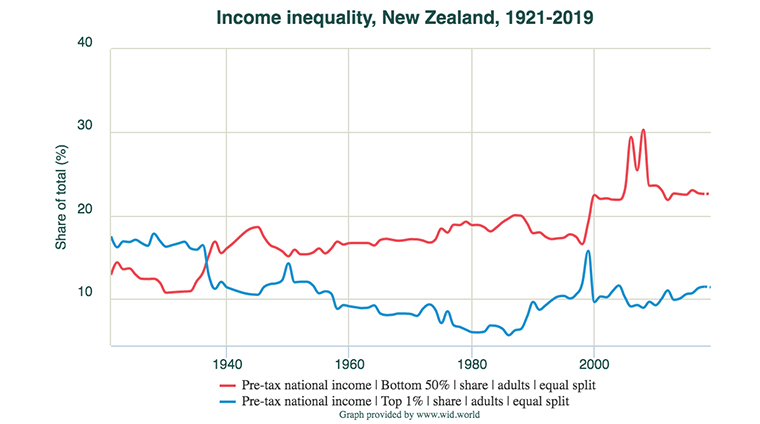
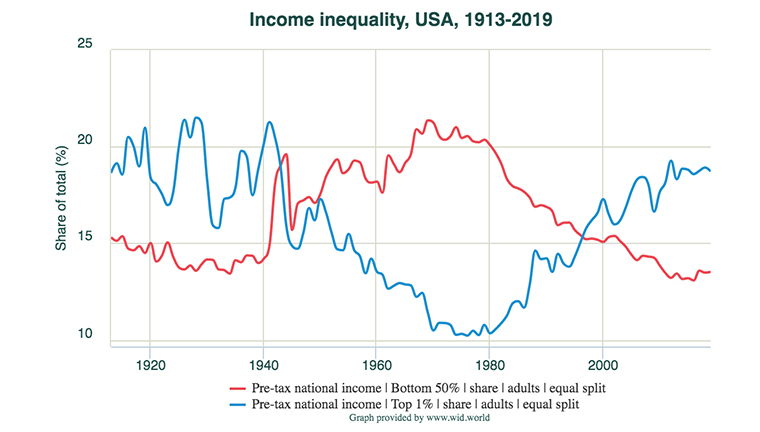
While the top 1% of income earners in New Zealand have gained a larger percentage of the total income pie over the last decade, at 11% income share we are still a long way from the levels of inequality in the USA where the top 1% account for almost 20% of the income share:
However New Zealand does have some of the highest levels of household debt in the world (currently 14th of the OECD countries), even before the pandemic struck. Most of this is mortgage debt due to the high cost of housing.
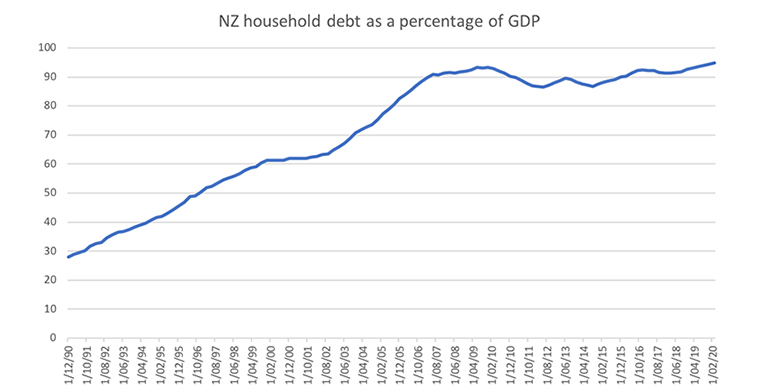
Data source: Bank of International Settlements
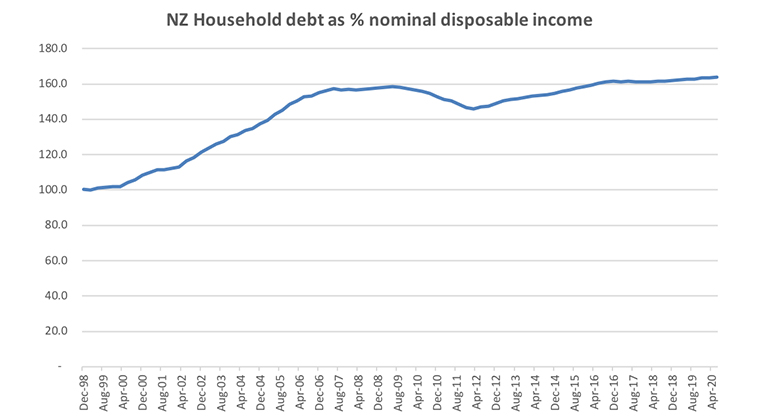
Data Source: RBNZ
Household borrowing declined slightly post 2008, but since then it has resumed its march upwards.
The 2020 pandemic and recession has only exacerbated the situation by disproportionately hitting low-income workers who tend to have less savings and more debt. All of this points to deflationary pressures which impact the debt-burdened the most.
The solutions to the liquidity-trap are tricky when there is a need to stimulate growth without sending households deeper into debt. The UK escaped a liquidity trap in the 1930s through a combination of cheap money combined with a house building boom. Mian, Straub and Sufi conclude the only solution is to redistribute funds away from the top 1% through things like wealth taxes, raising top marginal income tax rates and inheritance taxes.
Whatever the answer, the continued imbalance of debt, saving and investment are clearly not sustainable in the long run and more radical approaches will be required to avoid a level of inequality that will ultimately affect everyone.
1. The countries in the sample examined by “Indebted Demand” authors were Australia, Canada, Finland, France, Germany, Italy, Japan, New Zealand, Norway, Portugal, Spain, Sweden, United States and United Kingdom.
*Alison Brook is from the Knowledge Exchange Hub at the Massey University campus at Albany, Auckland. She is on the GDPLive team. This article is a post from the GDPLive blog, and is here with permission. The New Zealand GDPLive resource can also be accessed here.
We welcome your comments below. If you are not already registered, please register to comment
Remember we welcome robust, respectful and insightful debate. We don't welcome abusive or defamatory comments and will de-register those repeatedly making such comments. Our current comment policy is here.