
Here's something I thought I'd try. It's a bit like Bernard's Top Ten, but instead a weekly round up of the economic posts on various NZ blog sites.

I've currently got three categories - from the left, from the right, and economics blogs. Any feedback is greatly appreciated, especially on what other blogs Interest.co readers go to, and what you would like to see and read here in these posts.
From the left
Russel Norman from the Greens writes on Frogblog about 'state dispute mechanisms' involved in US free trade agreements. The US has said joining the Trans-Pacific Partnership is its priority over any bilateral deals at the moment, although questions are being raised about powers awarded to firms, and their ability to sue governments (ie ours) in international tribunals. The subject is also discussed by Lori Wallach in a double shot interview with Bernard Hickey here.
Key said the idea that investors would sue governments using investor state disputes mechanisms was “far-fetched”. This shows tremendous ignorance of the facts of NAFTA and apparent ignorance that Labour put these clauses into the NZ China FTA – chapter 11.2.
Then, I think it was Al from Scoop, persisted questioning him by pointing out that investor state disputes provisions were in NAFTA but that the Australians had blocked such clauses in the AUSFTA. And asked whether Key would block these clauses from entering the Trans Pacific Partnership deal.
Journalist: Is it that sort of thing being sought? Is it being negotiated?
PM: Not as far as I’m aware.
Journalist: And it’s being ruled out in that sense? The Australians apparently have ruled it out.
PM: I imagine we would too and I think it’s pretty farfetched.
So Key almost ruled out investor state dispute clauses in the TPP. This must have sent shivers up the spines of the MFAT officials and Tim Groser who both understand these issues well.
2. Key wanted to emulate the Irish. Possibly not any more
In separate posts on The Standard, Marty G and Lprent pull Prime Minister John Key up on comments he made in 2007 on economic lessons New Zealand could learn from Ireland .
Here’s the ‘Key Notes’ from October 2007, where Key says we should adopt Ireland’s economic reforms:
I’m always struck by the similarities between New Zealand and Ireland. We are the same size in terms of population, and we are both green, hilly, and have strong agricultural economies.
There are differences too. Ireland is also more prosperous than New Zealand. That hasn’t always been the case. Just fifteen years ago, the Irish and New Zealand economies were on a par. We were both poor performers compared to other developed countries.
Nothing much has changed in New Zealand. But Ireland has gone from being one of the poorest countries in Europe to being one of the wealthiest. It’s done this by adopting policies that encourage business growth, improve the skills of its young people, and entice Irish people all over the world to return home to live and work.
The lesson from Ireland is that countries can turn themselves around if they are determined enough. It’s a lesson New Zealand would do well to learn.
From Key’s speech to the NZ Institute of Foreign Affairs on emulating the “Celtic Tiger”:
Thirty years ago, Ireland was a total basket case. Today, it has all of the trappings of a considerable economic success story, including the capacity to attract and retain smart, educated, enterprising people.
three key policy initiatives which were critical to this success:
- They got the tax rates down to really competitive levels.
- They got infrastructure, especially communications infrastructure, up to an impressive standard, and
- They made sure the educational institutions were turning out graduates of the high standard demanded by the sectors that were seen as their areas of competitive advantage.
But the most important point is this: all these initiatives were deliberately targeted at leveraging off their most important strategic asset their location on the edge of the European Union.
Leave aside some of the EU subsidies that someone will mention if I do not the secret to Ireland’s success was location, location, location
And that, surely, must be the key to New Zealand’s economic success in the years ahead.
3. 'S&P say National is failing'
Rounding up the left blogs is Labour finance spokesman David Cunliffe with two posts (part 1, part 2) on Red Alert on the move by Standard and Poor's this week to put NZ's sovereign credit rating on negative outlook, indicating a 30% chance of a downgrade in the next few years.
In other words: New Zealand does not save enough, it has too much private debt, and that debt was used to fund the wrong things (property speculation not real business investment). New Zealand’s exports are under-diversified and New Zealand will continue structural bleeding on our external accounts after the immediate recession.
The logical repsonse to these problems should be;
- strong action to close the savings deficit (if possible by building good household saving behaviour)
- diversify and increase exports (presumably moving beyond a narrow range of bulk commodities)
- managing the fiscal position to encourage sustainable growth, employment and healthy tax revenues without blowing the fiscal deficit.
- ensuring monetary policy supports the direction of reform rather than acting against it.
It obviously should NOT include:
- borrowing more for tax cuts to upper income earners that neither create powerful stimulus nor correct the underlying imbalances
- reinforcing exisitng bulk commodity exports while reducing investment in innovation and R&D to divesify and add value to the export base
- cutting back Kiwisaver; cancelling prefunding for the NZ Super Fund; and taking two years to set up a Savings Working Group (and even then proscribing a range of strong policy options)
- pretending monetary settings are ideal when exporters face extreme currency volatility
Bill English and John Key declared S&P lifting their previous negative outlook as a” verdict’ on Budget 2009.
They should be straight-up enough to accept that S&P has now reversed its verdict.
Mr Key manages to contradict himself three ways in two paragraphs:
“Nothing has changed from our point of view, in fact if anything, our position looks stronger from our point of view (really?)…
We accept that we’ve had to take the earthquake on our balance sheet, accept tax revenues have been a bit weaker this year than we had anticipated…(corporate was 22.4% below 2010 forecasts, gst 15.8% below!)”
So… nothing has changed, we are stronger, but we are weaker. Classic. He must have been eyeballing three different journos and guessing they wanted three different answers, so why not try to please all of them at once?
The coup de grace is his attempt to pass it all off as Ireland’s fault. True, the Irish are in a bit of a bog, but lets assume S & P can tell the difference between the land of the long white cloud and the emerald isle.
From the right
4. Here's one of John Ansell's latest ads. Ansell's been up in Roger Douglas' office recently helping the old fella out.

5. Not much from the right this week in terms of economic policy posts, but seeing as Norman and Cunliffe are included above, here is a video from Finance Minister Bill English on his website, explaining the S&P move.
My initial thoughts are:
- I like the idea of a more flexible system where one can look at the likely life-time welfare cost of a beneficiary, which may mean spending more money early on to help them transition off welfare.
- Work testing for those with some capacity to work, is very important
- Childcare assistance should be targeted more at lower income families so you gain more financially from re-entering the workforce
- I like the idea of a transition allowance for those going from benefits to working
- I support some benefits being time-limited as this sets clear expectations. However some sort of emergency relief benefit would have to remain available with some flexibility.
If you have a view on what options are most preferable, then have your say. There is an online response form here. You can also e-mail submissions to welfareworkinggroup@vuw.ac.nz.
Business Roundtable Roger Kerr has his own website, this morning pointing to the Treasury chart on the tradable vs non-tradable parts of the economy. He's not happy, and wants govt spending cut.
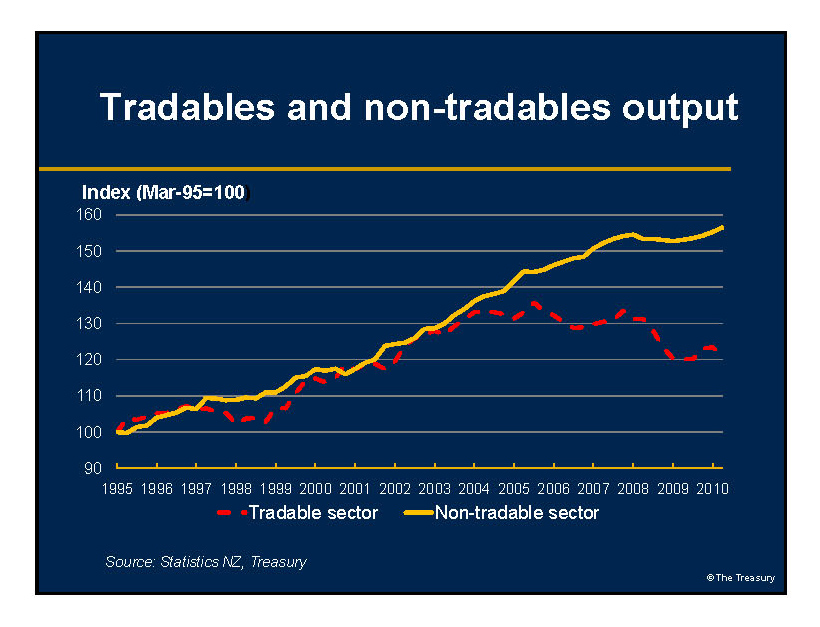
Reining in government spending is the single most important action the government can take to improve international competitiveness and export sector profitability and growth.
As John Whitehead warned, we are not as yet seeing the significant rebalancing needed in the economy – the shift of resources to tradables.
8. 'Peak oil? Don't worry, supply and demand will save us'
Roger Kerr also has a go at the peak oil debate. He thinks the laws of supply and demand will save us, given governments don't get suckered in by "fake" peak oil premises.
Danish environmentalist Bjorn Lomborg suggested in his 2003 Sir Ronald Trotter Lecture for the Business Roundtable that oil and substitutes like shale oil could cover current energy consumption levels for 5000 years.
He also noted that “Sheik Yamani, founder of the Organisation of Petroleum Exporting Countries (OPEC), has often pointed out that the oil age will come to an end but not for a lack of oil, just as the stone age came to an end but not for a lack of stones. Humans search constantly for better alternatives.”
Provided markets are allowed to adjust to supply and demand trends, and are not distorted by government interventions based on false ‘peak oil’ premises, there is every likelihood of an eventual smooth transition to other energy sources.
Economics blogs.
Not wanting to place them in the left-right argument, there are a couple of good economics blogs out there, namely TVHE and Offsetting Behaviour.
9. Matt Nolan at TVHE has some questions as to why everyone loves the chart above from Treasury
A key set of points for me is that:
- Our terms of trade has structurally increased
- Changes to policy throughout Asia have lead to massive productivity growth among our neighbours – something we as importers benefit from
- There was a tax bias towards housing, and potentially other investment vehicles, through the tax system following the introduction of the top tax rate – a matter that has been largely dealt with.
All three of these issue will have pushed up our real exchange rate, and if we assume the third one has now been dealt with, there is no policy recommendation required here.
Now my question to people is simply this three parter:
- Does this graph show an issue,
- If so, what is it?
- And if so, are their any changes that could improve matters?
We welcome your comments below. If you are not already registered, please register to comment
Remember we welcome robust, respectful and insightful debate. We don't welcome abusive or defamatory comments and will de-register those repeatedly making such comments. Our current comment policy is here.