
By Bernard Hickey
The Reserve Bank's Monetary Policy Statement last Thursday seemed on the face of it to be a non-event.
The central bank left the Official Cash Rate on hold and reiterated its downbeat outlook for the New Zealand economy. But it was the Reserve Bank's decision to further lower its forecast track for the 90 day bill rate that really caught the eye. See more from the RBNZ's MPS here. This caps an extraordinary year of forecast changes for the bank.
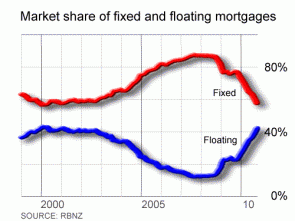
It has changed the landscape for interest rates and helped reinforce a massive shift in behaviour in the mortgage market away from fixed mortgages to floating rate mortgages. Back in March the Reserve Bank was forecasting the 90 day bill rate would rise from around 2.8% then to a high of 6.5% by the end of 2012. That implied floating mortgage rates would rise to around 9% from around 6%.
That was more than enough to encourage some to fix their mortgage rates for two years at around 7.2% But since then the Reserve Bank has begun to realise that the huge stock of household debt bearing down on households has changed the way the economy responds to low interest rates.
Unlike in previous years, low interest rates are not encouraging quite so many home buyers out into the market to borrow more to buy homes. Instead, many households and businesses are sitting on their hands.
Worried banks are now even resorting to the age old tactics of offering discounts on legal and establishment fees and trimming fixed mortgage rates to encourage borrowing interest. These blandishments are boosting demand at the margins and life is beginning to return to some of the richer suburbs in Auckland and Wellington where tax cuts are helping to boost pay pay packets. Mortgage approvals hit their highest levels for the year last week. See more here.
But any heat is sporadic and not ready to spread out into the suburbs on the fringes or into provincial areas.
This lack of activity in the housing market is one of the factors driving the Reserve Bank's forecasts for economic growth and the 90 day bill rate lower through 2011 and into 2012. Now the Reserve Bank is forecasting the 90 day bill rate will only rise from 3.2% now to a peak of 4.4% by the March quarter of 2013.
This suggests that floating mortgage rates are only likely to rise to around 7.4% over the next two years. That makes a three year mortgage of around 7.1% far less attractive, particularly for those who have benefited from being on a low floating rate for the last year as the interest rate track has dropped. This has helped change the type of mortgages people are choosing. Most fixed mortgages are now being turned into floating rate mortgages when they roll over. See all mortgage rates here.
The Reserve Bank confirmed last week that the average time to reprice mortgages has dropped to just 8 months from nearly 20 months at the height of the housing boom. Over 42% of the nation's mortgages are now on floating rates, up from a low of around 12.5% in August 2007.
This would appear to add power to the Reserve Bank's only monetary policy tool -- the Official Cash Rate -- because any change will have a more immediate impact on household finances.
The irony for the Reserve Bank is that the Monetary Policy Statement made clear that its monetary stimulus of a low Official Cash Rate is not having as much effect as expected because home owners are not adding to their already crushing debts.
Borrowers can now look forward to floating rates remaining to flat for the next six to 9 months. Many, however, will choose not to add to their debts after that fright from earlier this year at the prospect of floating rates rising to 9%.
Mortgage rates
Select chart tabs
10 Comments
"The Reserve Bank's Monetary Policy Statement last Thursday seemed on the face of it to be a non-event "
That was my thought and comments at the morning tea table also
" 2.8% then to a high of 6.5% by the end of 2012. That implied floating mortgage rates would rise to around 9% from around 6%."
For many decades now I have noticed that the floating is usually or settles after a change close to the 90 day plus 1/3
6.5 / 3 = 2.2 (well close enogh to it 6.5+ 2.2= 8.7% which is slightly over the 8.4% very long term ave.
"That makes a three year mortgage of around 7.1% far less attractive, particularly for those who have benefited from being on a low floating rate for the last year as the interest rate track has dropped."
I mention a while back that these drops in the 2 and 3 yrs are just marketing ploys to suck people in, incease customer base, and while on or around ..most prob just before the due date the long term and floating have crept up...in effect preventing (without being hit with penalities) to hook into cheaper 4 and 5 yr terms in the next 12 18 months.
So we are sitting out on the floating for now....came off fixed a couple months ago, and now find paying more off the principle than in interest....
And If those who rem...the veggie garden we put back in in 08 ...just incase things turn real bad,( doom and gloom and uncertain times) wasnt needed, but still a very nice 'bonus' to the household surplus income...Still returns just over $80/per hr net for the time put in..legally .tax free.
Well done on the vege garden steps!
We getting tomatoes and our fruit on the tyrees coming through as well
When is the REINZ stats coming out BH??
"This lack of activity in the housing market is one of the factors driving the Reserve Bank's forecasts for economic growth"
It's disconcerting when RBNZ decisions revolves around the housing market.
"It's disconcerting when RBNZ decisions revolves around the housing market."
But when have they not?
Nope. Its indicative of what is going on in the minds of households and thus is a pointer to likely activity... households that are bullish will be looking to load up on debt and spend, households that are pessimistic will be looking to pay down debt and save.
The RB is looking for a change in sentiment here, and what it is seeing is the latter, not the former.
Well as long as you have a positively shaped yield curve (short rates lower than long rates) then it makes sense to have a floating mortgage...
And given the monetary policy settings and RB liquidity rules that is what we are going to have for some time...
When (because there is no if, just when) the yield curve inverts (short rates higher than long rates) then it will make sense to fix for 2 - 3 years...
The peasants believe the trading banks get their loot from the RB and then lend it out....few understand the origin of their mortgage is a foreign bank or trust fund and as they raise the cost of their investment, so too will the banks hike the rates here. Too much weight is placed on the ocr.
Only morons believe rates will not rise. The clue can be found in the refusal of the banks to provide 25 or 30 year mortgages. The bond markets have turned hostile and it aint going to get any better.
Savings by Kiwi families cannot grow because they are feeding the banks one way or another. There is the oceanic sized loophole in the OIO rules to allow the sale of any amount of farmland and residential property and the hole is there because the govt still believes it can sell its way to growth and save the bubbles to protect the banks.
http://market-ticker.org/akcs-www?post=174777
Fed Z1 Report: Yikes!
Here's a GREAT opinion piece on owning property for you Bernard by Jessica Irvine
http://www.stuff.co.nz/business/money/4452643/Confession-I-don-t-want-to...
Hit's the nail on the head for many, including myself
We welcome your comments below. If you are not already registered, please register to comment
Remember we welcome robust, respectful and insightful debate. We don't welcome abusive or defamatory comments and will de-register those repeatedly making such comments. Our current comment policy is here.