
By Bernard Hickey
Term deposit and mortgage rates are expected to rise over the next two years by around 1%, but the extent and speed of that rise will depend on the strength of the economy and the Reserve Bank's view of inflationary pressures.
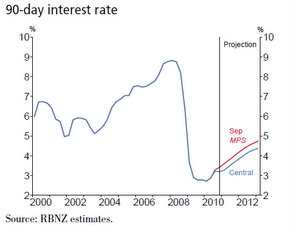
The Reserve Bank forecast in its quarterly Monetary Policy Statement on December 9 that it expected the 90 day bank bill rate to rise from around 3.2% then to around 4.3% by the end of next year.
The 90 day bill rate tends to follow the Official Cash Rate (OCR) set by the Reserve Bank relatively closely and is the basis for floating mortgage rates and shorter term deposit rates.
This forecast by the Reserve Bank isn't quite their own forecast of the OCR, but it's a pretty good proxy.
Outlook for mortgage rates
If the Reserve Bank turns out to be correct, floating mortgage rates would be around 7.1% by the end of 2012, up from around 6.1%% now. This is because floating mortgage rates have tended to be around 3% higher than the 90 day bill rate since the onset of the Global Financial Crisis (GFC) made it more expensive for New Zealand's banks to borrow offshore.
Fixed mortgage rates aren't quite as closely connected to the OCR and the 90 day bill rate. They tend to take their cue from the so-called "swaps rates," which are wholesale interest rates for longer periods such as 1, 2 or 3 years. See our interactive Swaps rate chart here.
Two year mortgage rates are currently around 6.6%, which is around 2.7% above the 3 year swap rate on 3.9%.
See all bank mortgage rates here.
Outlook for term deposit rates
Term deposit rates also tend to follow the OCR and the 90 day bill rates, depending how long the term deposit is for.
Currently most 12 month deposit rates are around 5.2%, which is about 2% above the 90 day bill rate and almost 2% above the 1 year swap rate. See our interactive Swaps rate chart here.
This is unusual situation when compared with term deposit rates on offer before the GFC hit in September 2008.
Back then term deposit rates were at or below the OCR. But since then, the banks, with some encouragement from the Reserve Bank, have been trying to raise local funding and reduce their reliance on 'hot' international money. This means term deposit rates have been around 2% above the OCR.
This means if the OCR rises around 1% over the next two years then 12 month term deposit rates would be around 6.2% by the end of 2012, assuming the pressure remains on the banks to keep raising funds locally.
See all 1 year and over term deposit rates here and see all term deposit rates up to 1 year here.
Outlook for the OCR
Most economists expect the Reserve Bank to start increasing the OCR from either its June 9 or September 15 announcements, but that any increases after that will much slower and lower than previous rises and slower/lower than what the Reserve Bank was expecting a year ago. Back the the Reserve Bank saw the 90 day bill rate headed for 6%.
Economists believe the Reserve Bank can afford to wait until June or September because the economy is growing only slowly and underlying inflationary pressures are weak. The Reserve Bank Governor Alan Bollard's job is to keep the underlying inflation rate between 1% and 3% over the medium term.
Under the terms of his Policy Targets Agreement with Finance Minister Bill English, Bollard is allowed to 'look through' one-off shocks to the inflation rate, include spikes in the oil price and tax increases such as the GST hike and the Emissions Trading Scheme increase. That means that even though the headline inflation rate could hit 5% later this year he could conceivably leave the OCR at 3% for most of this year.
The economy has rebounded from the 2008/2009 recession in a much less robust way than initially forecast because households are being much more cautious about taking on new debt and parts of the global economy (particularly Europe and America) have grown very slowly.
What the latest figures suggest
Every week or two fresh economic data emerges to give the Reserve Bank and economists a better view of whether inflationary pressures are building and whether the Reserve Bank will have to raise (or lower) the OCR sooner or later, and by more or less than previously expected.
The latest figures on retail spending in the period before Christmas and on confidence for businesses and consumers shows the economy remains subdued.
If anything, economists have been pushing out their forecasts for the next OCR hike from its current 3% to the September quarter from the June quarter.
Although there are signs that a recovery could start to build momentum later this year, particularly as spending on Christchurch Earthquake repairs and the Rugby World Cup kick in.
What to watch out for next
The Reserve Bank is due to issue its latest OCR decision and make a short comment on Thursday January 27 at 9 am.
Everyone expects it will leave the OCR on hold at 3% and suggest rate hikes later in the year, possibly well into the second half of 2011.
Reserve Bank Governor Alan Bollard is scheduled to make a speech on Friday January 28 at 1pm titled: "Looking into the crystal ball: A forecast and some risks for the year ahead."
The things to watch out for apart from those two events are the US Federal Reserve's statement on Thursday January 27.
More broadly, the major drivers for the global interest rate outlook in the short and long terms are the global economic growth outlook -- often driven by activity in America, Europe and China -- and financial market turmoil -- which has been driven by concerns in recent years about wobbly northern hemisphere banks and government debt.
But don't take it from me
Here's a selection of what bank economists have said most recently about the outlook for the economy, the OCR and interest rates more generally.
BNZ sees an OCR hike from June and a rise to 5% by the middle of 2012.
Here's the latest comments from BNZ economist Craig Ebert
For Thursday’s OCR review, the Reserve Bank will probably acknowledge the still-soft undercurrents in the recent NZ data, but maintain its broader view of a gradual pick-up ahead. So while emphasising a wait-and-see approach for the immediate term, maintaining its indications of further OCR hikes at some stage.
In doing so, we believe the Bank will be aiming to validate current market pricing for the Official Cash Rate, which is about fifty-fifty for a June hike, with two 25bp hikes not fully priced until late October.
We don’t have a major problem with this, at this stage of proceedings (and may well shift our next-rate-hike call to September, from June, depending on what the Bank intimates on Thursday). However, we also counsel there could well be some significant crunch points later this year, which market participants and clients would do well to think about, in these apparently “settled” times.
And that we see more potential for this to involve upside surprises in GDP and inflation than news of ongoing softness. while the Reserve Bank has little cause to ruffle any feathers at this Thursday’s OCR review, it should be conscious of something blowing up, or gushing up, before too much longer.
We believe the chances of a gush are greater than those of something blowing up. Until we get a clearer steer on these scenarios, however, we’ll default to our middle course of a decent enough GDP pick up this year, bringing niggling inflation issues and a 5.00% cash rate by mid next year.
ASB sees the first OCR hike from September and expects it to rise to 4.5% by September 2012
Here's the lastest comments from ASB Chief Economist Nick Tuffley:
We expect the RBNZ will want to be much more certain than usual that economic recovery is entrenched before it resumes lifting the OCR. These considerations suggest the tightening cycle will start even later, and that the initial phases are likely to be gradual.
We continue to expect the first few tightenings will be spaced out, occurring at the September, December 2011 and March 2012 Monetary Policy Statement releases.
Beyond that we expect the tightening cycle to pick up pace as inflation concerns elevate.
Our outlook for the OCR is 25bp increases at the September and December 2011 MPS releases, followed by consecutive increases at each meeting from March 2012 through to July 2012, with the OCR peaking at 4.5%.
Westpac sees the first OCR hike from September
Here's the latest comments from Westpac Chief Economist Brendan O'Donovan:
Given the shortfall in September quarter GDP, the RBNZ will probably go into next week's review with an OCR track in mind that is at least as soft as in the December MPS projections, which were most consistent with a September start.
Interest rate markets are pricing a July move, and a small majority of forecasters are still picking a hike by June; next week's media release may be aimed at nudging expectations towards a later move.
We currently expect a September hike, with the risks towards later rather than sooner. To us, the key line in the December statement was: "for now it seems prudent to keep the OCR low until the recovery becomes more robust and underlying inflationary pressures show more obvious signs of increasing."
The accumulation of evidence needed before a recovery could be termed "robust" suggests that the hurdle for a hike earlier than September is fairly high.
ANZ sees the first OCR hike from June
Here's the latest comments from ANZ Chief Economist Cameron Bagrie:
The RBNZ are expected to largely stick to their December 2010 MPS script, expressing a cautious view towards the economy. We still see the potential for a June restart to the tightening cycle, though signalling this from a policy perspective requires a clear turn in the data. This looks to be a post-March MPS story, with caution the order of the day until such consistency emerges.
We suspect the RBNZ will try to deliver a statement that provides them with the maximum degree of flexibility. They may mention growth concerns relating to the high NZD/USD, with the aim to weaken the NZD. The RBNZ remain concerned over the activity outlook. However, with an improving outlook for economic activity, high headline inflation and rising food prices, the medium-term inflation outlook could deteriorate fairly quickly.
We expect the next OCR hike will be in the June MPS, but with a gradual path of policy tightening thereafter.
HSBC sees a June quarter OCR hike and OCR at 3.75% by late 2011
Here's the latest comments from HSBC Australia and NZ's chief economist Paul Bloxham:
The RBNZ is itching to lift interest rates. Inflation targeting central banks typically want to get rates up ahead of tax changes, which boost CPI readings and have the potential to affect inflation expectations.
Weakness in demand in the second half of 2010 meant that the RBNZ’s plans of returning the OCR towards normal levels were thwarted. But as this year progresses demand will likely rise, given the factors above.
We believe the first signs of a pick up in demand will see the RBNZ hike – the Kiwi policy rate is more than 200bps below estimates of neutral. Expect the next move in Q2 2011.
JP Morgan sees the OCR being hiked from June, with the risk for a later hike
Here's the latest comments from JP Morgan economist Helen Kevans
There certainly is no urgency for RBNZ Governor Alan Bollard to further reduce the policy stimulus still in place. On top of still-sluggish growth (or lack there-of), benign underlying inflation means there is plenty of scope for low interest rates to be maintained. Indeed, in the absence of a rise in the goods and services tax (GST) on October 1, quarterly CPI would have printed at a mere 0.3%.
Price expectations also have eased following an earlier GST-related spike, as firms lack pricing power given the persistent weakness in domestic demand. Maintaining current, accommodative policy settings should help encourage the resumption of the recovery that was, until recently, underway.
With the New Zealand economy having contracted again in 3Q10, our view is that the RBNZ should hold off resuming its tightening cycle until at least June. The risks are skewed to a later-than-June move should growth fall short of our expectations.
We welcome your comments below. If you are not already registered, please register to comment
Remember we welcome robust, respectful and insightful debate. We don't welcome abusive or defamatory comments and will de-register those repeatedly making such comments. Our current comment policy is here.