
By Rodney Dickens
The latest Christchurch quakes will hopefully open Governor Bollard’s eyes.
Even before the horrific earthquakes in Christchurch today I had been telling clients of our pay-to-view reports that token OCR cuts were justified because economic growth was slowing much more than the RBNZ was predicting.
However, I didn’t expect the RBNZ to contemplate OCR cuts because it was focused particularly on the stimulus to economic growth in the second half of 2011 that was expected to be
driven by the massive reconstruction job in Canterbury. The events of today will hopefully encourage Governor Bollard to at least contemplate token OCR cuts.
The last Raving, titled “Lessons to be learnt from 2010”, showed how the housing market downturn was instrumental in driving economic growth below what the RBNZ and economic forecasters were predicting for 2010.
It is timely to revisit the core of my argument for why economic growth will continue to be weaker than the RBNZ is predicting.
This is because the latest quakes in Christchurch, which are expected to be followed by more aftershocks, mean the reconstruction phase in Canterbury will be delayed further.
I have no idea how much, but in a worst case scenario it could be for many months. This means the RBNZ should severely discount expectations that the reconstruction job in
Canterbury will deliver the economy from the current state of near-recession if not actual recession.
In March 2010 the RBNZ predicted that annual economic growth would be 4.4% for the 12 months ending in the 2011 March quarter (orange line, left chart below). In June 2010 the RBNZ revised this prediction down to 3.9% (green line). In September 2010 the RBNZ revised this prediction down to 2.5% (red line).
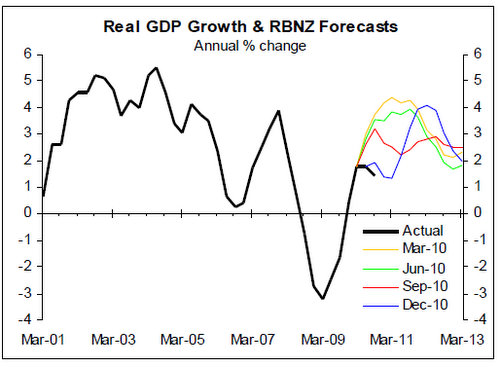
In December 2010 the RBNZ revised the prediction down to 1.4% (blue line), but then predicted a strong rebound in economic growth in 2011, driven to a significant extent by the reconstruction work in Canterbury (blue line). In response to revising down its predictions for near-term economic growth the RBNZ progressively scaled down talk of OCR hikes and delayed when it expected OCR hikes to begin.
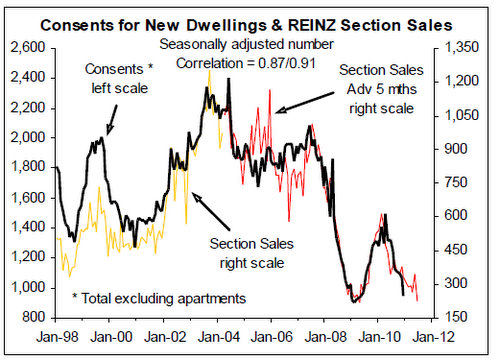
The primary reason economic growth slowed much more than the RBNZ expected in 2010 was because of a sharp fall in housing market activity and falling house prices. The black line in the right chart shows the sharp fall in the national number of consents for non-apartment new dwellings in 2010, with the number of consents in December back to around the recessionary lows experienced in 2008-09.
The most recent Raving discussed the negative economic multiplier effects the housing market downturn would set in motion, which will mean that economic activity in the 2011 March quarter will struggle to be higher than in the previous March quarter (i.e. growth will be significantly weaker than the 1.4% the RBNZ was predicting in December, even before the negative impact of the quakes in Christchurch today).
The number of section sales reported by REINZ has in recent years provided around a five month advance warning on what will happened to the number of consents for new dwellings. This is reflected in the right chart by the red section sales line being advanced or shifted to the right by five months. Based on the low numbers of section sales reported by REINZ for the last five months there is, if anything, a bit more downside risk for the national number of non-apartment consents over the next five months.
Our detailed analysis of the outlook for residential building is contained in the top-notch, monthly Building Barometer reports.
But in summary I expect net migration and hence population growth to remain below average in 2011, so if the reconstruction job in Canterbury is delayed significantly and there are no interest rate cuts, prospects for residential building in 2011 are grim, which will weigh heavily on economic growth. Hence I see a case for immediate, token OCR cuts.
* Rodney Dickens is the Managing Director Strategic Risk Analysis. See more detail here.
We welcome your comments below. If you are not already registered, please register to comment
Remember we welcome robust, respectful and insightful debate. We don't welcome abusive or defamatory comments and will de-register those repeatedly making such comments. Our current comment policy is here.