
Here's my blogroll for the week. And what a week it was. Thank God the capital gains tax announement is out of the way. I was having discussions in my dreams about the pros/cons of the policy.
Bit of a shorter one today as I officially have the day off. Having a lovely sunny time on a dairy farm in the Wairarapa. Have a good weekend all.
Just a thought before we start. In terms of election policies, this is likely to be the 'worst news' from a Labour policy. So get it out of the way now, and in subsequent policy releases, which will include a nice warm savings policy, announce things that people might like better. There's a Rugby World Cup coming anyway, so people are likely to forget about this for those six weeks.
From the right
1. What about Singapore and Hong Kong? Cactus Kate wonders why Labour didn't include these two countries on their lists of developed countries that did or didn't have capital gains taxes. She also wonders whether we really want to be following the example of some of the other OECD countries.
Problem is that currently many OECD countries are not the envy of the world
- USA
- UK
- Portugal
- Iceland
- Greece
- Ireland
- Spain
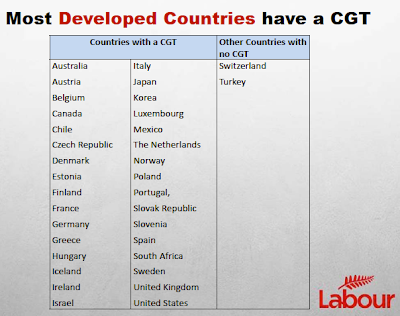
Most developed countries have a CGT according to Labour, and there are just two that do not.
And here are two more that do not:
Hong Kong
SingaporeI suggest Labour do not wish to talk about either jurisdiction. Neither is aspirational for Labour.
Low-tax systems of social order in the centre of the Universe for New Zealand's future exports into China and wider Asia.
He asks, do the rich really not pay their fair share of tax like Labour says? Now, Labour would hike the top tax rate to 39% for individual taxpayers earning over NZ$150,000, which is 2% of all taxpayers. Households with income over NZ$150,000 make up 9.7% of taxpaying households, according to the figures.
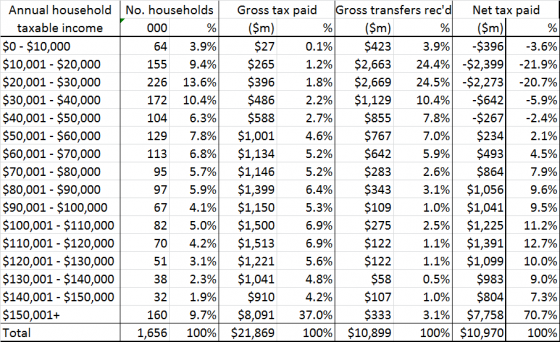
It tells us that overall households with income of $50,000 or below pay no net tax at all. Not only do they pay no net tax, they receive around $4.40 in benefits for every $1 of tax they pay. So they pay $1.7b in tax and receive $7.7b in welfare (and this excludes superannuation).
So that is 44% of households are net tax recipients. And Labour’s tax policy is geared towards having them become larger recipients. Yes Labour’s tax policy announced in January even includes an increase in the level of benefit payments for all beneficiaries.
Now let us look at the households with income of over $150,000. We don’t know if this is one person earning say $150,000 or two people earning say $80,000 each but we do know it includes be definition everyone earning at least $150,000. Household income is used as welfare payments are normally made on a household basis.
So 10% of households have an income of $150,000 or greater. And those 10% fund 71% of net taxation. And these are the households that Labour are saying are not doing their fair share and must pay more.
If we go slightly further down to households with an income of $120,000 or greater – which is 17% of households. Well those 17% of households are paying 97% of net taxation.
What makes me think that?
Apart from that lovely old song 'Is That All There Is?' there are three signs.
1) The package does not do what Labour needs to do. It does NOT demonstrate how they will pay for their election promises which now amount to over $12 billion.
2) It does NOT actually raise any serious revenue for at least ten years. It sounds good but delivers nothing. Goff already has conceded that he will borrow more than Bill English has borrowed and for longer.
3) This is a Cunliffe scheme, not a Goff scheme. Cunliffe is front footing the charge to sell this somewhat turgid deal and Cunliffe will be leader during the next parliamentary term.
Numbers 1 and 2 above simply reaffirm the conventional wisdom that Labour knows it cannot win in November. Therefore, all the planning is aimed at 2014. But what will they spring on the public when the real deal is released, some time in 2013?
My guess is that the CGT will morph into a transaction tax or stamp duty on THE FULL SALE PRICE of selected assets. It will not cost Labour's core 29% a penny but it will sock the middle income and wealthy every time they sell something significant. In fact it will be a damned easier sight to 'sell' than a CGT.
From the left
The rich guy who isn’t a selfish prick: Sellwyn Pellet made $8m on a business and didn’t have to pay a cent in tax and says “Clearly, if you go to Otara, Waitakere, or Whangarei, or any of these hard hit communities with low income it looks really bad [that they're paying tax and he isn't]. So I think it’s time that people like me stepped up to the plate and paid more tax”
Like the Morgans, Pellet is proof that you can be wealthy and not be a sociopath who is devoted to hoarding every cent they can get for themselves. In fact, that’s true of all the great entrepreneurs. It’s only those that are driven by pure greed that have a problem with paying their fair share.
Peter Dunne, who earns $209,100 as a Minister outside Cabinet, and who owns an investment property in Taupo, calls it a "desperate, ignorant attack on [his?] achievement". Meanwhile, 90% of us will be better off. 98% of us will pay less personal income tax, and the vast majority of us will never encounter these new taxes at all.
The numbers stack up. This is not a spendthrift plan to just keep on borrowing. Instead, its a cautious, sensible, fiscally conservative plan to balance the government's books by closing a serious tax loophole. And we don't have to sell anything to do it.
Overall my initial impressions of the CGT and associated policy is that it’s pretty good, but vulnerable to attack. There are the usual economic and ideological objections — full of loopholes, won’t raise enough revenue, raises rents, punishes people for getting ahead, will require more borrowing in the medium term, and so on — but for mine the best attack line rests on the coincidence of taxation rates between CGT and GST.
If I were running the National party’s attack campaign, I’d be leading with “Tax off fruit & veg, tax on houses”, or better yet, “tax on bricks & mortar”. Just another of many reasons why GST off fruit & veg is bad policy.
Media blogs
7. Will it win any votes? Andrea Vance at Stuff thinks no.
National says same old, same old. Labour will have to borrow more in the short term, especially if it wants to take GST off fresh fruit and veg from April 1.
Labour's own polling tells it the policy is unpopular. Convincing voters, in a matter of weeks, that it's theoretically a good plan would be no mean feat.
Getting people to trust Labour as the competent economic managers able to make this work for the long-term good of the nation, instead of squandering the revenue, is where the real hard work starts.
Goff says it's "game changing" - but it's a stretch to imagine it changing the outcome of the election.
Video
Here's the ACT Party's new media liason Lindsay Perigo interviewing Business Roundtable Roger Kerr.
We welcome your comments below. If you are not already registered, please register to comment
Remember we welcome robust, respectful and insightful debate. We don't welcome abusive or defamatory comments and will de-register those repeatedly making such comments. Our current comment policy is here.