
By Bernard Hickey
Someone has to say this loudly in public and it may as well be me.
Bank profitability in New Zealand is too high and we have to do something about it. It's time regulators and customers hammered their banks into producing fairer returns that help the economy grow healthier. That means lower mortgage rates and higher term deposit rates.
Don't take my word for it that the banks are too profitable.
The Reserve Bank Governor Alan Bollard said as much recently in a very under-reported speech to the New Zealand Shareholder's Association in Tauranga.
"It seems unlikely that the rates of return in banking enjoyed over the past decade can be sustained in the future,"
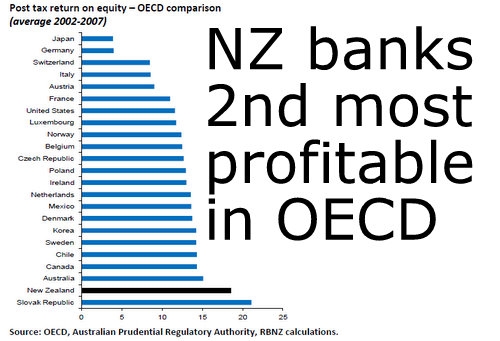
Bollard said in a 10 page speech packed full of detail showing how high bank profitability was and trying to explain why it was so high. After tax return on equity for the banks averaged around 18% from 2002 to 2007. See the full speech here.
This made them the second most profitable set of banks of a sample of 22 OECD countries conducted by the Reserve Bank. They were even more profitable than their parents in Australia, who third most profitable behind the Slovak Republic and New Zealand.
The last two weeks of profit reports from ANZ, ASB and Westpac underline just how profitable these banks are again, despite the weak growth in the economy and virtually no lending growth.
Banks have boosted their profits by quietly allowing their net interest profit margins to rise and they have seen their bad loan costs fall as the economy recovers. See more here from Gareth Vaughan on growing bank profitability and the need to haggle.
The latest bank leverage and return-on-capital data, by individual bank, is here »
Many may ask, how did the banks increase their net interest margins at the same time that mortgage rates were unchanged? Partly it has happened because banks pumped the effects of higher funding costs from the Lehman Bros crisis into their margins in 2008 and 2009 and haven't taken them back out as those wholesale market funding costs have fallen through late 2010 and early 2011. Floating mortgages are also more profitable for the banks and there has been a big shift to floating from fixed over the last year.
Close to 60% of all mortgages are now floating because they are nominally cheaper for borrowers, but more profitable for banks.
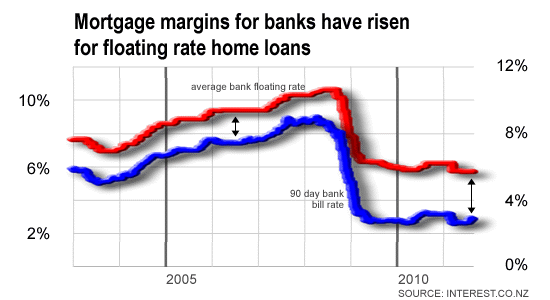
Back on July 1, 2005, the margin (what the bank pays to borrow versus what it charges to customers) on a floating home loan rate was 1.87% with the average bank floating rate at 8.90% versus the 90-day bank bill rate of 7.03%.
As of last Friday it was up almost 100 basis points to 2.85% with the average bank floating rate at 5.73% versus the 2.88% 90-day bank bill rate.
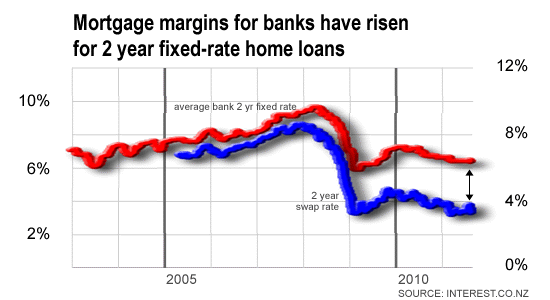
On July 1, 2005, when fixed mortgages were still all the rage, the average margin between the two-year swap rate and two-year fixed-term home loan rate was just 0.92% with the two-year swap rate 6.68% and the average bank two-year fixed rate 7.60%. As of last Friday it had more than trebled to 3.07% with the average two-year fixed rate at 6.41% versus the 3.34% swap rate.
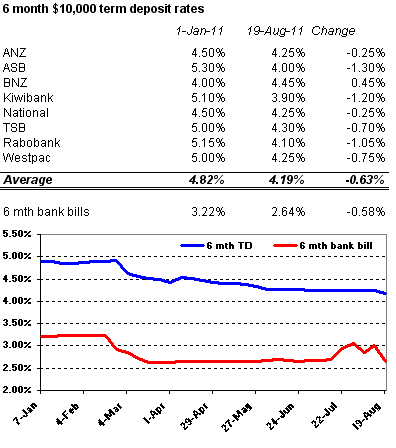
Also, term deposit rates have slowly fallen through the year as competition between the banks for such deposits has eased back.
The average bank one year term deposit rate has fallen 71 basis points this year. See more here on falling term deposit rates here from Gareth Vaughan.
All this meant the banks' net interest margins are rising. ASB reported this week its net interest margin rose 40 basis points to 2.08% this year.
Reserve Bank figures show the banks' combined net interest margin has risen to 2.23% by June from 1.87% in September 2009. New Zealand households need lower mortgage rates. The Reserve Bank can't cut the Official Cash Rate without fueling inflation.
It needs the banks to do that work by cutting mortgage rates. Savers need higher term deposit rates to help lift national savings.
It's time the banks played their part.
We welcome your comments below. If you are not already registered, please register to comment
Remember we welcome robust, respectful and insightful debate. We don't welcome abusive or defamatory comments and will de-register those repeatedly making such comments. Our current comment policy is here.