
By Gareth Vaughan
Times are tough right? The world's financial markets are spooked, the domestic economy isn't exactly roaring along, Christchurch has been hard hit by earthquakes, and most businesses are finding the going tough as regular Kiwis feel the pinch.
But not quite everyone is living on Struggle Street. The country's big banks are still making plenty of hay even though the sun rarely breaks through the clouds.
ASB last week posted record annual net profit after tax of NZ$568 million. That's even NZ$36 million, or 7%, more than the NZ$532 million it managed in 2007, the peak of the noughties' cheap credit bubble.
ASB notched record profits in a year when its core business, a bank's raison d'etre, which is lending money, actually went backwards. ASB's advances to customers before provisions contracted by NZ$657 million in the year to June 30 compared with the NZ$6.2 billion growth it achieved in the year to June 2007. Its total assets also fell, by NZ$507 million, compared with 2007's huge NZ$8.3 billion growth surge when banks were throwing money at customers.
So where did ASB get the profit growth from, which even when the NZ$209 million structured finance transaction tax settlement with IRD is taken out of last year's figures, rose 28% year-on-year?
Its impairment losses on loans tumbled 42% to NZ$72 million from NZ$125 million in 2010 (they were just NZ$18 million in 2007), and its net interest margin rose by 0.4% to 2.08% as customers switching from fixed-term mortgages to higher margin floating, or variable, rate mortgages, pushed net interest income up 22% to NZ$1.107 billion.
Over the year ASB's bottom line benefited from a big switch with 59% of all its home loans on floating rates at June 30, up from 37% a year earlier. This is in line with a trend across the industry, with Reserve Bank figures putting, as of June, NZ$94.637 billion, or 56%, of the country's total NZ$169.118 billion worth of home loans on floating rates, up from 36% a year earlier.
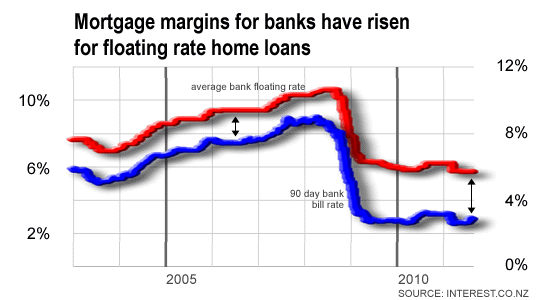
Banks do better out of floating, or variable, mortgages because the margin between the variable rate and short end of the yield curve, such as three month bank bills, is higher than the margin between swap rates and fixed rate mortgages.
ASB not alone
The tumbling impairment losses and the fixed to floating switch are also benefiting the other big Australian owned banks - ANZ, BNZ and Westpac.
ANZ's most recent results, for the March quarter, showed profit up NZ$85 million, or 64%, to NZ$218 million. Westpac grew profit after tax by NZ$22 million, or 30%, in the three months to March to NZ$96 million and CEO George Frazis indicated earlier this month things had continued along a similar path since.
And BNZ's March quarter profit rose NZ$39 million, or 59%, to NZ$105 million once a NZ$78 million tax credit related to over compensating for the structured finance transaction dispute settlement is stripped out last year's March quarter. The truck rolls on to, with parent National Australia Bank saying last week BNZ's June quarter delivered sound earnings and revenue growth.
And it's not as if ANZ, BNZ or Westpac are getting the strong lending growth ASB is missing out on. The Reserve Bank's sector credit data shows agriculture debt as of June stood at NZ$47.251 billion, down 0.4% year-on-year, business debt at NZ$72.348 billion, up 0.7%, and total household claims, which includes housing and consumer loans, up 1.1% to NZ$184.103 billion. That is anemic growth at best.
In the boom years from 2002-2008 credit growth was much, much stronger, peaking at 24.9% for agricultural debt growth, 17.4% for housing debt, 21.7% for businesses, and 13.7% for consumer loans.
The third profit arm
Banking's a pretty simple business really. They borrow money at one rate and on-lend it at a higher rate. And this is another area where their profits are benefiting. The margins on their now NZ$172.367 billion worth of home loans have widened.
Back on July 1, 2005, the margin (what the bank pays to borrow versus what it charges to customers) on a floating home loan rate was 1.87% with the average bank floating rate at 8.90% versus the 90-day bank bill rate of 7.03%. As of Friday it was up almost 100 basis points to 2.85% with the average bank floating rate at 5.73% versus the 2.88% 90-day bank bill rate.
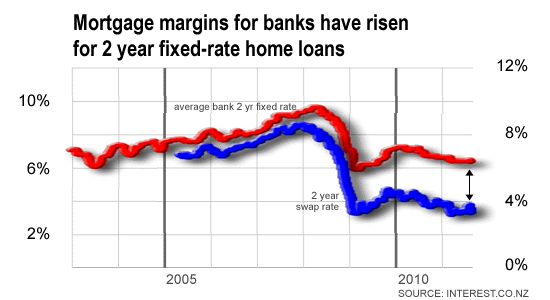
On July 1, 2005, when fixed mortgages were still all the rage, the average margin between the two-year swap rate and two-year fixed-term home loan rate was just 0.92% with the two-year swap rate 6.68% and the average bank two-year fixed rate 7.60%. As of Friday it had more than trebled to 3.07% with the average two-year fixed rate at 6.41% versus the 3.34% swap rate.
Nice work if you can get it.
Over the same time period savers have seen their term deposit rates slashed with the Official Cash Rate (OCR) down 4.25%. On July 1, 2005 the average 90-day term deposit rate was 5.85% and six month rate was 6.78% at a time when the OCR was 6.75%. As of Friday the average 90-day term deposit rate was 3.48% and six-month rate 4.24% versus the 2.5% OCR.
Strong banks better than weak banks
Now let's be clear here. It's good for customers and the whole economy that we have strong, profitable banks rather than weak or even collapsing ones. Our banks, and we, are lucky they didn't completely lose the plot and load up on Consolidated Debt Obligations, the sliced up sub-prime mortgage junk that was all the rage in the US and served as the catalyst for the global credit crunch. And nor did they push the self destruct button on property development lending like Ireland's banks, leaving that to the now defunct finance companies such as Bridgecorp, Hanover and Strategic.
With uncertainty again sweeping world financial markets and concerns over what that might mean for off-short fund raising where they source about 36% of their money, combined, they're sitting on NZ$48.5 billion worth of liquid assets, the likes of cash, treasury bills, government securities, residential mortgage backed securities, bank bonds, and call deposits with the Reserve Bank. The idea is that this stock pile comprises either cash, or stuff that can quickly be converted into cash, should the banks need money in a hurry.
Time to make a stand
But although it's good that our banks are strong, is it right their margins on home loans should be so much higher now than six years ago? In an election year in Australia, this widening of home loan lending margins would be an election issue. Here it's time more borrowers started to question the rates their banks are offering. Next time you're talking mortgage rates with your banker, pretend you're shopping somewhere in the third world and haggle over price. You never know, it could be your lucky day.
Meanwhile the man who heads up the organisation tasked with regulating our banks, Reserve Bank Governor Alan Bollard, has pointed out just how profitable and entrenched in the market the big four, systemically important banks as he puts it, are.
In a speech to the Shareholders' Association's annual meeting this month Bollard warned bank shareholders not to expect profits in the future at the same levels they've enjoyed over the past decade due to post global financial crisis (GFC) regulatory changes and ongoing deleveraging by customers. Bollard said from 2002 to 2007 New Zealand's banking system produced a return on equity (RoE) second at about 18%, behind only the Slovak Republic, out of a sample of 22 OECD countries.
He noted the four Australian owned banks dominate the New Zealand financial system to an extent seen in few other economies, accounting for nearly 90% of the banking sector, or just over 70% of the financial system as a whole.
His comments come after the central bank said in its Financial Stability Report back in May the GFC may have entrenched the dominant position of the big four and it would monitor lending markets for any signs this was affecting the availability or pricing of loans. So Bollard is watching bank profitability, but whether he actually does anything about it remains to be seen.
Great return on equity and dividend stream
The big banks certainly produce profits the envy of most, if not all, our industries. ASB's June year RoE bounced back to 17.2% from 15.3% the previous year. It was 21.3% in 2007 and peaked at 25.4% in 2003. And the banks want to see that RoE continue rising, with ASB CEO Barbara Chapman saying the 17.2% can be improved on.
In the 10 years since ASB's 2001-2002 financial year the bank has paid total dividends of NZ$3.188 billion, or an average of NZ$318.8 million a year. Parent Commonwealth Bank of Australia, which has shareholder's equity in ASB as a percentage of ASB's total assets of 6.3%, should be happy. Very happy.
That said, Bollard's message of lower profits in the new deleveraging, uncertain and more regulated bank world may prove prophetic. The fixed to floating mortgage switch will run its course and loan impairment costs can't fall forever. The banks are keen to start growing their lending books again. But before you borrow, make sure you take a close look at their lending margins. Or you could just buy some shares in their Aussie parents.
This article was first published in our email for paid subscribers this morning. See here for more details and to subscribe.
We welcome your comments below. If you are not already registered, please register to comment
Remember we welcome robust, respectful and insightful debate. We don't welcome abusive or defamatory comments and will de-register those repeatedly making such comments. Our current comment policy is here.