

Here's my Top 10 links from around the Internet at 11:30 am today in association with NZ Mint. Bernard Hickey is on vacation and won't be back until early May.
I welcome your additions in the comments below or via email to david.chaston@interest.co.nz.
See all previous Top 10s here.
1. A payments revolution is about to arrive
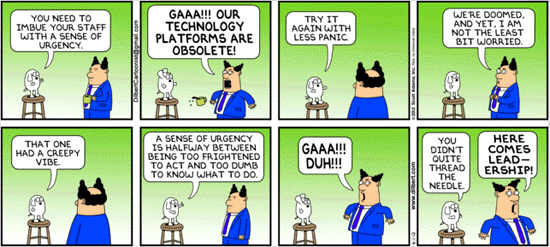
The next big technology revolution will be in how we pay for stuff.
The big global payments networks of Mastercard and Visa are rolling out their versions of 'pay wave' where you only need to place your smartphone near a merchant's check-out or billing device to pay their bill. But the telecoms industry really, really wants to be part of this revolution other than just making the very brief technical connection.
Here in New Zealand, the three big telecoms providers have announced a joint effort to offer a service in conjunction with Paymark, itself owned by the four major banks.
This technology will roll out fast now. Get ready if you are a merchant; understand the risks and benefits if you are a consumer (the risks may be less than you think).
“Over the past decade, our mobile phone has swallowed our newspaper, our map and our camera to become an essential all-in- one device,” Eric Hertz, chief executive officer at Auckland- based 2degrees, said in the statement. “The logical next step is to make it even more convenient by having it swallow our wallet.”
The service, which plans to use near-field communications technology, will allow customers to make payments by holding an enabled phone close to a special terminal in stores and on trains or buses, according to the statement. Software inside the phone will send transactions over the banking network.
2. Reshoring
The growth in US manufacturing jobs in the past year has actually been impressive and surprising. It is surprising in that you don't assume a high-wage country can strengthen is manufacturing employment given the vast alternatives available in China and India. But there appears to be a trend to bring manufacturing jobs back, a movement that is big enough to show up in the data. And one company doing it is GE.
Jeff Immelt, General Electric’s chief executive, says the decision to put US$1 bln into the group’s domestic appliances business is “as risky an investment as we have ever made”.
He may well be right. The decision to bring back to Louisville, Kentucky, hundreds of jobs that had been outsourced to Mexico and China is emblematic of his strategy for GE. If it fails, it will be hung around his neck forever.
“Reshoring” production is a strategy being tried by many American manufacturers, as rapid wage growth in emerging economies and sluggish pay in the US erodes the labour cost advantage of offshore plants.
3. Making stuff
Manufacturers are surveyed regularly for the PMI confidence measures. Over the past few days we have heard of weakness in Europe, and surprising strength in both the US and China. Even New Zealand is recording positive attitudes from its manufacturers. But for a wider perspective, check out this graphic covering many more of the world's economies.
4. Buying houses by the thousands
When your housing market is in the mire, when hundreds of thousands of homeowners are 'under-water', how can you make a buck from property in this new environment? Maybe one answer is to 'buy everything'. It's not a strategy for the feint-hearted, but it is one some Americans have adopted. By taking big risks, they are hoping for big returns.
At least 20 times a day, Alan Hladik walks into a fixer-upper and tries to figure out if it is worth buying.
As an inspector for Waypoint Real Estate Group, Mr. Hladik takes about 20 minutes to walk through each home, noting worn kitchen cabinets or missing roof tiles. The blistering pace is necessary to keep up with Waypoint’s appetite: the company, which has bought about 1,200 homes since 2008 — and is now buying five to seven a day — is an early entrant in a business that some deep-pocketed investors are betting is poised to explode.
With home prices down more than a third from their peak and the market swamped with foreclosures, large investors are salivating at the opportunity to buy perhaps thousands of homes at deep discounts and fill them with tenants.
5. 'Peak oil' vs 'Human ingenuity'
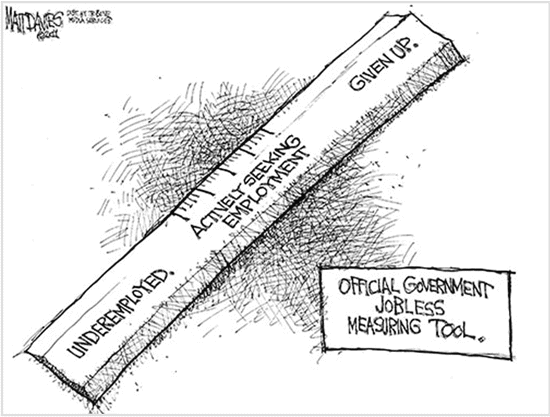
I'm linking to this just as a curiosity. Honest.
6. The $1.3 billion bond deal haunting Goldman
For the second time in less than two years Goldman Sachs is likely to be charged by the SEC with securities fraud related to a mortgage deal.
But what makes FHLT 2006-E potentially fraudulent, and why the SEC is likely to sue Goldman, is that it appears the firm knew that even compared to the incredibly low standards it stated it was using to select loans for the deal, the mortgages Goldman actually sold to investors were a good deal worse.
For instance, the deal's prospectus that Goldman assembled and distributed to investors, and filed with the SEC, said that there was only one home loan out of 5,012 in the Fremont trust, or 0.01%, in which a borrower had taken out more than their house was worth. But an audit conducted for the FHFA suit found that at least 1,179 loans in FHLT 2006-E, or 23.5%, were already underwater at the time Goldman was pitching the deal to investors.
The suit alleges that Goldman also hid the number of loans in the Fremont trust that were made to real estate investors, which are generally considered riskier than a loan to someone who intends to live in a house themselves. Goldman's pitch claimed that just under 14% of the loans in FHLT 2006-E were made to investors. In fact, that number was over 24%.
7. French fantasy
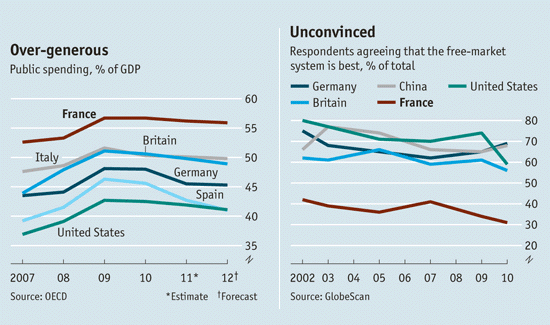
Even by the standards of Europe, France has an unsustainable social safety net, and is facing a crisis simply because the french have refused to gradually adjust to the real world. You can take minor pain gradually, or massive pain by refusing to acknowledge that change is necessary. A cautionary tale for us.
This erosion of French competitiveness raises hard questions about the underlying social compact. Frenchmen cherish the notion that everyone has an equal right to decent services in good times and a generous safety net in bad. But what sort of level of support, in sickness, joblessness, infancy or old age, can France really afford to offer its citizens? How can the country justify its massive public administration—a millefeuille of communes, departments, regions and the central state—which employs 90 civil servants per 1,000 population, compared with 50 in Germany? How can France lighten the tax burden, including payroll social charges, so as to encourage entrepreneurship and job creation?
Put simply, France is about to face the tough choices that Gerhard Schröder, Germany’s former chancellor, confronted in the early 2000s or that Sweden did in the mid-1990s, when its own unsustainable social system collapsed.
8. Unfunded pension schemes a growing US problem
US corporate pension funds recorded their most disastrous deficits ever in 2011, with the gap between assets and liabilities for the 100 biggest portfolios hitting a record US$326.8 bln. Companies are running hard pumping in extra cash but can't seem to keep up with the fast-rising liabilities. Something has to give. Some retirees may not get everything they expected, especially once they are well into their golden years and at the time they can least do anything about it.
The record 9.3% growth in liabilities versus 2010 overwhelmed the 5.9% investment return for the year for the 100 biggest corporate pension funds, which had expected a 7.8% average return for 2011, said Milliman.
“Given the record-low discount rates, we estimate that 2012 pension expense will increase US$16bn, resulting in a record US$54bn charge to corporate earnings.”
The deficit was also in spite of the companies pumping US$55.1bn of corporate cash into the pension funds in efforts to reduce the shortfall. There’s no sign of a let-up, given the Fed’s intention of keeping rates low.
9. 'The economy is complicated. Let us walk you through it'
If you have the time, this interactive is worth working through. You will get a very good rounded perspective of how the world's biggest economy has suffered through the GFC.
10. The last laugh
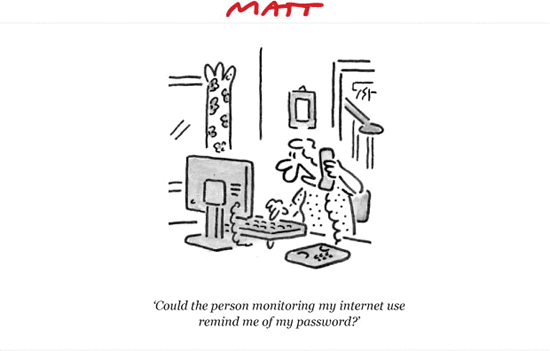
Help wanted. I am struggling to find the same type of really good video humour that Bernard linked to. Please email me with suggestions ...
We welcome your comments below. If you are not already registered, please register to comment
Remember we welcome robust, respectful and insightful debate. We don't welcome abusive or defamatory comments and will de-register those repeatedly making such comments. Our current comment policy is here.