
By Bernard Hickey
Nihao. Huan ying, huan ying!
This is a phrase every New Zealander and certainly every New Zealand tourism business should commit to memory.
It is Chinese for hello and a very sincere welcome.
It's also a phrase that should be built into their business plans. Unfortunately, for most tourism businesses, it's not and it's something we need to do quickly.
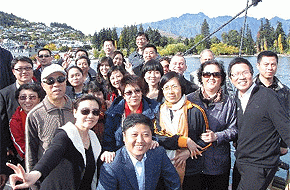
The growth in Chinese tourism to New Zealand in the last year is stunning, thanks largely to the beginning of daily flights by China Southern from Guangzhou in the south of China.
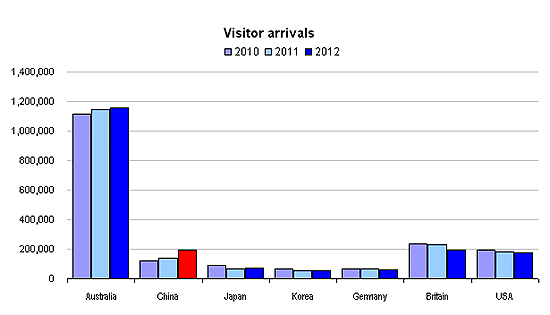
Short term visitor arrivals have risen 39.2% to 191,488 in the year to the end of October.
That made China the third largest contributor of tourists to New Zealand after Australia and Britain, and ahead of America.
Chinese tourism is forecast by NZIER to surpass British tourism next year and more than double by 2018.
The trouble for New Zealand is Chinese tourists currently spend much less per night and spend fewer nights here than British, German or American tourists. About two thirds travel in tour groups run by Chinese companies that visit Chinese owned stores.
NZIER also forecast the number of British, German and American tourists to fall over the next 6 years because of their weak economies and the strong New Zealand dollar.
Total spending from these traditional markets is forecast to fall from around NZ$2 billion a year in 2005 to almost NZ$1 billion by 2018. Chinese spending, meanwhile, is expected to rise to NZ$680 million from NZ$220 million over the same period.
That's great, but it obviously doesn't make up for the fall in tourism from traditional markets.
New Zealand needs to retool its tourism sector over the next decade in the same way it retooled its farming industry over the 1970s, 1980s and 1990s after Britain joined the European Union.
The work has started, but the sense of urgency or national awareness is nowhere near the same level that New Zealand had in the early 1970s as Britain joined the EU.
Auckland Airport and the Tourism Industry Association put out an excellent paper in late September about the need for a change in thinking on the China market. Just last week Auckland Airport and Tourism New Zealand signed a memorandum of understanding with China Southern to improve links. It was signed during a special trip to New Zealand by China Southern's executive team and 250 Chinese travel agents on one of its Airbus 380s.
New Zealand's tourism sector needs to retool the way it operates to embrace Chinese visitors and provide the sort of high value, high excitement, luxury travel experiences that are on offer to British, American and German tourists.
Obtaining visas for independent travellers from China will have to be easier.
Signs and public announcements will have to be in Chinese as well as English.
Campervans will need to include instructions in Chinese.
Staff in restaurants, duty free stores and hotels will have to learn Chinese.
Bungee operators will have to explain in Chinese how to jump.
I've said it before, but why isn't New Zealand making Chinese its third language and teaching it much more widely in schools? We now have a major base of Chinese speakers in Auckland to help us do that.
Where's the National strategy to retool our economy? A lot more needs to be done.
Auckland Airport got the ball rolling this week. It started including Chinese in its public announcements to departing traveling travelers about the need to fill out in their departure forms and pack their liquids, gels and aerosols in a separate bag.
Perhaps, collectively, New Zealand needs to learn how to say: "Nihao Huanying huanying" as well as "Haere Ra and thanks for the dough."
-----------------------------------------------------------------
This article first appeared in the Herald on Sunday. It is used here with permission.
We welcome your comments below. If you are not already registered, please register to comment
Remember we welcome robust, respectful and insightful debate. We don't welcome abusive or defamatory comments and will de-register those repeatedly making such comments. Our current comment policy is here.