

Welcome to our first story in 2013.
Here's my Top 10 links from around the Internet at 10:00 am today in association with NZ Mint.
Bernard is on his summer break and will be back on January 22, 2013, from Wellington.
As always, we welcome your additions in the comments below or via email to david.chaston@interest.co.nz.
See all previous Top 10s here.
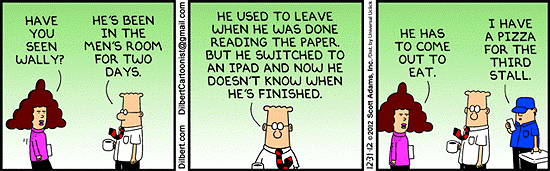
1. Still on the brink
Joseph Stiglitz thinks the key lesson from 2012 is that politics and economics are inseparable.
Markets on their own may be neither efficient nor stable.
But the politics of deregulation gave scope to unprecedented excesses that led to asset bubbles and the rolling crisis that has followed their collapse, he says.
The year 2012 turned out to be as bad as I thought. The two main surprises were the slowdown in emerging markets, which was slightly sharper and more widespread than anticipated, and Europe's embrace of some truly remarkable reforms though still far short of what is needed. Looking to 2013, the biggest risks are in the US and Europe. By contrast, China has the instruments, resources, incentives, and knowledge to avoid an economic hard landing and, unlike Western countries, lacks any significant constituency wedded to lethal ideas like "expansionary austerity."
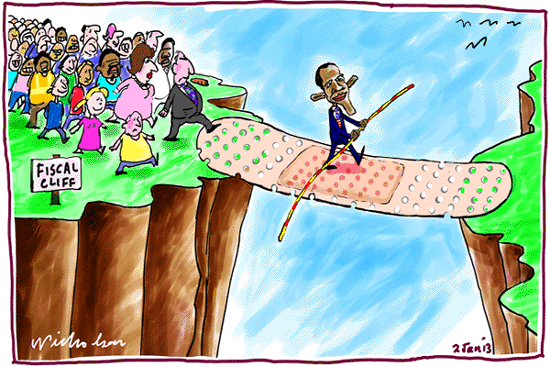
2. Mobile wealth
It is hard to obey your new country's rules when you are breaking them in your home country. Cash isn't only 'pouring in' to Auckland in Chinese travellers suitcases; it is reportedly flooding into Canada and the US in a tidal wave ahead of an impending anti-corruption drive. New data out in Canada is revealing. The WSJ reports:
Officials at Canada's two busiest airports—Toronto and Vancouver—seized around 12.9 million Canadian dollars ($13.0 million) in undeclared cash from Chinese nationals from April 2011 through early June 2012, according to documents provided to The Wall Street Journal by the Canada Border Services Agency.
The money, most of it returned to the owners, represented 59% of all cash seized at the airports in the period, according to the data. In the U.S., Chinese citizens are the top source of airport cash seizures after Americans. In June, a Chinese man touched down at Vancouver airport with around $177,500 in cash - mostly in U.S. and Canadian hundred-dollar bills, stuffed in his wallet, pockets and hidden under the lining of his suit case. Clarence Lo, the Canadian Border Service officer who found the cash, said the man told him he was bringing the money in to buy a house or a car. He left the airport with his cash, minus a fine for concealing and not declaring the money. "He wasn't very happy," said Mr. Lo.
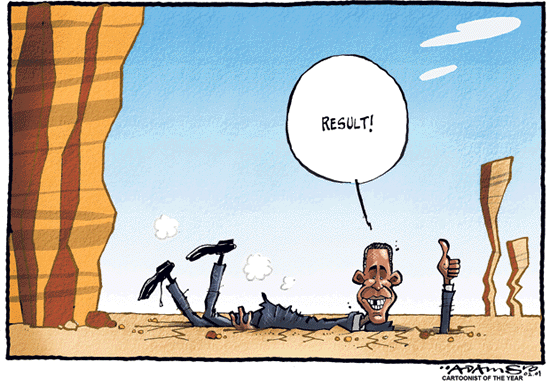
3. A free pass
A few extra kgs won't kill you, apparently. In a finding that could undermine many New Year's resolutions, a new US government study shows that people who are overweight are less likely to die in any given period than people of normal weight. Even those who are moderately obese don't have a higher-than-normal risk of dying. More from the WSJ.
Being substantially obese, based on measure called body mass index, or BMI, of 35 and higher, does raise the risk of death by 29%, researchers found. But people with a BMI of 25 to 30 - who are considered overweight and make up more than 30% of the US population - have a 6% lower risk of death than people whose BMI is in the normal range of 18.5 to 25, according to the study, being published Wednesday in the Journal of the American Medical Association. People who had a BMI of 30 to 35 - considered the first stage of obesity - had a 5% lower risk of dying, but those figures weren't considered statistically significant.
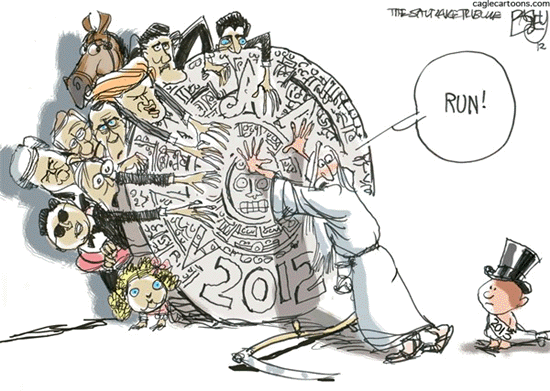
4. Today's raw market data ...
A quick holiday update:
| as at 11:10am | Today 9:00 am |
Dec 31 | Four weeks ago |
One year ago |
| NZ$1 = US$ | 0.8302 | 0.8203 | 0.8289 | 0.7771 |
| NZ$1 = AU$ | 0.7920 | 0.7910 | 0.7929 | 0.7624 |
| TWI | 74.52 | 73.59 | 74.00 | 69.36 |
| Gold, US$/oz | 1,688 | 1,694 | 1,615 | 1,613 |
| Dow | 13,320 | 12,928 | 13,066 | 12,408 |
| Copper, US$/tonne | 7,915 | 7,872 | 8,021 | 7,661 |
| Volatility Index | 15.31 |
18.02 |
16.58 | 22.97 |
5. deja vu all over again, now in Africa
Not only do the Chinese build whole cities which become ghost towns, they have built one in Angola as well. (Ireland and Spain have them too.) This Angolan one has been buil by CITIC and was financed by a Chinese credit line - which Angola is repaying with oil - so it has technically been paid for. HT Brendan W. more here »

6. How US federal agents busted HSBC
Here is a Reuters report of how US authorities nailed HSBC, after tracking a major Columbian drug-money laundering operation. Real-life crime story drama.
When several Colombian men were indicted in January 2010 on money-laundering charges, the case in Brooklyn federal court drew little attention. It looked like a bust of another nexus of drug traffickers and money launderers, with mainly small-time operatives paying the price for their crimes. One of the men was Julio Chaparro, a 48-year-old father of four who owned three factories that made children's clothing in Colombia.
But to U.S. authorities the case was anything but ordinary. Chaparro, prosecutors alleged, helped run a money-laundering ring for drug traffickers that took advantage of lax controls at UK-based international banking group HSBC Holdings Plc. It was one of the most important leads for U.S. investigators pursuing a case against the bank that eventually led to a $1.9 billion settlement on December 11. Chaparro was "basically putting the orchestra together" and investigators saw "him as a major player in terms of cleaning a lot of money," said James Hayes, special agent in charge of Homeland Security Investigations at U.S. Immigration and Customs Enforcement in New York.
The Colombian's lawyer, Ephraim Savitt, said Chaparro was a middleman in the operation, but disputed the extent of his client's role, saying he was the "page turner of sheet music for the conductor." Chaparro, who was arrested in Colombia in 2010 and extradited to the United States in 2011, pleaded guilty to a money-laundering conspiracy count in May and is awaiting sentencing in 2013.

7. Bond issuance by banks hits a 10 year low
Bond issuance by international banks is at its lowest level in a decade, underlining the impact that new Basel III regulations and the eurozone debt crisis are having on the way financial institutions operate. Going against the international trend, local banks loaded up on covered bonds in 2012. And, our banks are well positioned ahead of Basel III. More from the FT:
The main drag on issuance came from Europe, where banks raised just $639bn in debt capital markets, the lowest in 10 years. By contrast, banks in the US issued more debt than last year and Asian banks raised $307bn, the highest annual issuance since Dealogic started tracking the data in 1995. Northern European banks have maintained access to public debt markets through much of the year but, with worries over the future of the eurozone influencing investor demand, many lenders hit their 2012 funding needs at the start of the year.
8. The GM reactionaries
Has New Zealand become a backwater of GM reactionaires? Henry Miller and Grahan Brookes think so. They point out that 17 million farmers now grow crops on 1 billion hectares, and the consumption in North America alone of more than two trillion servings of foods that contain GM ingredients – not a single case of injury to a person or disruption of an ecosystem has been documented.
People everywhere are increasingly vulnerable to the use of what Nobel Prize-winning chemist Irving Langmuir dubbed “pathological science” – the “science of things that aren’t so” – to justify government regulation or other policies. It is a specialty of self-styled public-interest groups, whose agenda is often not to protect public health or the environment, but rather to oppose the research, products, or technology that they happen to dislike.
For example, modern techniques of genetic engineering – also known as biotechnology, recombinant DNA technology, or genetic modification (GM) – provide the tools to make old plants do spectacular new things. Yet these tools are relentlessly misrepresented to the public.
More than 17 million farmers in roughly three dozen countries worldwide are using GM crop varieties to produce higher yields with fewer inputs and lower environmental impact. Most of these new varieties are designed to resist crop-ravaging pests and diseases, so that farmers can adopt environmentally friendlier no-till practices and use more benign herbicides. Critics of GM products insist that they are untested, unsafe, unregulated, unnecessary, and unwanted. But the facts show otherwise.
9. A 'Great Rotation'?
Market strategists are wondering whether the next year will be the time of a "Great Rotation", a significant acceleration in flows out of safe, recession-proof assets such as government bonds and into equities. After all, "Everyone is shaking the bushes pretty hard to find yield, but there’s not much left." More from the FT:
"Rotation by stealth" is under way already, says John Bilton, European investment strategist at BofA Merrill Lynch, who points to investors returning to previously unloved assets such as eurozone bank stocks. The "great rotation" will be a "major theme" in 2013, he says. "Equities will become more attractive because they are geared to growth and offer returns that investors simply cannot get from their bond portfolios."
The snag with "great rotation" forecasts, however, is that evidence of large-scale conviction, investing in equities is not overwhelming. Despite bullish expectations about economic growth, investors have this month held equity allocations at November’s levels, according to a survey of almost 200 global fund managers by BofA Merrill Lynch. "Although they are becoming more positive about the world, they have not yet put their money to work," admits Mr Bilton.
10. Today's quote
"To be clever enough to get all the money, one must be stupid enough to want it." G. K. Chesterson
No chart with that title exists.
We welcome your comments below. If you are not already registered, please register to comment
Remember we welcome robust, respectful and insightful debate. We don't welcome abusive or defamatory comments and will de-register those repeatedly making such comments. Our current comment policy is here.