

Here's my Top 10 links from around the Internet at 10:00 am today in association with NZ Mint.
Bernard is back tomorrow with his version.
As always, we welcome your additions in the comments below or via email to bernard.hickey@interest.co.nz.
See all previous Top 10s here.

1. 'The best way to save banking is to kill it'
Banking may seem stable in our part of the world, but in the northern hemisphere folks think it is broken - even respectable and powerful people.
We track the leverage of the NZ retail banking system here ». While it is falling very slowly, it is still far too high to be safe. I reckon we would all be better off at 7 or 8 times, rather than the 12+ times leverage our banks are now operate with.
Here is Matthew Klein on Bloomberg:
One way to make [banks] more robust is to increase equity capital requirements. This is the remedy advocated by Bloomberg View's editors. The banks call it radical but it's really pretty moderate, because it leaves the basic structure of banking alone. The same is true of calls to make the banks smaller. Smaller banks are still banks.
A genuinely radical approach would be to kill banking as we know it. Rip all banks, large or small, in two - separate deposit-taking from credit-creation. Back the deposits one-for-one with reserves at the central bank. Then fund loans not with deposits or other money-like liabilities but by tapping investors who understand they've put their savings at risk.
The strangeness of the idea shouldn't rule it out, because as Tobin said the current marriage between deposit-taking and credit creation was itself a historical accident - and it's a union that hasn't worked out so well. Radical-seeming alternatives should be part of the conversation.

2. Chasing yield - trouble on a new front
It has an all-too-familiar ring. Investors, in search of better rates, rush to risky, high-yield bonds, raising worries that the market is overheated. But the concerns - which have already been voiced about the $120 billion of European and American junk bonds issued this year - are now being applied to the fledgling Chinese market.
While American and European companies have been selling high-yield debt for decades, Chinese businesses only recently started to tap into the junk bond market in earnest. The NY Times reports:
Chinese high-yield bonds have many of the same characteristics - and risks - as American debt. They tend to be sold by companies looking to finance ventures in new or untested areas or businesses that compete in industries where earnings are subject to volatile swings.
But the Chinese market has its own set of potential problems, and some analysts worry that investors aren’t being properly compensated for the added layer of risks.
For one, the bulk of the high-yield bonds in Asia this year — roughly half — come from Chinese real estate companies. The fear is that the housing market, which has been booming, is a bubble that will eventually burst.

3. Consuming their future
The cost of environmental degradation in China in 2010 was about $230 billion, or 3.5 percent of the nation’s gross domestic product - three times that in 2004, in local currency terms, an official Chinese news report said this week. The NYTimes assesses the size of the handicap China is building:
There is consensus now that China’s decades of double-digit economic growth exacted an enormous environmental cost. But growth remains the priority; the Communist Party’s legitimacy is based largely on rapidly expanding the economy, and China officially estimates that its G.D.P., which was $8.3 trillion in 2012, will grow at a rate of 7.5 percent this year and at an average of 7 percent in the five-year plan that runs to 2015. A Deutsche Bank report released last month said the current growth policies would lead to a continuing steep decline of the environment for the next decade, especially given the expected coal consumption and boom in automobile sales.
Mr. Thornton, the economist, said the recent official estimates of the environmental cost “marries with our on-the-ground feeling that a lot of short-term positives over the past few years are turning into long-term negatives.”
4. Today's raw market data ...
A quick new week update:
| as at 11:10am |
Today 9:00 am |
Friday |
Four weeks ago |
One year ago |
| NZ$1 = US$ | 0.8359 | 0.8365 | 0.8230 | 0.8176 |
| NZ$1 = AU$ | 0.8033 | 0.8038 | 0.8070 | 0.7905 |
| TWI | 76.93 | 76.96 | 75.71 | 72.89 |
| Gold, US$/oz | 1,598 | 1,603 | 1,574 | 1,678 |
| Dow | 14,577 | 14,577 | 14,138 | 13,203 |
| Copper, US$/tonne | 7,583 | 7,570 | 7,751 | 8,480 |
| Volatility Index | 12.70 | 13.15 | 14.01 | 15.64 |
5. Don't worry about future energy
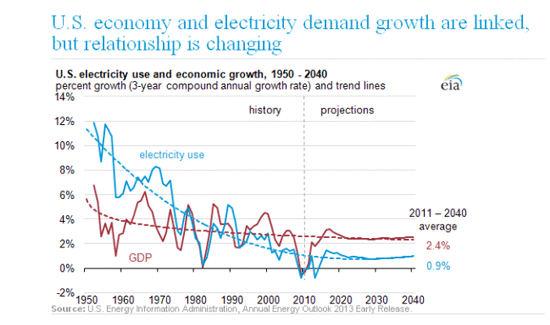
We may soon have an abundance of electricity, more supply than we know what to do with (thank you Rio Tinto?).
The changing nature of the products we buy is changing the amount of energy we need to run our modern economies - and the shift is startling. 'Heavy' manufacturing (or actually any manufacturing) is now much less important to economies than it once was.
Perhaps the most under reported story of the decade may be financial markets having totally missed the point at which oil actually became a growing economic irrelevance rather than a burden.
Basically, output is growing much faster that energy use. And that is not only a good thing, it is a game-changing thing.
In the next few years, oil exports are likely to become a major part of New Zealand's economy when the current investments in Taranaki start delivering. And the same is true worldwide. The problem is that the western world doesn't need all this energy to grow. Maybe the developing world does, but I suspect they too will move away from oil dependency pretty quickly.
I will try and put the data together for New Zealand, but in the meantime, here is a graphic for the US:
6. 'The gold standard, minus the shiny rocks'
Mathew O'Brien at The Atlantic explains why the current malaise in the euro-zone shows why we should avoid returning to a gold standard.
The euro is the gold standard minus the shiny rocks. Both force countries to give up their ability to fight recessions in return for fixed exchange rates and open capital flows. But giving up the ability to fight recessions just makes it easier for recessions to turn into depressions. And that puts all of the pressure on wages to adjust down when a shock hits -- the most painful and destructive way of doing things.
But the gold standard had an even bigger design flaw than creating depressions. That was perpetuating depressions. Under the rules of the game, countries short on gold were supposed to raise interest rates, which would push down wages, and push up exports. More exports would mean more gold, and then lower interest rates. But there was an asymmetry. Countries needed gold to create money, but countries didn't need to create money if they had gold. During the Great Depression, the U.S. and France sucked up most of the world's gold, but didn't turn it into money out of fear of nonexistent inflation. Countries that needed gold needed to push down wages even more to make their exports competitive - not that there were any booming markets for them to export to due to the self-inflicted economics wounds of the U.S. and France. Instead, the depression just fed on itself.
The euro suffers from a similar asymmetry.
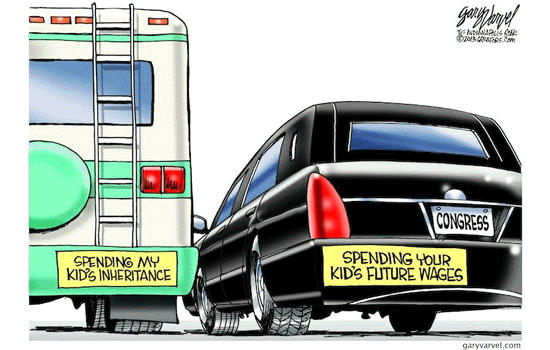
7. More carbon, but temperatures have stopped rising
Some of you who noticed we have a drought affecting most of the country will be puzzled why NIWA consistently 'forecast' normal rainfall and temperatures during summer, even when they could look out the window. NIWA scientists were part of the Nobel Prize award for their ability to forecast climate 30 years hence.
But the climate has acted differently to what the IPCC predicted for the past 10 years, and there is a scramble to explain it. This does not mean we don't have a problem, nor does it mean the future is reassuring. It is probably not. Before jumping to any conclusions, it would be wise to read this link. More from The Economist:
Temperatures fluctuate over short periods, but this lack of new warming is a surprise. Ed Hawkins, of the University of Reading, in Britain, points out that surface temperatures since 2005 are already at the low end of the range of projections derived from 20 climate models (see chart 1). If they remain flat, they will fall outside the models’ range within a few years.
The mismatch between rising greenhouse-gas emissions and not-rising temperatures is among the biggest puzzles in climate science just now. It does not mean global warming is a delusion. Flat though they are, temperatures in the first decade of the 21st century remain almost 1°C above their level in the first decade of the 20th. But the puzzle does need explaining.
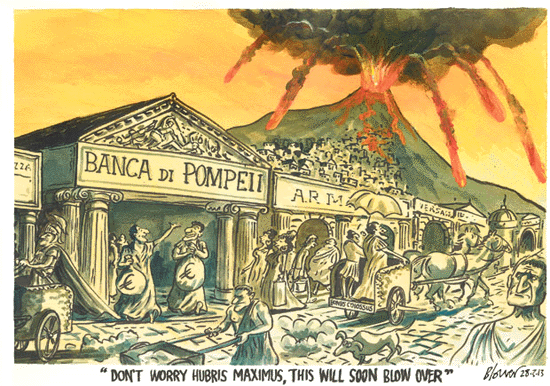
8. 'The bubbles will burst'
Long-term interest rates are now unsustainably low, implying bubbles in the prices of bonds and other securities. When interest rates rise, as they surely will, the bubbles will burst, the prices of those securities will fall, and anyone holding them – including banks and other financial institutions – will be hurt. You have been warned by none other than Martin Feldstein:
To the extent that banks and other highly leveraged financial institutions hold them, the bursting bubbles could cause bankruptcies and financial-market breakdown.
Investors are buying long-term bonds at the current low interest rates because the interest rate on short-term investments is now close to zero. In other words, buyers are getting an additional 2% current yield in exchange for assuming the risk of holding long-term bonds.
That is likely to be a money-losing strategy unless an investor is sagacious or lucky enough to sell the bond before interest rates rise. If not, the loss in the price of the bond would more than wipe out the extra interest that he earned, even if rates remain unchanged for five years.
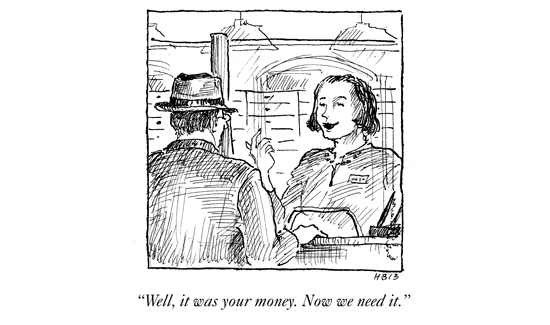
9. Job losses
While there was a bit of a flurry of job loss reporting this week, they were mostly a repeat of what has been reported before. We seem to be in a loop of recycling job loss stories; there is very little new. And most of the bigger ones are 'losses' that will be handled by attrition and reassignment, rather than actual layoffs or redundancy. No evidence yet that we have an 'actual' problem - it looks like more of a beat-up at this stage.
We are keeping a tally of reported job losses and we are asking readers for help keeping track of them. Let us know when you see some.
It it doesn't pick up soon, be may have to abandon our monitoring project.
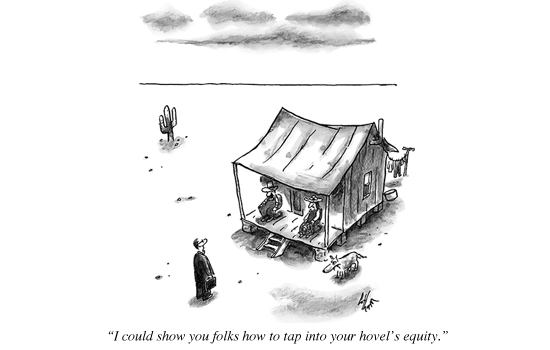
10. Today's quote
"People say that money is not the key to happiness, but I always figured if you have enough money, you can have a key made." Joan Rivers
We welcome your comments below. If you are not already registered, please register to comment
Remember we welcome robust, respectful and insightful debate. We don't welcome abusive or defamatory comments and will de-register those repeatedly making such comments. Our current comment policy is here.