

Here's my Top 10 links from around the Internet at 10:00 am today in association with NZ Mint.
Bernard is back tomorrow with his version.
As always, we welcome your additions in the comments below or via email to bernard.hickey@interest.co.nz.
See all previous Top 10s here.

1. 'A well-intentioned illusion'
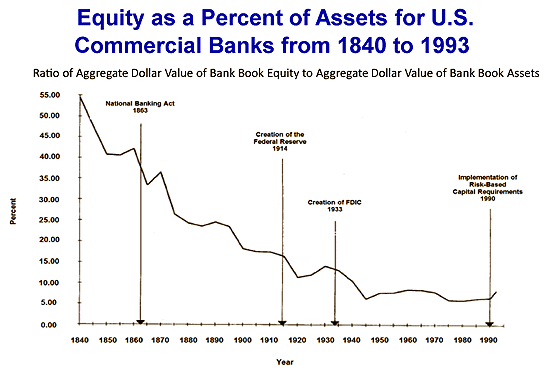
Tom Hoenig was the thoughtful and very well respected head of the Fed Kansas City. He now has a senior role at the FDIC. And he now wants to get rid of Basel III and replace it with direct leverage controls on banks - that is, make them raise much more capital.
And now a current Fed governor, Dan Tarullo, has come out in favour of direct leverage regulation. Policy makers in the US (at least) are starting to get very serious about a structural change in how banks are regulated.
Here's the crucial bit of the Hoenig position:
The tangible leverage ratio is a superior alternative to risk-weighting schemes that have proven to be an illusion of precision and insufficient in defining adequate capital. The effect of relying on such measures has been to weaken the financial system and misallocate resources.
The leverage ratio deserves serious consideration as the principal tool in judging the capital strength of financial firms. The Basel discussion would be well served to focus on the appropriate levels of tangible capital for banking firms to hold and the right transition period to achieve these levels.
We should not accept even comforting errors of logic which suggest that Basel III requirements will create stronger capital than those of Basel II, which failed.
Instead, past industry performance and mounting academic and other evidence suggest that we would be best served to focus on a strong leverage ratio standard in judging a firm and the industry's financial strength. No bank capital program is perfect. Our responsibility as regulators and deposit insurers is to choose the best available measure that will contribute to financial stability.
2. Money for 'nothing'
Are you chafing in the uncomfortable position of only getting 4% for your term deposit? Think it should be more? Think again and be thankful ! Even though I know full well about financial repression, I was still taken aback by this report in BusinessWeek. There is no way in our lifetime that these rates are going to go higher. Think about what you are about to read below. (Graeme Hart did his thinking earlier than the rest of us it seems.)
Here’s this week’s mind-boggler of a stat: So voracious is the global appetite for debt that yields on almost US$20 trillion of government securities are below 1 percent, according to Bank of America data.
Such little cost to borrow such an inconceivably large sum. These are at once generous and stingy times: If you are an economy or a corporation with any modicum of creditworthiness, your debt will get snapped up on low, long, easy terms. If you’re an investor, you have to hustle and dig for yield that you might think you can live with, and for a long time - at least well into an uncertain future.
Economies the world over are happy to cater to the ensuing need for yield. Rwanda, less than 20 years ago a failed, genocide-torn state, just raised $400 million from its first-ever foray into dollar bonds. The yield on the 10-year debt: a decidedly un-Third World 6.875 percent. Zambia, emboldened by its own $750 million sale last fall at just 5.625 percent, is now ready to offer as much as $1 billion in debt.
------------------------------------------------------------------------------------------------------------------------------------------
Keep it safe. Keep it in a New Zealand Mint safety deposit box. Details here »
------------------------------------------------------------------------------------------------------------------------------------------
3. Monetary emissions
Our base liquidity is measured by M2 - that is all the notes and coin in circulation, all the money in cheque accounts, and all the funds in on-call savings accounts. As at the end of 2012 that was NZ$103 billion or 49.2% of annual nominal GDP.
In the US the same number is 63% of GDP. But in China it is 188% !
China has been over-issuing its currency locally at a truly massive scale. In rough terms, China has half the GDP of the US but has twice the currency issued. It is even more remarkable when you realise the US currency is used internationally whereas that is not the case with China. China’s monetary expansion is a big concern, given that it could still trigger high inflation and lead to asset-price bubbles, debt growth, and capital outflows.
How can they get it back in control (a first step needed so that the stuff doesn't wash out everywhere, including New Zealand's property markets). The trouble is, almost all reform options will be unpalatable. Zang Monan has the story:
[The] trend is exacerbated by the declining efficiency of financial resources in the state sector, a product of the soft budget constraint implied by easily accessible, cheap capital.
Consequently, maintaining high GDP growth rates requires an ever-increasing volume of credit and a continuously growing money supply. So China is stuck in a currency-creating cycle: GDP growth encourages investment, which boosts demand for capital. This generates liquidity, which then stimulates GDP growth.
China’s low official government debt largely reflects the role of currency in assuming quasi-fiscal liabilities – not only the write-off costs incurred from reforming state-owned banks, but also the takeover of banks’ bad debts via note financing and the purchase of asset-management companies’ bonds. These activities both damage the PBOC’s balance sheet and constrain monetary policy.
4. Today's raw market data ...
A quick new week update:
| as at 11:10am |
Today 9:00 am |
Friday |
Four weeks ago |
One year ago |
| NZ$1 = US$ | 0.8530 | 0.8511 | 0.8408 | 0.7920 |
| NZ$1 = AU$ | 0.8274 | 0.8297 | 0.8112 | 0.7819 |
| TWI | 78.62 | 78.48 | 77.59 | 70.97 |
| Gold, US$/oz | 1,477 | 1,469 | 1,575 | 1,639 |
| Dow | 14,958 | 14,818 | 14,651 | 13,017 |
| Copper, US$/tonne | 7,122 | 6,871 | 7,458 | 8,530 |
| Volatility Index | 12.85 | 13.59 | 13.19 | 18.94 |
------------------------------------------------------------------------------------------------------------------------------------------
New Zealand Mint. Experts in gold & silver bullion, commemorative coins and jewellery. Details here »
------------------------------------------------------------------------------------------------------------------------------------------
5. Expatistan
Want to understand the differences in costs between New Zealand and just about anywhere else? This web service will help you. In fact you can add local costs to add to their knowledge bases.
For people who 'can't understand' why stuff costs more here than 'there', this is a good place to start. And if you think it would be simple to profit from these differences, you can do some basic research here. It always amazes me why those who complain about 'how much it costs' don't just go into business importing the lower cost stuff. (Or is that because they would just go broke doing it?)
The number of relatively young, educated people voluntarily moving from country to country is growing. Their motivation is a combination of career related issues and a desire to experience a new culture. These people are commonly referred to as 'expats' and they have become a regular fixture in urban environments around the world.
Expats are faced with a number of specific problems, which locals do not face in terms of finding services and fulfilling needs, especially if they are not proficient in the local language. Expats' difficulties begin even before they make the decision to move to a new city. Expats want answers to questions like, "how much money will I need in .....?" and "Will the salary that I have been offered in ..... allow me to maintain my current standard of living?" and they are generally not willing to pay large sums of money for answers.
Expatistan.com is dedicated to expats around the world. It's designed to be a down-to-earth, realistic index that is free and easy to use. Expatistan.com is a collaborative effort - created by people for people around the world.
6. Gulp
Even after Lehman Bros, it still not something you expect to read these days:
"The wrong-way risk in the current CCP system is so large it could potentially lead to a sovereign default," he said.
CCP system? wrong-way risk? sovereign default? What is that HSBC manager warning about?
CCPs are central counterparties and are at the heart of derivatives trading. Derivatives are at heart of our swap contracts that underpin our mortgage market, and the FX hedging contracts that our exporters use to mitigate our volatile exchange rate. But, and its a very big but, these counterparties are part of a mutualised system and if one goes down it is likely they will take other CCPs down with them - despite all the collateral that is supposed to underpin the process.
Just to give you an idea of how big the derivatives markets, are I looked up the latest ANZ annual accounts September 2012). On page 27 they list nominal derivative values of almost a trillion NZ$ (NZ$954.8 billion - yep, billion.). The ANZ Group lists AU$2,884 billion - almost AU$3 trillion. And they are just one of the four 'pillar' banks in our system.
They are relying on central counterparties in Europe and America - key banks that underpin the huge derivatives markets.
Apart from a taxpayer bailout, I wonder how our regulators are planning it insulate us from a meltdown of the type that HSBC manager was warning of? We might find out at the next RBNZ FSR (Wednesday, May 8) but likely we won't. We need swaps and FX hedging contracts - but can we handle the consequences of a CCP failure?
There is more here from Lisa Pollack at FTAlphaville.
------------------------------------------------------------------------------------------------------------------------------------------
Available now. Our brand new 1 oz Taku gold bullion coin. Details here »
------------------------------------------------------------------------------------------------------------------------------------------
7. 'There is no alternative'
Jan Kallmorgen explains why the Germans are trapped with the euro, even though they got it without any choice, and even though a new political party has sprung up vowing to revert to the D-mark.
It seems German voters want a strong currency, not a weak one (like the euro). He explains why 24% are considering voting for that new party, but why in the end most Germans will want to stay with the euro.
For this to change, there would have to be wider popular dissatisfaction with the euro -- the kind of anger that existed when the currency was first born. There are no signs that this is happening now. An astonishing two-thirds of Germans say they want to keep the euro, according to an April 9 poll by the Forsa agency.
Alternative for Germany is probably just too radical for 2013. Many Germans would like the EU to adopt a tougher policy on the euro crisis, to ensure that debtor countries carry out the changes they have agreed to. But Germans understand that deutsche marks, pesetas and francs can no longer compete against Chinese yuan, U.S. dollars and Brazilian reals.
8. Creative destruction
Hedge funds are just mutual funds for the rich. They have an aggressively managed portfolio of investments and use advanced investment strategies such as leveraged, long, short and derivative positions in both domestic and international markets with the goal of generating high returns. However they make mistakes and can lose their investors huge amounts - as John Paulson is finding out. And there are now far too many of them; they are eating themselves. Paulson is one rich person who is not getting richer. There are likely to be many more like him soon.
Even some of the best-known hedge fund managers say the golden days are over for the industry. There are simply too many people running hedge funds with too much money.
This year, Soros spoke at the World Economic Forum in Davos. “Since hedge funds are now a dominant force in the market, they can’t, as a group, outperform the market,” he said.
Research from BarclayHedge and TrimTabs Investment Research suggests he is right. In 2012, the hedge fund industry as a whole was up just 7.8 percent, while the S&P 500 was up 14 percent.
“There are around 10,000 hedge funds. How many can be right at the same time?” asks McCullough.
9. Job losses
Later this week (Thursday) the Q1 2013 employment data will be out and we will know whether employment is growing or shrinking, what is happening to unemployment levels, and how the participation rate is holding up. We have not been seeing many job losses in our survey, so perhaps we should be expecting good numbers?
We are keeping a tally of reported job losses and we are asking readers for help keeping track of them. Let us know when you hear of some, even small ones.
10. Today's quote
"Women fake orgasms and men fake finances." - Suze Orman
We welcome your comments below. If you are not already registered, please register to comment
Remember we welcome robust, respectful and insightful debate. We don't welcome abusive or defamatory comments and will de-register those repeatedly making such comments. Our current comment policy is here.