

Here's my edition of Top 10 links from around the Internet today.
We have a Monday-Wednesday-Friday schedule for Top 10. Bernard will be back with his version this Wednesday. We will have another guest posting on Friday.
As always, we welcome your additions in the comments below or via email to david.chaston@interest.co.nz.
See all previous Top 10s here.
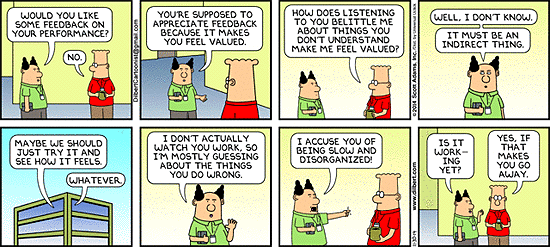
1. 'Print money and raise interest rates'
A British central banker - well actually an ex-central banker at the Bank of England - says pouring created money (money that does not need to be repaid) into a dying fire of a depressed economy would be the fastest way to get back to 'normal'.
He sees not 'technical reasons' why this won't work.
But he is not a behavioural economist; he is a traditional economist.
Perhaps he would unleash bizarre incentives in the banking system (?) or similar unexpected behaviour among borrowers and savers.
It is unlikely to be a solution adopted in New Zealand given our economy is trucking along nicely with relatively high interest rates now.
But stressed eurozone economies might be contemplating it (although are unlikely to get German agreement). The Japanese or Chinese could be listening ...
We should indeed seek a swift return to higher interest rates, to remove the dangerous subsidy to high leverage. But paradoxically, the best way to do that, particularly in Japan and the eurozone, would be to deploy a variant of Friedman’s idea of dropping money from a helicopter. Government deficits should temporarily increase, and they should be financed with new money created by the central bank and added permanently to the money supply.
Money-financed deficits would increase demand without creating debts that have to be serviced. This would lift either real output or inflation and allow interest rates to return to normal more quickly. True, banks might amplify the stimulus by creating additional private credit, but they can be restrained with higher reserve requirements.
Orthodox theory sees helicopter money as risky. But current quantitative easing policies are at least as risky, and have produced adverse side effects.
In the UK the Bank of England has bought £375 bln of government bonds to try to stimulate the economy through swollen asset prices and rock-bottom interest rates.
It could instead have created new money to finance a smaller one-off increase in the fiscal deficit. If it had done so, a return to normal interest rate disciplines would now be nearer.
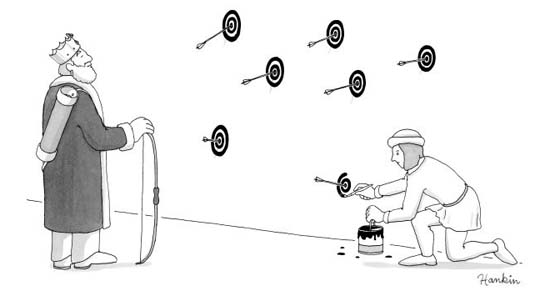
2. Easier money
Chinese banks need to keep about 20% of their deposits as capital reserves - the equivalent in New Zealand is about half that - but now there are moves afoot to reduce the cover. Chinese banks are already among the world's largest. Reducing their reserve ratio will give them much more fire-power, and for free.
"Clearly, the increase in Shibor despite the rate cut shows fund tightness,” said Zhou Hao, a Shanghai-based economist at Australia & New Zealand Banking Group. “Bank balance sheets are already tight and they need funds to ease the thirst. The reduction in reserve ratios is likely to take place this month and more will come in the coming year."

3. Post peak wood
When societies used wood for shelter and fuel, forests suffered. When alternative materials and fuels came along things improved, as this German study shows. Going back to the 'old ways' (green philosophy) would come with a harsh consequence if everybody did it. Developing countries need to make the transition to improve the world's carbon sinks. (Click image above - or here - to animate.)
"More than 100 years ago, timber was used for almost everything: as fuel wood, for metal production, furniture, house construction. Hence, at around 1900 there was hardly any forest areas left in Europe. Especially after World War II, many countries started massive afforestation programs which are still running today," Fuchs told The Washington Post.
As a result, Europe's forests grew by a third over the last 100 years. At the same time, cropland decreased due to technological innovations such as motorization, better drainage and irrigation systems: Relatively fewer area was needed to produce the same amount of food. Furthermore, many people migrated from rural to urban areas, or overseas.
Fuchs' fascinating conclusion: Forests and settlements grew at the same time and Europe is a much greener continent today than it was 100 years ago. A closer look at different regions and countries reveals Europe's recovery from the deforestation of past centuries.
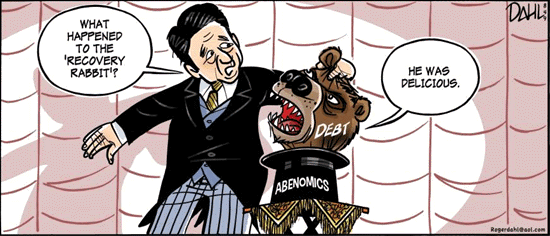
4. Are we obstructing China's graft sweep?
China doesn't like our legal system and is frustrated our judges won't co-operate with them when they want something.
There is a cultural and social tension rising here.
China is going after its corrupt officials and doesn't understand why we insist on due legal process when they want them extradited after they have been discovered here.
How they look at how we protected and shielded Kim Dotcom is anyone's guess.
Should we automatically hand over someone accused by China (or Germany) even though they have committed no crime here? How do you feel about sheltering offshore corruption?
I suspect our legal systems are about to be tested by these types of cases. The Chinese President is setting up the issue:
Mr Xu called on western nations that have refused to sign formal extradition treaties with China to rally to the cause. Their often “cumbersome” legal procedures and biased judges were obstructing Operation Fox Hunt, he said.
“In some countries, judges who sometimes don’t understand or even have prejudices against China refuse to co-operate.”
Chinese fugitives often seek refuge in countries such as the US, Canada, New Zealand and the UK, where authorities are not obliged to honour Beijing’s extradition requests but can do so on a case-by-case basis.
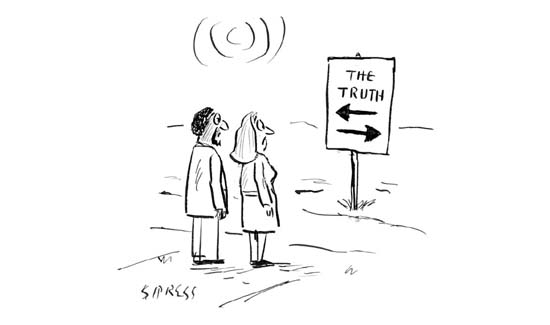
5. Draining away?
The push by ECB boss for full-blown QE - and the resistance by Germany & Friends - reinforces the notion that they are playing a very high-stakes game. And there is not certainty it will end well. Ambrose Evans-Pritchard has penned another apocalyptic warning:
Let me be clear, I have no criticism of Mr Draghi. He has worked wonders, given the political constraints. His management of the ECB has been nothing less than heroic.
I agree fully with the logic – though not the purpose – of his cri de coeur in Finland a week ago. The ultimate success of EMU, he said, “depends on the acknowledgment that sharing a single currency is political union, and following through with the consequences”.
Or put another way, once you have launched a monetary union, you have automatically launched a political union too. That is what EMU means. The euro means a single government and a European superstate, and implicitly the abolition of Germany as a fully sovereign independent state. To pretend otherwise is intellectually infantile. To resist this truth - yet to proceed doggedly with EMU anyway - merely condemns Europe to rolling crises and permanent depression.
Mr Draghi is absolutely right about this, which is why those of us who were eurosceptics at Maastricht – and I wrote the leader for the Daily Telegraph on the night of that infamous treaty exactly 23 years ago – always opposed EMU with inflexible determination, and why we have great sympathy for those in Germany who wish to pull out of EMU in order to save their own sovereign state before it is too late.
6. How to lose two-thirds of your readers
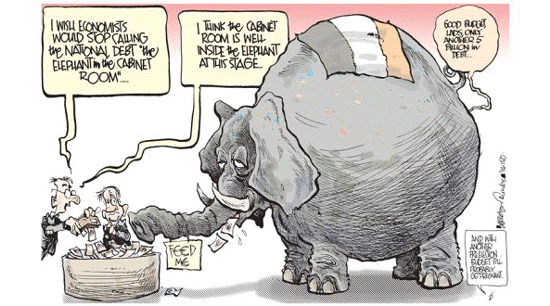
Here is something a little unsettling. It may help explain the reactions of a number of our commenters - "if it isn't bad, its not real".
In what turned out to be a rather disheartening social experiment, the Russian news site City Reporter only reported good news to its readers for an entire day.
The site brought positive news stories to the front of its pages and found any and all silver linings in negative stories (“No disruption on the roads despite snow,” for example). The result was a smorgasbord of sunshine, lollipops, and rainbows—that absolutely no one wanted to read. The City Reporter lost two-thirds of its normal readership that day, according to a post by one of the editors on Facebook.
For anyone familiar with the old newsroom adage “If it bleeds, it leads,” this shouldn’t be too shocking. But the City Reporter’s experiment is an indication that our fascination with negativity may be even more pervasive than we thought.
There is no shortage of psychology studies explaining why we love to read and watch bad news. Our brains make us do it. Negative events are more memorable and emotionally impactful than good ones. And the media only give the people what they want.
We cover quite a bit of 'good news' - it is hard not to in New Zealand these days. Imagine what our traffic would be if we didn't do that ... ;)
7. Humongous waste
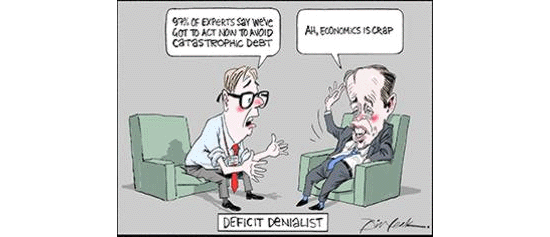
In a stunning indictment (and an equally stunning piece of research), a couple of Chinese academics have suggested that the Chinese 'stimulus' programs over the past five years have resulted in gargantuan waste.
It is waste that is worth almost 9 times New Zealand's whole GDP over the same period.
In fact, another observer says that is about 5% of GDP, skimmed right off the top.
It is brave stuff from inside China. This from Jamil Anderlini of the FT in Beijing:
"Ghost cities" lined with empty apartment blocks, abandoned highways and mothballed steel mills sprawl across China’s landscape – the outcome of government stimulus measures and hyperactive construction that have generated US$6.8 tln in wasted investment since 2009, according to a report by government researchers.
In 2009 and 2013 alone, "ineffective investment" came to nearly half the total invested in the Chinese economy in those years, according to research by Xu Ce of the National Development and Reform Commission, the state planning agency, and Wang Yuan from the Academy of Macroeconomic Research, a former arm of the NDRC.The bulk of wasted investment went directly into industries such as steel and automobile production that received the most support from the government following the 2008 global crisis, according to the report.Mr Xu and Ms Wang said ultra-loose monetary policy, little or no oversight over government investment plans and distorted incentive structures for officials were largely to blame for the waste.
8. A gigantic change
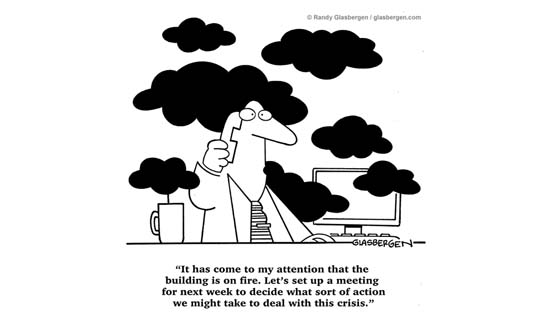
China's growth has been the envy of the developed world. But now it's slowing. However I did a double-take recently when I saw the Irish industrial production numbers. They are up +38.5% in the year to October. Now that is a serious rebound. This is from the Irish Times:
“We expect the global economy to pick up speed in the coming year and demand for Irish goods in general should increase as a result, with currency developments, particularly in relation to the euro/dollar a huge plus,” he said.
“Ireland is better placed than most to take advantage of an upturn in the world economy. The industrial output figures are also now clearly fitting better with the Irish manufacturing PMI, which has been in expansionary territory for the eighteen months up to November, with the latest figure just shy of the 15-year high hit in August,” he added.
9. US dollar still king
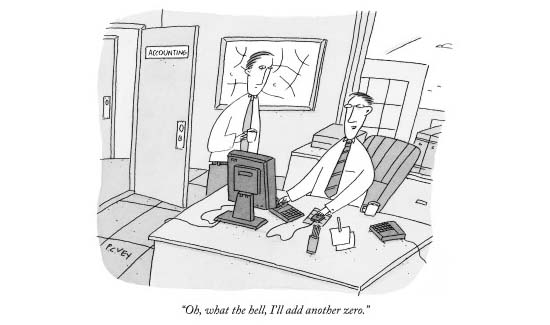
Even though the share of world GDP by the US is now less than 20%, the US dollar is by far the most widely used currency for international trade, and by far the the most preferred for holding international reserves. We might trade with many other nations but we really don't want their local currency; we all seem to only want US dollars. Despite its travails, the US dollar is key, knocking back weak challenges from the euro and the Japanese yen.
The BIS has been looking at why.
10. High demand
"Hospitals report that the hearts of bankers are in strong demand by transplant patients, because they’ve never been used." - the Torygraph
And one for MortgageBelt ...
Einstein dies and goes to heaven only to be informed that his room is not yet ready. "I hope you will not mind waiting in a dormitory. We are very sorry, but it’s the best we can do and you will have to share the room with others" he is told by the doorman.
Einstein says that this is no problem at all and that there is no need to make such a great fuss. So the doorman leads him to the dorm. They enter and Albert is introduced to all of the present inhabitants. “See, Here is your first room mate. He has an IQ of 180!"
"That’s wonderful!” says Albert. “We can discuss mathematics!"
"And here is your second room mate. His IQ is 150!"
"That’s wonderful!” says Albert. “We can discuss physics!"
"And here is your third room mate. His IQ is 100!"
"That’s wonderful! We can discuss the latest plays at the theater!"
Just then another man moves out to capture Albert’s hand and shake it. "I’m your last room mate and I’m sorry, but my IQ is only 80."
Albert smiles back at him and says, "So, where do you think interest rates are headed?"
We welcome your comments below. If you are not already registered, please register to comment
Remember we welcome robust, respectful and insightful debate. We don't welcome abusive or defamatory comments and will de-register those repeatedly making such comments. Our current comment policy is here.