

Here's my edition of Top 10 links from around the Internet today.
We have a Monday-Wednesday-Friday schedule for Top 10. Bernard will be back with his version this Wednesday. We will have another guest posting on Friday.
As always, we welcome your additions in the comments below or via email to david.chaston@interest.co.nz.
See all previous Top 10s here.

1. Keeping capitalism clean
The financial auditing firm as we currently know it may be about to go extinct.
Systemic failure to identify major problems in who it audits have become famous.
The first really big-name recent failure was Enron, a failure that saw the demise of the Arthur Andersen auditing firm.
There have been many other spectacular failures.
But the most recent is of a British firm, Tesco. Investor Warren Buffet has lost his shirt there partly because he relied on the firms accounts, blessed by PwC as auditors.
The Economist has been looking at the issue, and especially about how to fix the problem.
I particularly like one solution they identified.
Auditors perform a central role in modern capitalism. Ever since the invention of the joint-stock corporation, shareholders have been plagued by the mismatch between the interests of a firm’s owners and those of its managers. Because a company’s executives know far more about its operations than its investors do, they have every incentive to line their pockets and hide its true condition. In turn, the markets will withhold capital from firms whose managers they distrust. Auditors arose to resolve this “information asymmetry”.
The stakes are high. If investors stop trusting financial statements, they will charge a higher cost of capital to honest and deceitful companies alike, reducing funds available for investment and slowing growth. Only substantial reform of the auditors’ perverse business model can end this cycle of disappointment.
But because the profession was historically allowed to self-regulate despite enjoying a government-guaranteed franchise, it has set the bar so low - formally, auditors merely opine on whether financial statements meet accounting standards - that it is all but impossible for them to fail at their jobs, as they define them. In recent years this yawning “expectations gap” has led to a pattern in which investors disregard auditors and make little effort to learn about their work, value securities as if audited financial statements were the gospel truth, and then erupt in righteous fury when the inevitable downward revisions cost them their shirts.
The most elegant solution comes from Joshua Ronen, a professor at New York University. He suggests “financial statements insurance”, in which firms would buy coverage to protect shareholders against losses from accounting errors, and insurers would then hire auditors to assess the odds of a mis-statement. The proposal neatly aligns the incentives of auditors and shareholders - an insurer would probably offer generous bonuses for discovering fraud.
Unfortunately, no insurer has offered such coverage voluntarily. New regulation may be needed to encourage it.
2. Getting worse?
The sheer scale of corruption in China has been breathtaking and continues to get a good airing as the Government there 'cracks down'. But there are growing concerns this is just another Chinese power purge, of which there have been many before.
This article by Beijing-based Kiwi journalist Jamil Anderlini is an eye-opener. It is very brave reporting. It includes:
“There is an unwritten rule within the party when it comes to the children of top leaders, we need to be very careful about arresting and sentencing them,” says Lin Zhe, a professor specialising in anti-corruption at the Central Communist Party School, the top training academy for the party elite. “Their parents are busy with revolutionary work and don’t have time to look after them so we need to protect them. This is a long tradition within the party.”
Critics of the current campaign say its biggest flaw is that it relies on the same campaign-style political mobilisation that has been ineffective in the past in curbing rampant corruption and abuses.
Instead of trying to introduce external institutional checks and balances, the party is being told to “improve discipline” and regulate itself better.
As the trials of the activists show, the party is also reserving for itself the exclusive right to say who is corrupt and who is not.
Even those who admit to being involved in corruption say the current approach is not working.
A wealthy Beijing-based property developer, who insisted on anonymity, told the Financial Times the campaign had actually hurt his business because it drove up the cost of bribing crooked officials.
“Several of the officials I deal with have told me the risks are higher now and so they need to charge a premium,” this person said. “In some cases that has doubled the cost of my transactions and I have had to go to much greater lengths to conceal these payments [of bribes].”
3. Germany the next China
Money printing drives down interest rates, this we all know. But the impacts can be quite distortionary. The ECB is widely tipped to be about to embark an a major QE program, and already low euro interest rates are likely to go even lower if that is possible. Savers are unlikely to just lie there and take it.
Deutsche Bank analysts have been looking at how local savers are likely to respond - especially German savers - and things could get interesting.
Essentially they are seeing a really big sift of savers driving euros out of the eurozone. This will further depress the euro exchange rate. And they don't see it as a short-term thing.
There will be huge amounts of German money available looking for yield. Rising rates in the US in 2015 will be the main beneficiary, but NZ will also be able to fill its boots. We have no need to worry about Chinese flows ending.
These quotes from the Deutsche Bank report are a bit clipped, but they will give you the idea. FTAlphaville has a fuller analysis:
Given punitive rates on deposits, households have realized the need to invest their savings in capital markets in order to preserve their value at the very least.
Foreign inflows therefore partially mask the fact that German portfolio investment abroad has begun to fire on all cylinders, especially in 2014.
To put it all together, we find a rising German preference for non-Euro denominated assets, particularly fixed income. Our work suggests that recent trends are likely to be persistent if not intensify further as ECB QE gets under way. Not only does this have depreciatory implications for the euro, but it also suggests low global bond yields and a stronger dollar can continue to co-exist for some time yet.
4. Slam dunk
Here's the key reason why the Murray Report says the Aussie banks need to raise more capital:
The big four banks and their shareholders can afford the cost of becoming a bit safer more than the taxpayer could now afford having to bail one or more of them out.
It undoubtedly applies in New Zealand as well. Get on with it. Get their leverage ratios down to 7 times. (The 'best' are still at 11 times, or more. Kiwibank is a dangerous 17 times, a double risk for the taxpayer.)
5. Lower intensity
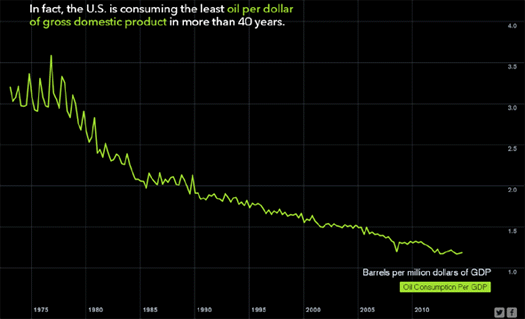
It may not exactly be a new story, but it is one that helps explain one reason why the oil price is soft and may say soft for some time: energy intensity is declining.
Bloomberg has produced an interesting infographic series telling the story from a US perspective. It is a story that is true for most western countries. Basically, we are getting more (better quality) output for less energy consumed. It would still be a big story if it was for the 'same energy consumed' but it looks like it actually for less. Consumer habits are changing and businesses have followed. The 1980's are not going to be our energy consuming future, despite what the 'environmentalists who grew up in the 1980s' think.
Click here or the image above for the Bloomberg series.

6. Visualisation porn
On Friday last week, the NZ Herald ran a piece of environmental PR with a catchy title and graphics.
Exclusive: Some 268,000 tonnes of plastic are floating in the world's oceans. Here, we look at where it's to be found. Each dot on the map represents 20kg of plastic.
It featured this global image:
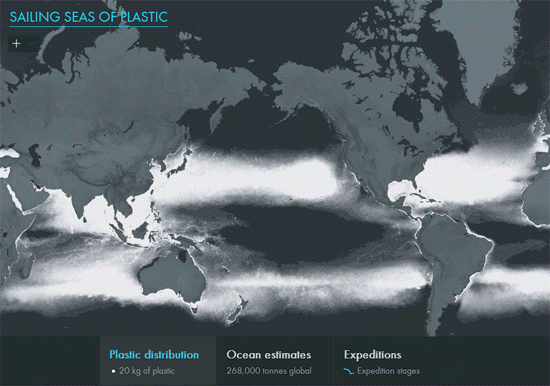
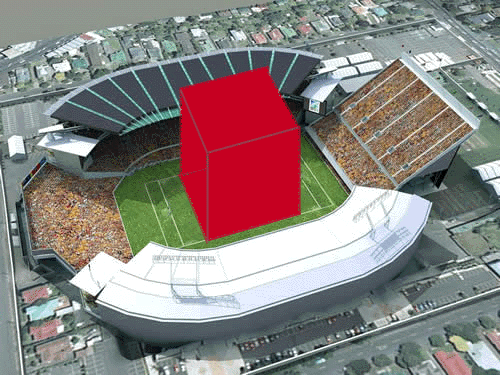
But the density of 'plastic' (HDPE) is about 0.95 g/cm3 so that means there is in total about 282,000 m3 of the stuff floating around in the global oceans. Given the humongous size of the oceans, actually that seems like a very tiny amount. The global weight of plastic pollution on the sea surface, from all size classes combined, over all time, is only 0.1% of the world production in a single year (2012 in this case).
The smallest Auckland water reservoir, the Hays Creek Dam in the Hunua Ranges would be less than a quarter full with that global volume, every last bit of it. (Hays Creek Dam is one of ten and by far the smallest; almost 200 times smaller than the largest.)
You can make 'visualisation tools' paint any picture you like - scary or benevolent. They are the new propaganda tools used by corporates, governments and "public interest" groups alike. You should always be sceptical. But to an unthinking readership, they no doubt work. They look 'factual' and 'credible', especially photo-like map images.
To visualise the amount of that material in a different way to the NZ Herald except not as a 'dot'-on-a-Mercator-projection, here is the same global volume: 66m x 66m x 66m. Do the math.
A problem? Yes. One that needs a solution? Yes. A major global issue? I don't think so.
7. Half way there
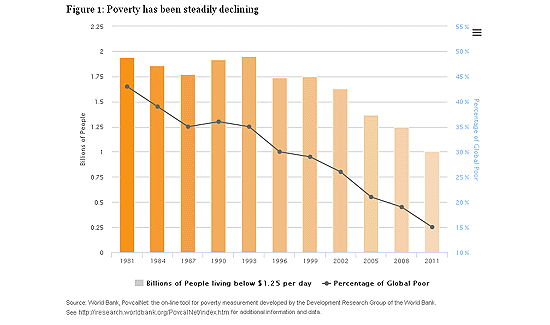
For the record, the World Bank has recorded the progress in overcoming extreme poverty. Actually it is an amazing achievement, although we are only half-way there. In 1981 43% of the world's poor were in extreme poverty, defined as living on US$2/day or less. By 2011 that had fallen to 15%. In absolute numbers, that is a fall from just under 2 bln people to just on 1 bln.
The risk however, is that we don't kick on and complete the job. Even more important, we should also start to focus on the poverty level the next level up. Hans Rosling has it nailed. If you didn't click on his video in Eric Crampton's Friday Top 10, take the time to do it now, here.
8. Recording the gains
An email correspondent asked a question this week: "Under National, debt has skyrocketed ... why are we broke again then?" These types of queries force me back to the data. This is what I found and reported back to him:
A good question. The National Party was elected in November 2008 at the start of the GFC.
Activity
From 2009 to 2014 (June years) New Zealand GDP has grown from $108.1 bln (nominal) to $132.6 bln per year, a rise of $26.2 bln or +24.6% over the whole five year period. (Remember, GDP is a 'flow', starts at zero each year.)
Debt
Total debt over the same period has grown to $340.3 bln a rise of $48.4 bln or +16.6%. Of this, household debt rose by $34 bln or +19.6%. (Remember, Debt is a 'stock', starts at the previous year's balance each year.)
Bank deposits
On the same basis, household deposits rose from $82.6 bln to $129.6 bln, a rise of $47 bln or +56.9%. Of those, term deposits rose $24.5 bln, a rise of +29%. (Deposits are a 'stock'.)
Household Assets
The value of houses has risen from $591.6 bln to $735.6 bln, a rise of $144 bln or +24.3%. The value of household financial assets (that are not housing related) rose from $170.1 bln to $248.1 bln, up $78 bln or +45.9%.
All data is from the RBNZ public stats here, all are nominal.
Where the money went ...
Over that period household bank deposits rose +$47 bln, and household financial assets (other than housing equity) rose +$78 bln. Interestingly these rises were equivalent to +10.8% of the GDP over the period. Households have built their financial assets impressively. There is no ready data on it, but I doubt the increases were evenly distributed although that is unlikely to be unusual to this period.
But it turned out what he was only asking about Government debt. (I read too much into his query.) This rose from $30.4 bln at the start of the period to $75.2 bln at June 2014. That is a rise of $44.8 bln or +147%. Without that 'public investment' (that is, with 'austerity' during this period) would our economy be in this current 2014 position? What policies could have given better outcomes? There is no doubt better policy choices would have given even better results but the ones we got are not bad, especially compared to some other countries. Your views?
By the way, in case you wanted to know, the CPI rose from 1061 to 1195 over the same period according to the same RBNZ data source. That is a rise of +12.6% in the six year period.
9. Are you a dunce if "my dog ate my homework"?
There may be growing scepticism about how our children are being taught at school - a structure than hasn't changed in 100+ years - but there seems to be little doubt that New Zealand students are doing reasonably well in the PISA assessments on an internationally comparative basis.
But that same OECD database shows that kiwi kids do less homework than our Aussie cousins. We are doing 4 hrs per week average, they do six. The OECD average is about 5. But what that data also shows is that the more you do, the better your scores. And that also seems to track "socio-economically". That is, those in higher brackets do more homework and get better scores. "Socio-economically advantaged kids in Shanghai do about 17 hours of homework a week. The same study clearly shows that the amount of homework time clearly correlates with student performance.
10. Japanese banking crisis
The problems for the Japanese economy are getting worse, and affecting their banks. In the last 7 days Origami Bank has folded, Sumo Bank has gone belly up and Bonsai Bank announced plans to cut some of its branches. Yesterday, it was announced that Karaoke Bank is up for sale and will likely go for a song while today shares in Kamikaze Bank were suspended after they nose-dived. While Samurai Bank are soldiering on following sharp cutbacks, Ninja Bank are reported to have taken a hit, but they remain in the black. Furthermore, 500 staff at Karate Bank got the chop and analysts report that there is something fishy going on at Sushi Bank where it is feared that staff may get a raw deal.
We welcome your comments below. If you are not already registered, please register to comment
Remember we welcome robust, respectful and insightful debate. We don't welcome abusive or defamatory comments and will de-register those repeatedly making such comments. Our current comment policy is here.