

By Bernard Hickey
The Government is ploughing on with its supply-side only approach to dealing with Auckland's housing shortage, but it faces some tough choices about how far it can push ahead without stumping up a serious amount of its own money.
The land mine sitting under the surface not too far down that road is how to pay for the infrastructure needed to support all these houses the Government hopes will be consented for its new Special Housing Areas.
There are already smoke signals drifting up from the bowels of Auckland Council that it has reached the bottom of its barrel of funding for new infrastructure, including the pipes, roads, railways, footpaths and community facilities needed to go with all these houses. Its debt ratios are stretched and it can't fund too much more.
Earlier this month the Auckland Council's Development Committee decided in a confidential session to defer approving the consents on two Special Housing Areas 'pending greater certainty on provision of necessary infrastructure.'
Some in the development community are up in arms over what they say is a full suspension of consents for greenfield Special Housing Areas. This would be explosive for the Government's strategy, if true, given its complete reliance on more house building to solve Auckland's housing problem in the wake of its rejection of the Reserve Bank's call for demand side measures such as reducing tax incentives for landlords.
Sources within the Council itself say the deferment approvals is for just a 'handful' of Special Housing Areas and Housing and Construction Minister Nick Smith remains bullish about the prospects for lots of new house building.
However, economists and the Reserve Bank are beginning to shuffle their feet over an apparent stalling in the growth of consents in Auckland. Figures for March confirmed the trend for Auckland consents has been falling since late 2014. The Reserve Bank highlighted that less than 8,000 consents were granted last year when more than 10,000 were needed to keep up with record high net migration, let along eat into the shortage it estimated at 15,000 to 20,000.
MBIE itself is estimating a shortage of 25,000 dwellings in Auckland by the end of this year, while BNZ Economist Tony Alexander said this week the shortage could be be as much as 76,000 if Auckland had the same number of occupants per dwelling as the rest of the country.
Mr Smith is aware of the challenges, particularly around paying for the larger scale pipes and connectors needed to link whole suburbs together, rather than just the infrastructure needed to service the sections in the Special Housing Areas.
"Where it gets more complicated is where you have a new (water) main that doesn't just service one Special Housing Area, but maybe goes further along from that, and how we meet some of that cost," Smith said.
"That's a big challenge and it's part of the ongoing dialogue with Council," he said, adding however he expected Council rather than Government to pay for the big interconnectors, given the Government was already paying for motorways.
Here is the crux of the issue. Will the Government's entire housing strategy fall down the cracks opening up in the Auckland Council's balance sheet and be finished off by its own reluctance to fund anything other than motorways?
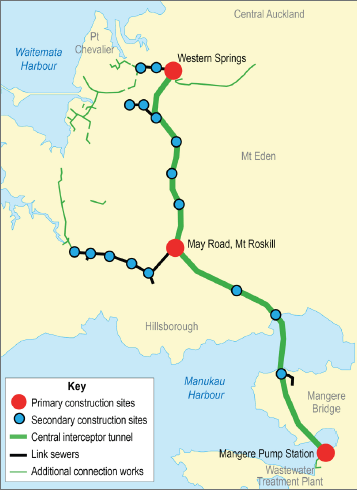
The Council is reluctant to borrow more and current ratepayers don't want to stump up immediately to pay for the really big pipes such as the NZ$1 billion Central Interceptor planned between Mangere and Western Springs. Talk of a 5.5% rates hike will go down badly with rateypayers. The Government is also reluctant to quickly fund the likes of the NZ$2.5 billion City Rail Loop, which would accelerate the growth of the inner city apartment developments called for by the Reserve Bank.
This infrastructure land mine needs to be defused with some hefty investment decisions by taxpayers and ratepayers in the pipes and roads and rails needed to support all the new houses
------------------------------
A version of this article has also been published in the Herald on Sunday. It is here with permission.
We welcome your comments below. If you are not already registered, please register to comment
Remember we welcome robust, respectful and insightful debate. We don't welcome abusive or defamatory comments and will de-register those repeatedly making such comments. Our current comment policy is here.