

This is the third chapter of Oliver Hartwich essay "Why Europe Failed", an analysis of an ageing Europe, burdened by the size of its welfare state. He draws cautionary lessons for New Zealand's policy makers. You can read the full version here.
This third section is titled "Building uptopia: Europe as an elitist project".
By Oliver Hartwich*

The project of European integration embodied by the EU and its predecessors should not be confused with lofty idealism. It has been power politics from the moment it started. As such, it was initiated by those in power – and not by the governed. The entire framework of European integration has always been one designed by Europe’s elites.
The peoples of Europe did not one day realise they wanted to be integrated and bound together by a supra-national organisation. The French, Italians or Dutch did not suddenly demand to be European henceforth. The Germans did not plead with their government to give up the Deutsche Mark and introduce the euro. There has never been a popular movement for any kind of European integration.
That European integration happened regardless is entirely due to the agenda of its political and economic elites. They convinced their people of the benefits of an integrated Europe – and if that was not enough, they were (and still are) prepared to go ahead with their agenda notwithstanding lack of popular support.
Eurobarometer results show how little the European project resonates with ordinary Europeans. Since 1973, the European Commission has been monitoring the evolution of public opinion in its member states. One of the regular questions is about popular interest in European affairs: “And as far as European politics are concerned, that is matters related to the European Community, to what extent would you say that you are interested in them?”
Figure 1 shows that mass interest in European politics was never particularly high. Perhaps alarmed by the prevalence of the answer “Not much” when people were asked about interest in EEC affairs, the Eurobarometer introduced a category “To some extent” in the mid-1980s. But even that did not improve the results much.
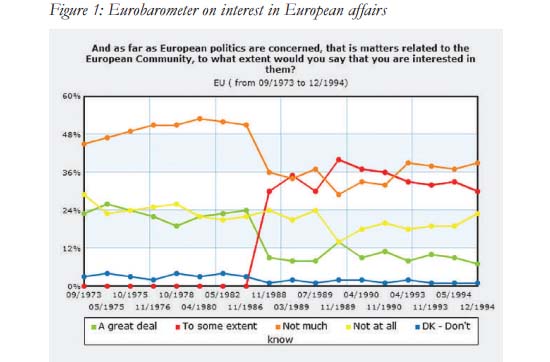
“Great interest” in European affairs declined steadily. The predominant answers demonstrate that Europeans have had little interest in EEC affairs.
This lack of public interest corresponds with a lack of common knowledge about EU affairs. Paul Statham surveyed European journalists and asked them about their readers’ interests. The answers were unequivocal: The interest and knowledge of national political affairs by far exceeded the corresponding figures at the EU level.9
Europe was never an issue high on people’s agenda; nor was it something that would win the hearts and minds of ordinary Europeans. Most opinion polls show Europeans are lukewarm on European integration – not openly hostile, but certainly not glowing supporters either.
That the European integration project has proceeded despite such disinterest was only because European politicians kept pushing it – and are still pushing it.
A few examples easily demonstrate how elitist European integration has been. The first concerns the practice of seeking legitimacy for further European integration through referenda. This in itself is not elitist. On the contrary, it is only right and just that the peoples of Europe have a say in policymaking.
However, European referenda show their elitist streak the moment the people of Europe do not vote as the elites would like them to vote. When that happens, it does not mean the end of the matter. It typically means the referendum is either ignored – or the people get a second chance to come up with a “better” or “more correct” result.10
The first time this happened was when the Danes rejected the Maastricht Treaty in a 1992 referendum. Following this, the EU granted Denmark some concessions on the treaty, which justified putting an amended version to a second referendum a year later. This time it passed.
Ireland then rejected the Treaty of Nice in 2001 – only to be called back to the polls a year later. At their second chance, the Irish voted for the new treaty. History repeated itself when Ireland rejected the Treaty of Lisbon in 2008 – only to approve it a year later on the second chance.
Speaking of the Treaty of Lisbon, this treaty is in effect the planned and failed EU Constitution by another name.11 But why did the Constitution fail? Because it was rejected not once but twice in referenda. Both France and the Netherlands threw it out in 2005. This should have killed the attempt to introduce the Constitution. Instead, the bulk of it was preserved and reintroduced under the Treaty of Lisbon – which, by the way, also meant that Britain did not hold a referendum on it. When it was still called the Constitution, all major British parties had pledged to put it to a referendum. Once it was renamed, the promise no longer applied.
Referenda that are held again and again if the first run does not produce the right result are one way in which Europe’s elitist politicians work the system. An even more striking example are those referenda that are never held because politicians know they would fail.
The history of Europe’s major treaties, such as the treaties of Rome, Maastricht, Nice or Lisbon, is one of treaties rarely ever being put to a popular vote. In the vast majority of countries, treaty changes are passed only by parliaments. Though theoretically that lends legitimacy to those treaties, it means rather than the electorate it is the very same political parties, whose leaders negotiate the treaties at the international stage, that pass them in national parliaments.
An additional complication is that political parties in some EU member states form a de facto cartel on EU matters. In the German Bundestag, for example, there is practically no opposition to fundamental EU matters (with the exception of a smallish post-communist party, The Left), while all other parties across the political spectrum support not just the EU project but also further integration. Political respectability, at least in Germany, required a subscription to the European integration consensus view. Questioning integration could turn any political party into a pariah. This means even if the public feels uneasy about EU affairs (or maybe is just not interested in them), such popular scepticism is not represented in parliament by their representatives.
Of course, politicians are only too aware of those areas of European integration that would never stand a chance of being implemented if the people were asked. Former German Chancellor Helmut Kohl, for example, has been very explicit in a number of interviews that he did not put the introduction of the euro currency to a popular vote because he knew it would have failed:
I knew that I could never win a referendum in Germany. We would have lost a referendum on the introduction of the euro. That’s quite clear. I would have lost and by seven to three … If a Chancellor is trying to push something through, he must be a man of power. And if he’s smart, he knows when the time is ripe. In one case – the euro – I was like a dictator.12
If one were generous, one might call such behaviour political leadership. However, one might also be astounded by how a head of a democratically elected government knowingly put his own (elitist) views above the views of the vast majority of people.
Europe’s elites, of course, would never accept the accusation of European elitism. They would rather maintain that Europe is a thoroughly democratic project – and to underline this assertion, they would point to the European Parliament, the parliament with second-largest electorate in the world (after India).
The European Parliament itself is not without its problems, though. Well, actually there are three. First, it is not a real parliament. Second, its democratic legitimacy evaporates a little bit more with each election. And third, the common European hardly takes any notice of it.
The first problem is the most basic one: Unlike national parliaments, the European Parliament does not have the right to initiate lawmaking procedures. This is not a triviality. Parliaments are often called legislatures because that is what they are there for: to legislate. The European Parliament can neither make laws on its own (it needs the European Commission, i.e. the executive branch of the EU, to do that), nor easily remove the executive (it needs a two-thirds majority). In effect, the European Parliament hardly deserves its name. It is a toothless parliament by the standards of most democratic nations.
Maybe because of the European Parliament’s lack of power, few Europeans bother to vote in European elections – the second problem with European democracy. Since the first election to the European Parliament in 1979, voter turnout has decreased with every single election: from 63% in 1979 to just 42.5% in 2014.
The third problem with the European Parliament is loosely connected to the previous two: Europeans only really take notice of the European Parliament when it is elected every five years. And even then, turnout is low, and national rather than pan-European political topics dominate the election campaign. In between elections, the European Parliament hardly ever features in the media. It is no exaggeration to say that the vast majority of Europeans do not follow a single debate in the European Parliament in any given year. It is thus a Parliament that meets in splendid isolation from its voters – not entirely without function, admittedly, but almost entirely without a democratic audience. This is problematic not least because the European Parliament plays a crucial role in making laws affecting the entire EU – laws that may be highly unpopular if discussed at the national level. Once passed at the EU level, however, laws become binding, leaving little discretion for nation-states to deviate from them.
Despite its limited rights, low electoral turnout, and limited public reach, the European Parliament does not make the EU any less of an elitist project. On the contrary, EU parliamentarians are very much part of the EU elite.
From a democratic perspective, the state of European affairs is so dismal that it is often quipped that any country configured like the EU would struggle to be admitted into the EU. It would simply not be democratic enough to be worthy of accession.
Though this sounds like a harsh judgment, it is nevertheless true. EU affairs are and have always been deeply anti-democratic. It is a European elite that determines the course of European politics. This author has made his own experiences with what happens when the EU elite’s view gets challenged (see Appendix 1).
In contrast, the will of the people does not matter. But then again, there is not a European people anyway but only European peoples – but that is a different problem altogether.
9. Paul Statham, “Making Europe News: Journalism and Media Performance,” in Ruud Koopmans and Paul Statham (eds), The Making of a European Public Sphere: Media Discourse and Political Contention (Cambridge (Mass.): Cambridge University Press, 2010), p. 131.
10. Gráinne de Búrca, “If at First You Don’t Succeed: Vote, Vote Again: Analyzing the Second Referendum Phenomenon in EU Treaty Change,” Fordham International Law Journal 33:5 (2011), pp. 1472–1489.
Oliver Hartwich is the Executive Director of The New Zealand Initiative. Before joining the Initiative he was a Research Fellow at the Centre for Independent Studies in Sydney, the Chief Economist at Policy Exchange in London, and an advisor in the UK House of Lords. Oliver holds a Master’s degree in Economics and Business Administration and a Ph.D. in Law from Bochum University in Germany.
This is part III of a serialisation of his essay "Why Europe Failed". Part I is here. Part II is here. Part IV tomorrow is titled: "No country. No people". You can read the full version here.
We welcome your comments below. If you are not already registered, please register to comment
Remember we welcome robust, respectful and insightful debate. We don't welcome abusive or defamatory comments and will de-register those repeatedly making such comments. Our current comment policy is here.