
By Cam Preston*
This May’s Budget will be a continuation of New Zealand’s magical fiscal turn-around from an $18.4 billion deficit in 2011 to surplus in 2015.
And who doesn’t like magic, right?
But the thing about good magic tricks, is that you tend not to find out what the real trick is until toward the end, and you actually don’t know whether it will be ‘pulled off’ until right at the end.
In fact if the trick is dangerous enough, like sawing the Beautiful Assistant in half, the consequences of getting it wrong can be disastrous.
So let’s take a quick look at this fiscal trick. To quote the novelist, Christopher Priest:
Every great magic trick consists of three parts or acts. The first part is called "The Pledge". The magician shows you something ordinary: a deck of cards, a bird or a man. He shows you this object. Perhaps he asks you to inspect it to see if it is indeed real, unaltered, normal. But of course... it probably isn't. The second act is called "The Turn". The magician takes the ordinary something and makes it do something extraordinary. Now you're looking for the secret... but you won't find it, because of course you're not really looking. You don't really want to know. You want to be fooled. But you wouldn't clap yet. Because making something disappear isn't enough; you have to bring it back. That's why every magic trick has a third act, the hardest part, the part we call ‘The Prestige’.
The Magician in this case is our Government and the Beautiful Assistant is the Treasury.
Of course the Beautiful Assistant is simply there to assist the Magician. They are likely aware of the mechanics of the trick, but they don’t know all the Magician’s secrets.
Under the Public Finance Act 1989 section 26G our Magician must exhibit “responsible fiscal management”, that’s where this trick begins.
The first part of the trick is of course “The Pledge”.
In this case we have to go back to the Government’s 2011 Budget speech:
Today I introduce a Budget that will further strengthen the long-term performance of the economy. It supports economic forecasts that show growth returning to its highest in over five years and 170,000 net new jobs being created by 2015. It channels resources into key social programmes, while ensuring they are well-targeted and protect the most vulnerable. It provides certainty that Christchurch, our second largest city, can be rapidly rebuilt. And, despite the earthquake, it eliminates the deficit and achieves surplus by 2014/15, a year earlier than forecast in last year’s Budget. As a result, the Government’s need to raise debt will greatly diminish. This year we have raised an average of $380 million of net new debt every week. Next year that will fall by more than two-thirds to around $100 million. And from 2014/15 on we will be repaying debt.
You inspect the $18.4 billion deficit to see if it is indeed real, unaltered, normal. But of course... it probably isn't. Why would the Magician bring the surplus track forward one full financial year less than three months after the country’s most expensive natural disaster?
Indeed it is a well-known commercial accounting trick that if you are going to have a bad year financially, make it really bad. It’s easy in modern accounting to book an “expense” and reverse it later, or capitalise a cost instead of expensing it, however this is all part of the magic, all part of the art of The Pledge.
Besides The Pledge looks like “responsible fiscal management” why bother looking any closer?
Now for the second act “The Turn”: The magician takes the ordinary something and makes it do something extraordinary. Now you're looking for the secret... but you won't find it, because of course you're not really looking. You don't really want to know. You want to be fooled.
Indeed by 2015 the $18.4 billion deficit disappears.
You don’t notice that Crown Borrowings jump from $103 billion in 2014 to $113bln in 2015. You’re not really looking though.
Just like you didn’t notice that Crown Borrowings jumped from $69 billion to $90 billion in 2011 the time The Pledge was given. You weren’t really looking were you?

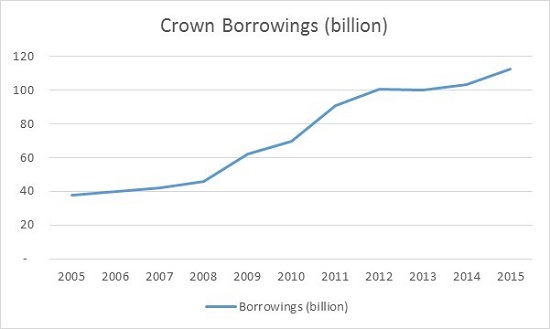
Source: Treasury – NZ Government Financial Statements 2015 page 25
You’re impressed, but you wouldn't clap yet. Because making something disappear isn't enough; you have to bring it back. That's why every magic trick has a third act, the hardest part, the part we call The Prestige.
In this case The Prestige was repaying that debt.
In line with the requirements of the Public Finance Act, and The Pledge, our magician must “reduce debt to prudent levels”.
The Prestige is the most impressive, dangerous and difficult act in the trick.
For this they will need their Beautiful Assistant, the Treasury.
The Assistant does some calculations and in Budget 2015 our Magician declares that if the surplus is reached, no matter how small, for just one year, and migration falls from 56,600 a year to 12,000 a year by mid 2017, oil rises to US$78 a barrel by 2019, dairy prices recovered to USD3,900 a tonne by the end of 2016, and short term wholesale interest rates stay steady at 3.6% until the end of 2016, tax cuts would magically appear!
The audience don’t know that the Assistant has been arguing for years, via the four year “Investment Statement” that New Zealand needs to repay debt.
It says while government borrowing was required for the recent economic downturn, repaying it is vital.
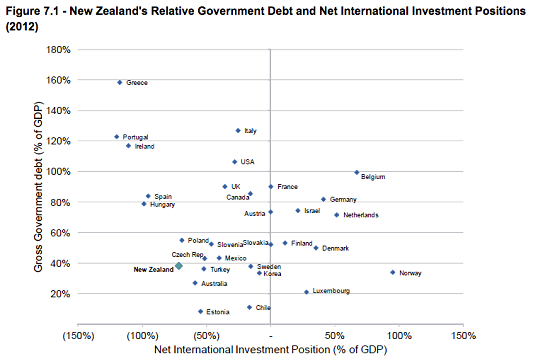
The Assistant points to the fact New Zealand’s big fiscal difference to the so called PIGS (Portugal, Ireland, Greece and Spain) countries is our relatively low government debt, which has been used up over the last few years, leaving no buffer, a buffer required under the Public Finance Act:
The Assistant knows that we are so reliant on overseas capital and the ageing Audience is so heavily indebted to foreign banks via their insatiable appetite for borrowing, that the prudent thing to do is either save or repay debt.
But this is the Magician’s show.
The Assistant’s job is to help out, and smile for the audience, to convey confidence in the Magician’s powers before The Prestige, the final dangerous act.
But there is a problem. The Audience gasps. The surplus can’t be maintained. There are questions over whether it really even existed, migration does not fall, dairy prices don’t recover, and short term interest rates begin to suddenly drop again.
But the Magician and the Assistant are prepared. In the Budget Policy Statement 2016, issued in December last year, words are changed.
The surplus doesn’t need to be maintained any longer, just as long as they outweigh the deficits over the next five years.
Repaying debt is pushed out from repayment in dollar terms in 2014/15 to 2017/18, and then to “around 20% of GDP by 2020”.
The “rapid” disappears from the rebuild of Christchurch.
The Magician has a new “Pledge” to introduce to the audience.
Tax Cuts.
They certainly know how to work a crowd.
So while the Beautiful Assistant knows the real prestige, the real magic is ensuring that New Zealand recognises and contributes to its full pension liabilities for the future, and that a sustainable surplus – not one financed by massive overseas borrowings – is achieved, that high ACC and EQC levies will offset any tax cuts, and that debt needs to be repaid to refill the “buffer” for future generations, the Assistant will not say anything.
It’s not their show.
The Prestige won’t come in Budget 2016, it won’t come in Budget 2017, and it won’t even come by the general election of 2017.
True Prestige is a much longer term goal: to repay the debt we have borrowed, and to eventually save for the risks we face in the future.
That is what the audience have come to see, but will they be fooled? Do they want to be fooled?
You see, anyone can make something disappear, the real prestige is making it reappear.
---------------------------------------------------------------------------------------------------------
*Cameron Preston is a Christchurch chartered accountant and homeowner who has longstanding unresolved quake insurance claims.
We welcome your comments below. If you are not already registered, please register to comment
Remember we welcome robust, respectful and insightful debate. We don't welcome abusive or defamatory comments and will de-register those repeatedly making such comments. Our current comment policy is here.