
By Bernard Hickey
How do New Zealanders get richer? It seems such an obvious question, but it's not one we think nearly deeply enough, and one we seem to be ignoring through our actions.
New Zealanders make a lot of wrong assumptions about wealth and income that hopefully our leaders shouldn't copy, but appear to be doing a lot of lately.
Let's cut to the chase first on what most New Zealanders think and do about wealth. Firstly, we get a regular and hopefully high paying job so we can save a deposit and then borrow a shedload to buy a house to live in. Then, if we're lucky, (which has meant living in Auckland over the last five years), we can further leverage those tax-free gains in our equity by buying a few rental properties, and/or investing in our own small businesses.
Once we've got the five rentals, the bach, the business, the boat and the BMW then we can sit back and live rentier-style into a comfortable retirement. We can then supplement a steady stream of rents and untaxed capital gains with a non-means tested pension that rises with average wages, rather than the much more measly inflation rate.
Perfecto! That's how we get wealthy in New Zealand. Or at least that's what the majority of the population has come to believe, despite the earnest exhortations from Reserve Bank Governors and Finance Ministers alike about the need to invest in real businesses to become more productive with every hour we work.
Understandably, Joe and Joesephine Public have just followed their noses and watched what the politicians and grown-ups have actually done themselves. They keep cutting interest rates and allowing tax-free capital gains, while at the same time ignoring the advice of their Tax Working Group that a land tax would change some of these behaviours.
A quick perusal of the Parliamentary Register of Pecuniary interests show most MPs own multiple houses, rental properties and baches. The phrase 'family trust' is the most popular in the document, followed quickly by 'rental property'. For example, Sue Moroney, a Labour List MP who targeted a Kyle Lockwood flag-flying bach owner in a tweet she apologised for this week, owns a home, an apartment, a bach and a rental property.
Yet everyone who has looked at wealth creation in any detail, and that includes the Government's own Productivity Commission and countless other experts, says the only sustainable path to increasing the wealth of New Zealanders is to increase the amount of goods and services we produce every hour. This is productivity and is what eventually increases real wages and supports the prices of assets we own. Asset prices can go up and down in the short term because of capital flows or supply shortages/surpluses or migration or more/less borrowing, but ultimately it's the ability to service a mortgage or a rent with an income that matters.
That's why the Government keeps banging on through its Business Growth Agenda about growing businesses that invest in their people and technology to produce exports. It's why the Productivity Commission has beavered away for the last five years investigating why New Zealand's productivity performance has been so poor over the last 50 years and what could be done about it.
It's still early days, but the Government has yet to really drink the Productivity Commission's Kool Aid. A bunch of its recommendations around competition policy, social services, land use planning and international freight have yet to be adopted, or have been allowed to quietly wither on the policy-making vine.
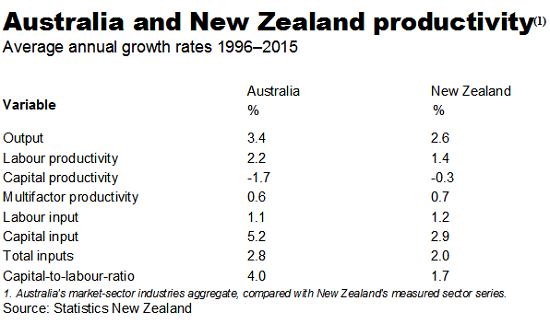
This is all showing through in the statistics for GDP, wages and in the gap between New Zealand and the rest of the world. No one noticed it, but last week Statistics New Zealand reported that labour productivity grew 0.3% in the year to March 2015, which was well below the already anaemic long-run average of 1.4% seen from 1996 to 2015. For comparison's sake, Australia's long run average over that period was 2.2%. Australia had a capital to labour ratio -- which measures how much technology businesses use and train their staff to use -- of 4.0 over the period, while New Zealand's was 1.7. These numbers may seem small and pointy-headed, but they're the reason why Australia's wages are 30% higher than New Zealand's.
All this is showing through in New Zealand's real income per capita, which fell 0.4% in the 2015 year, despite a 2.5% rise in total GDP for the year. We added more people working longer hours and added plenty of natural resources with a bit more capital, but didn't actually produce much more per person per hour worked. Business investment actually fell 1.1% in the December quarter and rose just 0.9% from a year ago.
It's the same old story. New Zealand has avoided the tough decisions about taxation, investment and competition and has simply bought growth by adding more resources -- more people, more hours, more land and more water. We're not working much smarter or using technology to make us richer.
The best current example is around migration. This week it emerged MBIE and Treasury warned the Government in December that a surge of an extra 50,000 working holiday makers and students per year could lower productivity.
"Migrants are meeting firm demands for labour and skills, but increasingly in low productivity growth industries and lower-wage and-skilled jobs," they wrote, adding they were concerned this would water down the Government's Business Growth Agenda objectives of improving skill levels and productivity.
The top categories for 'essential skills' visas applicants last year were tour guide, chef, dairy cattle farmer, cafe or restaurant manager, retail manager, dairy cattle farm worker, aged or disabled carer, truck driver, aged care nurse and winery cellar hand. Doctors, software engineers, and programmers didn't even make it into the Top 15 visa categories.
The OECD also criticised the Working Holiday Maker and International Student temporary visa schemes too in a 2014 report.
"Both of these are largely unmanaged, and there is little oversight of their working conditions," it wrote. "There seems to be some need of strengthening control in the lower-skilled occupations where competition with New Zealanders is most likely," it said.
Since that warning the student and working holiday maker numbers have surged by nearly 50,000 to over 250,000 a year, including 4,137 successful visa applications for tour guides in the eight months to February 2016.
The economy is getting bigger, but productivity has stalled. That is not a recipe to make everyone richer in the long run.
A version of this article was also published in the Herald on Sunday. It is here with permission.

We welcome your comments below. If you are not already registered, please register to comment
Remember we welcome robust, respectful and insightful debate. We don't welcome abusive or defamatory comments and will de-register those repeatedly making such comments. Our current comment policy is here.