
Today's Top 10 is a guest post from Motu research analysts Eyal Apatov, Kate Preston, Wilbur Townsend and Tom Carver. Motu is an economic and public policy research institute.
As always, we welcome your additions in the comment stream below or via email to david.chaston@interest.co.nz.
And if you're interested in contributing the occasional Top 10 yourself, contact gareth.vaughan@interest.co.nz.
See all previous Top 10s here.
1) The real reason Middle America should be angry.
This is one of a few recent articles challenging the quiet presumption that commerce authorities are competently policing well-designed competition laws – a presumption that has squeezed competition law into the wonkish footnotes of public debate. This article challenges that presumption, not with the usual trade-off between market power and efficient business models, but with a close study of the regional effects of those efficient business models. It catalogues the dismantling of local production in the United States’ Midwest and investigates the proximate causes: changes to infrastructure, to social networks and to corporate governance. It concludes that the dismantling was led by newly-consolidated businesses who would not have existed under stricter competition laws. Expect competition law to return to the headlines of public debate soon.
2) Should Labour oppose the TPPA? (Yes!)
According to Bradford Jensen, Dennis Quinn, and Stephen Weymouth from the NBER, opposing free-trade agreements is a great campaign strategy. Their (US based) study, suggests that with any one unit increase in the merchandise trade balance (as a % of GDP) was associated with a 4% increase in the share of votes for the incumbent president. Furthermore, the rate was especially strong among low-wages earners from swing states. Hear ye, hear ye Mr Little…
3) Panama Papers: the animated version.
A short, informative, and entertaining animated clip explaining the fuss about the “Panama Papers” using piggy banks.
This is a short but fascinating historiography of modern Europe from Yanis Varoufakis, the polarising former Greek Finance Minister.
Varoufakis narrates his own experiences as a child in a family resisting rule Junta rule and as a politician resisting German diktat. His narration vandalises the dichotomy of a technocratic Germany and an incompetent Greece with two aims: First, to demonstrate the impossibility of any European country separating itself from the European project; by describing the complicated connections between Germany and Greece he tries to show that the connections cannot be cleanly severed. Second, to escape the choice between Eurosceptic nationalism and the Brussels technocracy; by depicting the insanity of Europe’s current governance he tries to assure us that a saner Europe can be constructed. Given the importance of Europe to the global order, it should trouble us that his first aim is much more successful than his second.
5) The rise of employment in alternative work arrangements.
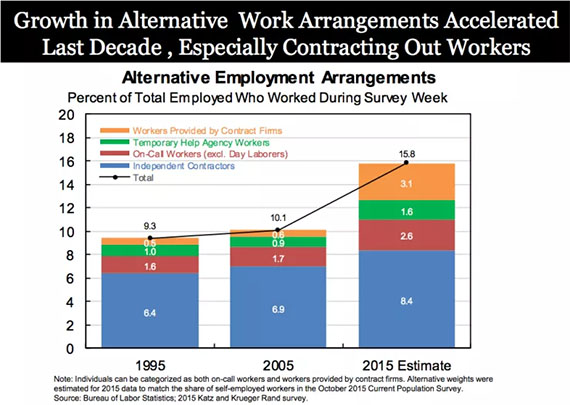
In the last ten years in the US, employment in temporary, gig, and contract work (e.g. Uber drivers) increased by around 5% every year. By 2015, this sort of work accounted for over 15% of all employment. Does this signals a movement towards a “better world” in which workers have more flexible employment arrangements and improve work-life balance, or is this merely a reflection of weak economic growth, with workers taking any job available?
6) Welcome to the future: Middle-class housing projects.
For those reading in Auckland wondering what will become of the city once every house is worth $2M, look no further than Silicon Valley (tip: Never say the word bubble three times in the mirror at night). This New Yorker article discusses the implications of housing subsidies for families earning 6 figures. Such subsidies are proposed in San Francisco and the Bay Area, where Palo Alto is exploring the possibility of subsidising housing for families earning between $150K-$250K USD. To many this may feel preposterous, but with middle class families increasingly squeezed out of the city by high earning tech employees, the issue is real. What, however, does it mean when teachers, police officers and nurses can no longer afford to live in the communities they service? Will the ‘poor’ middle class supplant the ‘old poor’ (many of whom live below the poverty line) in public concern?
This article presents the importance of gender equality in an economics perspective, describing some of the sexism ingrained in standard economic theory and statistical measures. GDP does not include measures of unpaid productivity including childcare and housework. This can distort a government’s goals if they ignore the benefits of such important contributions to the economy.
8) Incentive compatible advertising on a social network.
Are you looking for a way to draw attention to your research output? A trailer could be the perfect solution. This preview of Kfir Eliaz and Ran Spiegler’s “yet to be submitted” working paper is “an inspiration” for all researchers.
9) A job-creating powerhouse? The way we measure unemployment can lead to misleading conclusions.
Monica Threlfall from London Metropolitan University explains the common misinterpretation that the unemployment rate is a measure of those without work in an entire population. She reminds us that the unemployment rate is in fact the proportion of unemployed in the labour force, where the labour force is all those who are employed or actively seeking employment. Unemployment within a total population can be termed the unemployment ratio. While media has portrayed that around half of all young people (16 to 25 year olds) in Spain and Greece are unemployed, the actual youth unemployment ratios are considerably lower. On the other hand, many may be surprised to know that the UK has the 7th worst unemployment ratio in the EU.
10) Mathematicians mapped out every “Game of Thrones” relationship to find the main character.
Much as you may try, it is impossible to avoid groups of Game of Thrones fans arguing over their favourite characters (even worse are all of the terrible “winter is coming” jokes now that summer is well and truly behind us). Thankfully Mathematics is here to end the arguments. Researchers at Macalester College in the US used network science (a branch of applied graph theory) to turn Game of Thrones into a social network. Using the third book in the series, A Storm of Swords, they determined that Tyrion was the true ‘main’ character – with the most important connections with other characters. Anyone arguing that it’s not appropriate to judge characters from the Fantasy Middle Ages as if they were trending on Twitter is invited to a wedding.
18 Comments
#1 and 2 relate and is a problem in NZ where many jobs have been exported as industries try the easy route to cut costs and improve on profits. Greed chasing the short term dollar. This is the free market economy at work and is inevitable. Balanced regulation is needed to control it.
#5 I have heard Judith Collins try to wax lyrical on Nationals tinkering with out labour laws to "have more flexible employment arrangements" but the claim that this results in "improve[d] work-life balance is pure BS as workers trapped in this arrangement tend to spend their time working multiple jobs at or near the minimum wage, very little protection and a significantly worse work-life balance. This is just another way to create a new form of slavery.
#6 Last I heard the average income in the US was in the $40 - $50K range, so the average worker is still shut out...
Murray86. The term 'free market' is interesting. The last thing the cartels who are extorting us want is a free market. Rather they move into positions where they have major market control, eliminate free markets, and they are prepared to go to great lengths to maintain that position. That includes influencing government.
Look at the position if you are a grower of vegetables for instance. Or want to start up as a small innovative grocery item manufacturer. Or indeed a contractor seeking work with Fonterra.
We only have two big grocery chains. As a small new supplier you are screwed from the start.
We need 'free markets' in my view, and that idea would challenge the position of the big cartels we have in energy, banking and building supplies. (and the rest)
I agree with you there is a need for regulation. My expectation of government it not that it becomes a player, but becomes a strong referee.
Your last comment is my whole intent. The term "free" - by definition means free of regulation and therefore as you identify, the big players are able to force the smaller ones out. This in many industries will also stifle innovation. This as we see in so many areas this leads to imbalance and corruption.
Murray86. The term 'free market' is interesting. The last thing the cartels who are extorting us want is a free market. Rather they move into positions where they have major market control, eliminate free markets, and they are prepared to go to great lengths to maintain that position. That includes influencing government.
Look at the position if you are a grower of vegetables for instance. Or want to start up as a small innovative grocery item manufacturer. Or indeed a contractor seeking work with Fonterra.
We only have two big grocery chains. As a small new supplier you are screwed from the start.
We need 'free markets' in my view, and that idea would challenge the position of the big cartels we have in energy, banking and building supplies. (and the rest)
I agree with you there is a need for regulation. My expectation of government it not that it becomes a player, but becomes a strong referee.
I like the idea of middle class housing projects. At least the middle class will have somewhere to live even if they have to rent it. It will also be cheaper to provide the poorest 50% of the population with cardboard boxes to live in. What could possibly go wrong with their health, standard of living or the future productivity of the nation?
#1: It's also a reason why middle New Zealand should be angry
Thanks for most of these links.
The only odd ones out are 8 and 10, the rest were all very timely and interesting, different facets of the same issue
The World’s Favorite New Tax Haven Is the United States
"Last September, at a law firm overlooking San Francisco Bay, Andrew Penney, a managing director at Rothschild & Co., gave a talk on how the world’s wealthy elite can avoid paying taxes.
His message was clear: You can help your clients move their fortunes to the United States, free of taxes and hidden from their governments.
Some are calling it the new Switzerland."
http://www.bloomberg.com/news/articles/2016-01-27/the-world-s-favorite-…
John Key, does that ring a bell??
Now that David Cameron is confirmed as having been benefitted, will the Panama Papers scandal go away quickly ? God save the Queen.
JK's claims only the opposition are using the term for NZ as tax haven are again wrong
even our so called new friends are not happy expect a phone call JK to explain why you have done nothing
"But in China, where news outlets and social media is heavily censored by the Communist government, reports were conspicuously absent.
Its state news agency, Xinhua, appeared to have only one report on its English language website, criticising New Zealand's “shameful complicity” in the schemes "
http://www.afr.com/business/banking-and-finance/the-panama-papers-nz--t…
... I cant remember when jk was last right. God he must have his fingers crossed that one of the Kardashians has a drup overdose or new boob job.....the damn flag change was supposed to keep us distracted for a few more months, but that go messed up...labours fault of course.
Don't forget that Richie has been involved in some sort of endurance race for the last 4/5 days and JK hasn't been able to ask him for advice lately.As long as Richie pulls up ok JK will be back to his spectacular self shortly.
#10. Well, there are a few characters (and common taters) that could benefit from meeting up with the Caretaker from Hogwarts.....
Something about Panama Papers
- keep it under your hat....
https://www.youtube.com/watch?v=KS1oJkGgeYg
Further economic analysis
http://www.bbc.co.uk/programmes/b075thgv
The Guardian's Foreign Correspondent Luke Harding discusses what it was like to investigate the Panama Papers.
#4
the entire Labor party and the Trade Unions controlled by it are now against Brexit, apart from a handful of its members in Parliament. So, what has changed since 1975? Has the EU moved to the Left, or is it the other way round, i.e. the Left is today theoretically and politically bankrupt and has been fully integrated into the NWO of neoliberal globalization?
http://www.globalresearch.ca/brexit-globalization-and-the-bankruptcy-of…
Just think, in a few years from now all this power will be in the hands of ordinary people
Intel's fastest 22-core Broadwell chip comes to new servers
http://www.pcworld.com/article/3050302/intels-fastest-22-core-broadwell…
Nvidia's monstrous Pascal GPU is packed with cutting-edge tech and 15 billion transistors
The birth of this chip required "five miracles."
http://www.pcworld.com/article/3052312/components-graphics/nvidias-mons…
I note the clever animators a vox using their little piggy banks manage to get in a little anti Putin propaganda while failing to mention David Camerons father and in fact the whole Panama Papers scandal has avoided anyone who is anything in the USA ,except that mover and shaker, Tina Turner. She obviously didn't get the memo to use the Caymen Islands. Why don't the clever little piggy bank animators show how the western banking system profits from death and destruction and is in desperate need of a third world war to hide their corrupt mismanagement of the financial system.
No wonder they are mad at Putin. He thwarted their attempts to create chaos and war in Syria,twice, and now he has negotiated a ceasefire between Armenia and Azerbaijan. But lets all write headlines about his friends financial misdeeds and keep the public prepped for Hero USA to attack evil Russia.
https://www.youtube.com/watch?v=5hfEBupAeo4
We welcome your comments below. If you are not already registered, please register to comment
Remember we welcome robust, respectful and insightful debate. We don't welcome abusive or defamatory comments and will de-register those repeatedly making such comments. Our current comment policy is here.