
Today's Top 10 is a guest post from Selena Eaqub, an economist and co-author of Generation Rent - rethinking New Zealand's priorities. She has previously worked for Goldman Sachs JBWere, the Reserve Bank and Statistics New Zealand.
As always, we welcome your additions in the comment stream below or via email to david.chaston@interest.co.nz. And if you're interested in contributing the occasional Top 10 yourself, contact gareth.vaughan@interest.co.nz.
See all previous Top 10s here.
1. NIMBYs rule their roosts everywhere
Last week Auckland’s Unitary Plan stalled because of lobby groups Auckland 2040 and the Character Coalition. Essentially, these lobby groups are calling for a judicial review, which means that plans to grow housing in Auckland are held up for at least a year in court. It may add to costs for developers to build more homes because they have to compare both the old planning rules and the new. The NIMBYs are holding the rest of Auckland to ransom.
We are not alone in these problems. As reported by the BBC, The British Communities Secretary Sajid Javid urged NIMBYs in the UK to be fair to the next generation. In fact, it is our moral duty:
We have got to change that attitude. Of course there are sometimes some valid reasons for opposing some local planning applications - if they are in the wrong place, if there is not enough infrastructure or if they are just plain ugly, but all of us we have a duty to think of the long-term consequences of every decision we make. We have a responsibility to build more houses, a responsibility not just to our constituents but to the next generation.
2. NZ building bigger houses
Statistics New Zealand reported that we are building bigger houses. The total floor area fell during the global financial crisis but is starting to creep up again.
In New Zealand, it is more profitable for developers to build bigger houses but unfortunately much of the demand is for smaller houses. An ageing population is driving the demand for smaller houses.
Statistics New Zealand reported that:
Fewer homes are being built now than in the 1970s, but they are much bigger…
“The number of homes we’re building is lower than in the mid-1970s, but we’re building more in terms of total floor area,” business indicators senior manager Neil Kelly said. “This is because houses are now so much bigger than they used to be.”
Consented homes nowadays are over 60% bigger than they were in the 1970s.
As seen in the chart below, the floor area of the average new dwelling has risen since the 1970s, but has been broadly stable at around 210 square metres for houses and apartments and houses tend to more smaller at closer to 110 square metres.

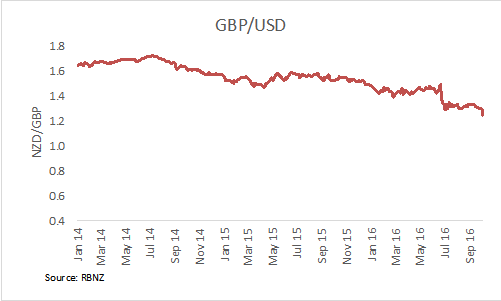
3. BREXIT pain: GBP at 31 year low
Last week British Prime Minister Theresa May gave Brexit a definitive timeline and confirmed that she is serious about UK leaving Europe. This has taken away any hopes of a softer approach and the pound reached a 31 year low.
Having more certainty on Brexit has taken away some of the global risks for NZ. NZ is very susceptible to what happens overseas, being a small open economy. Exports are a key driver for GDP movements and this is influenced by global economic activity.
Now uncertainty remains from the United States election - the result coming on 8 November 2016. At the time of writing this top 10, Trump made a huge blunder by making lewd comments about women and polls were poor following the latest debate. It is looking less likely he will be President because Republican candidates are no longer supporting him. Trump winning the election would be negative for NZ because he is anti-globalisation.
Here is a chart from ANZ of the NZD vs the British pound:
4. Brexit and the Kiwi OE
Kiwis have been told by the British High Commission to relax about a potential crackdown on immigration in Britain, as reported by Stuff.
While NZ’s may still want to go to Britain for their OE, the job market there remains uncertain, as reported by FT. Jobs fell, but we really need more data to understand what is going on:
Kevin Green, REC’s chief executive, said the jobs market “suffered a dramatic freefall in July, with permanent hiring dropping to levels not seen since the recession of 2009.” However, he added that it was important not to jump to conclusions from one month’s worth of data.
“The truth is we don’t know what long-term consequences the referendum result will have on UK jobs; with the political situation becoming more stable and the Bank of England making sensible decisions, we may well see confidence return to the jobs market more quickly than anticipated.
5. Growth needs fiscal stimulus, monetary tools out of ammo
Good news from the IMF economists that economies overseas have room to grow. IMF economists are telling world leaders that they aren’t out of ammo yet. One key issues of today is whether economies will grow when interest rates are very low and debt levels are high. A central governments key lever to encourage growth is to lower interest rates, which doesn’t work so well if they are already low. The IMF economists argue that it is possible to revive growth:
Even though interest rates around the world are bumping along the floor and government debt loads are heavy, they say that there is still room for fiscal, monetary and structural policies to lift global growth provided they are “comprehensive, consistent and coordinated.”…
To emphasise that policies have to be tailored to the economic circumstances in each country, the IMF economists present model-based simulations of the contrasting cases of Canada, which has a relatively light government debt burden, and Japan, which has a very heavy one, to make their point.
In the simulation, Canada deploys fiscal stimulus to offset any negative shock and help the central bank boost inflation to meet its inflation target. For heavily indebted Japan, they simulate a set of policies they dub “Three Arrows Plus” (after Prime Minister Shinzo Abe’s three-arrow policy of fiscal, monetary and structural reform.) The policies prescribed for Japan include a government policy to promote wage increases, a stronger Bank of Japan commitment to meet its inflation target, a very gradual increase in the value-added tax and labor market reforms.
Hopefully this means that growth overseas will improve the NZ economy, which is sensitive to global markets.
The advice to world leaders seemed to have worked. IMF members are pledging to revive flagging global trade, boost government spending and remove barriers to business to revive growth, as reported by Reuters. They are coordinating attempts to boost growth for maximum impact. These pledges in the past have not delivered much.
"The persistently low growth has exposed underlying structural weaknesses and risks further dampening potential growth and prospects for inclusiveness," the Fund's steering committee said in a communiqué:
“We reinforce our commitment to strong, sustainable, inclusive, job-rich and more balanced growth. We will use all policy tools - structural reforms, fiscal and monetary policies - both individually and collectively,"
6. Finding the right people for the right jobs
A London School of Economics article looks at the practical difficulties of identifying skills shortages and skill gaps. It is increasingly important in the UK (similarly in NZ) that immigration settings truly bring in the skills New Zealand needs to meet skill shortages.
Skill shortages occur when a vacancy is hard to fill because of a lack of skills, qualifications or experience. Skill gaps occur when an employee is not fully proficient at their job. As explained by the article, problems occur when:
- HR practitioners might use their influence to manipulate reports of skills deficits, for example to justify their recruitment and training budgets
- Employers are to blame through areas such as a lack of training and poor recruitment
- Differences in managers reporting skills gaps ie. Whether an employee is fully proficient at their job
The report concludes that such data collection is still important, but may need to be refined. Here they talk about the survey in question called the Employer Skills Survey (ESS)
The focus should be on further developing the ESS questions, alongside initiatives to complement the ESS, so that a holistic picture can be gained. Additions could include a large-scale qualitative phase to help contextualise the findings; and involving other managers in the survey, alongside HR respondents. By triangulating multiple sources of information and improving the current ESS methodology, skills policy may be better targeted where it is most needed.
7. Child poverty: targets are easy, not solving them
John Key has rejected the Children Commissioner's call to reduce poverty by 10%. Part of the reason he explains is there are too many measures of poverty and choosing is “too difficult”.
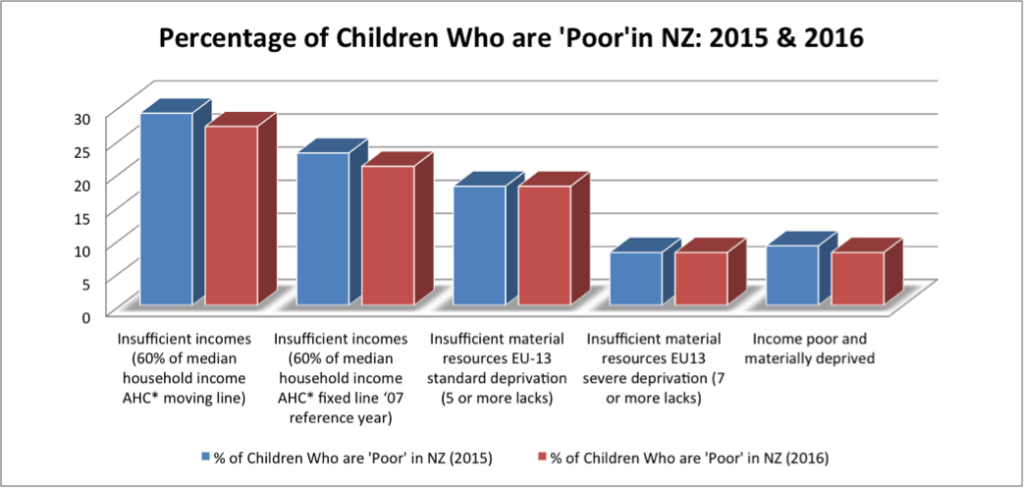
This article by Max Rashbrooke explains it’s pretty straightforward. Data from the Household Incomes report has two main measures of child poverty:
In line with a growing international consensus, the report, in crude terms, has two key ways to measure poverty. Neither is perfect, but between them, they give us an excellent idea of the scope of the problem.
The first thing is to simply measure income - most commonly, how many children are living in families that have less than 60% of the average income (adjusted for household size, and before housing costs). That means, for instance, having less than $785 a week after tax if you're a couple with one child.
That line is chosen because we know, from household budgets and from decades of international experience, that most people with less than that income will really struggle to have a minimally decent life. That's known as income poverty, and that affects around 220,000 children.
The second thing is to ask families what they go without. Are they unable to afford to heat their house, or buy their kids decent clothes and shoes? That's known as material deprivation, and it affects around 155,000 children.
You need to use both those measures because, as we can see, they give different results, often as a result of other things going on in families' lives. Some families under the income poverty line manage to give their kids the necessities of life because they have wealth to draw on, for instance.
In another report by Dr Jess Berentson-Shaw, she says it’s not rocket science:
It is completely possible for the Government to have target, and such a target would be more robust than some of the Government’s existing targets. Having a child poverty target is commonplace overseas and indeed it is required by the United Nations. So the question is “what are you waiting for Prime Minister?”
Dr Jess Berentson-Shaw also shows the graph below which the Government already reports – all of which can be used as targets.
8. Child poverty a life sentence
Getting stuck on which measure to use to identify child poverty is a real shame. As reported by New Science, this is not a trivial matter. Child poverty is a life sentence.
Politicians have a real duty to do something other than pay lip service… Science cannot tell politicians what to do, but it can alert them to hard-to-see problems. On child poverty, the evidence is solid and growing. Wherever you stand on the political spectrum, it ought to be clear that tackling child poverty and its lifelong consequences is not a political choice but a humanitarian duty.
9. Local election turnout down
Local government voter turnout is down this year to less than 40% vs 49% in 2010. The Otago Daily Times explained some of the reasons why voter turnout is down. Dr Jacky Zvulun, who in his 2009 University of Otago PhD studied voter turnout and electoral participation in New Zealand, stated a variety of reasons why voter turnout is low:
…busier 21st century lives, a lack of motivation through the print media, a voter base disconnected to the issues of the day, and even a public tiring of postal voting as a child tires of a new toy… One of the problems, he said, was that internationally, people had "lost empathy with politics".
"If you look at the last century, we had big [world] wars; people were motivated to go and vote."
"But by the 1990s, when the decline started, "people get to the stage they have everything".
"It doesn't matter. They're not really interested in politics, they're looking at their own space."
He also ruled out that it was due to postal voting and if postal voting were to be taken away, it would make voter turnout worse.
10. Unconventional monetary policy not new
This Vox article demonstrates that today’s unconventional policies are nothing new and we are merely repeating history, albeit in different ways. Between 1791 and 1821, the Bank of England suspended the convertibility of bank notes to gold.
The Bank of England – which was not yet a central bank in the modern sense, though it was already beginning to play a public role – had suffered a significant drain in its reserves from the mid-1790s. In 1797 it suspended convertibility of its notes into gold. It also issued small denomination notes for the first time. Banknotes became increasingly important as a means of payment
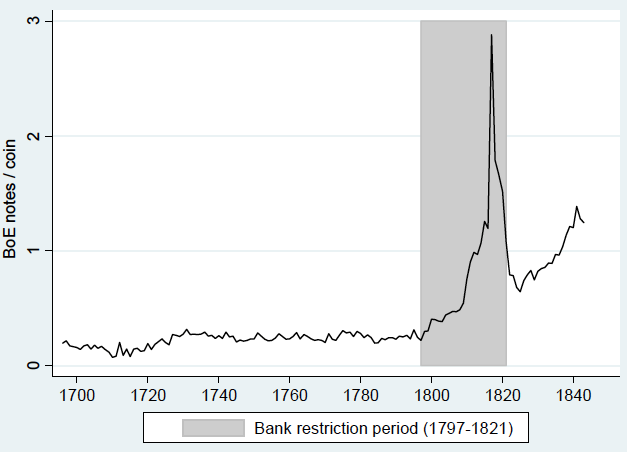
Monetary policy during the restriction period 1797-1821 was highly unconventional for the standards of the time. It would, though, be incorrect to say that it was similar to modern 'unconventional' policy, such as quantitative easing. Modern unconventional policies apply in an environment in which the short-term interest rate is zero, and hence traditional (or conventional) open-market operations are ineffective. In these conditions, central banks engage in alternative policies including the purchase of government debt of longer maturities or of commercial debt of good quality. They may also promise to keep rates at zero for a period of time to manage expectations ('forward guidance').
We welcome your comments below. If you are not already registered, please register to comment
Remember we welcome robust, respectful and insightful debate. We don't welcome abusive or defamatory comments and will de-register those repeatedly making such comments. Our current comment policy is here.