

Non-performing housing loans topped the $1.5 billion mark at the end of 2023 and rose by some 78.5% ($667 million) during the year.
This is according to the latest Reserve Bank loans by asset quality figures for December, which give the total non-performing housing loans as $1.517 billion at the end of 2023, up from $850 million as at December 2022.
That's the 'headline' news if you like, but to give it some perspective, the latest non-performing loan figure represents 0.43% of total housing loans ($349.687 billion). And while that percentage is up from 0.25% as of the end of 2022, it's rising from a very low base and compares with peak non-performing levels of 1.2% that were seen between 2009 and 2011.
The RBNZ figures show that the non-performing home loans figure rose by $34 million between November 2023 and December 2023 and there's no obvious sign at this stage of a particularly worsening or increasing rate of stress in the face of the much higher interest costs that householders are now facing.
Separate data from the RBNZ shows that the interest bill for NZ's mortgage holders in 2023 was a whopping $17.694 billion, which was up from $11.999 billion in 2022 - a 47.5% increase.
As a personal comment, I would have expected a sharper rise in non-performing housing loans given the sheer size of some of the loans taken out during the period in which interest rates were at such historically low levels - and the subsequent massive hikes seen, which have seen increases in the order of over 50% for some monthly payment bills.
But it does have to be taken into account that a lot of households appear to have built good buffers for themselves in the 2020-21 pandemic period when interest rates were virtually non-existent.
So, it then becomes a question of whether we will see an increase in those stress levels as buffers run out - and for how long will interest rates stay at these levels.
Looking beyond housing, we can see that some definite pockets of stress are forming within the economy. The commercial property sector has seen a sharp rise in non-performing loan levels over the past 12 months - again from low levels. And within business lending, the small and medium sized enterprises (SMEs) have seen some big rises and this looks like a worsening trend.
The RBNZ's published information on the detailed sectoral lending breakdown goes back just to 2018, but there is a 'long-run' series that takes in the the overall non-performing loan ratios going back to 2008, and so this captures the post-GFC high levels.
Here is an edited version of the RBNZ spreadsheet from this series that shows what's happened to the various non-performing loan levels over 2023.
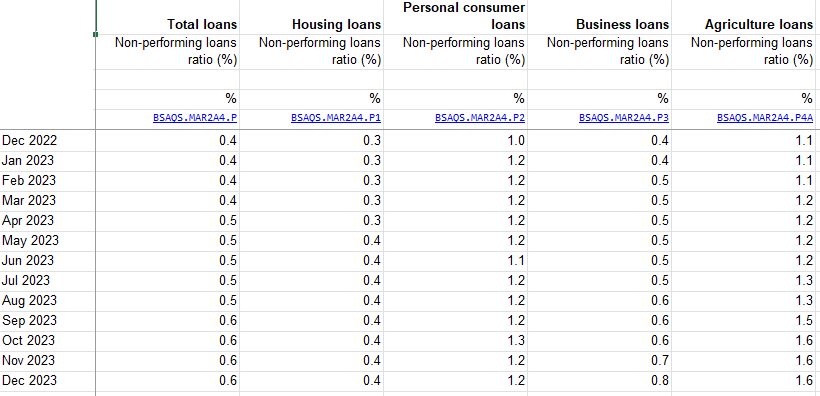
To fill in some detail, the total 'system' non-performing loans as at December 2023 were $3.552 billion, which makes up 0.64% of the total loans of $556.605 billion.
As at December 2022 the system wide non-performing loans had stood at $2.143 billion.
To give historical perspective, the peak system non-performing loans percentage hit was some 2.2% in 2011 - so we are a long way shy of that at the moment.
In terms of business loans, the rise from a non-performing ratio of just 0.4% in December 2022 to 0.8% a year later is quite sharp - but again the figure is well short of the post GFC high, which was 3.0% in 2011. Likewise the agriculture figure is up, but the 1.6% as of December 2023 compares with a post GFC high of 4.5% in 2011.
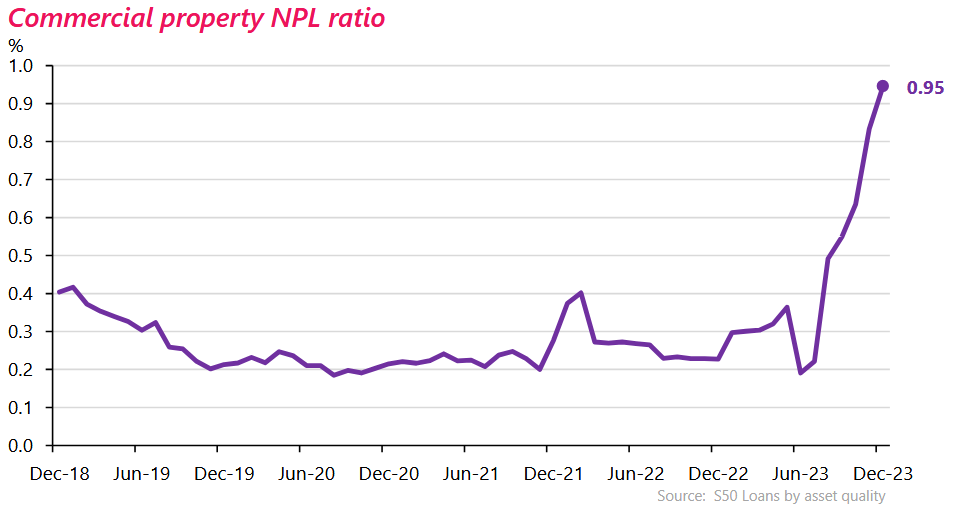
To go back to some of those particular pockets of stress that are forming, however, we can see that non-performing commercial property loans have exactly quadrupled during the past year, rising from $101 million in December 2022 to $404 million in December 2023. The percentage of non-performing commercial property loans has risen from 0.2% to 09% in that period, with total commercial property loans standing at $42.751 billion.
Worryingly, much of the increase in the non-performing loan levels for commercial property came in the second half of 2023.
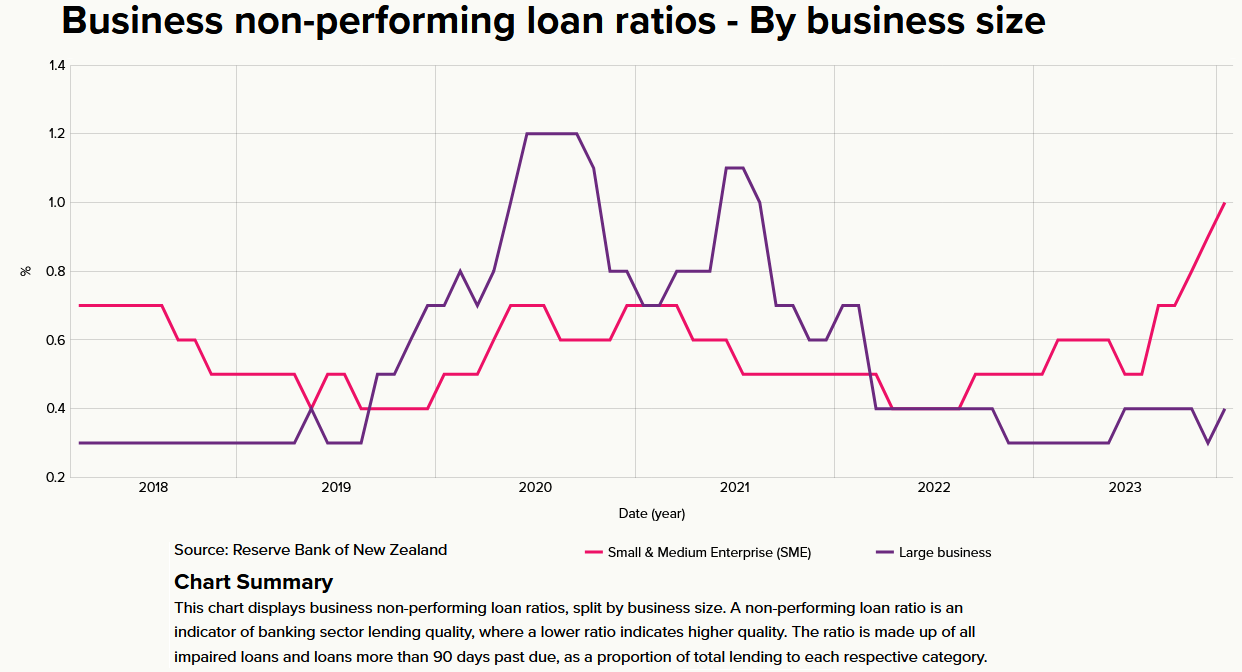
And then there's the SMEs. The RBNZ's detailed business loans data shows that large business loans are looking fairly robust. But there's signs that the position for SMEs has deteriorated quite sharply as 2023 has gone on.
Non-performing loans for SMEs more than doubled during 2023 to $758 million from $366 million and most of this increase came in the second half of the year.
The percentage of non-performing loans by amount went from 0.5% to 1.0%. The total amount of loans is $76.385 billion. It's worth noting also that the total amount has dropped during the year from $78.085 billion as at December 2022.
I guess the question with all of the figures quoted in this article is: Will this prove to be the peak of stress, or is there more to come? The SME and commercial property figures particularly, and the sharp deterioration of those figures in the back half of 2023, don't seem to bode well.
We welcome your comments below. If you are not already registered, please register to comment
Remember we welcome robust, respectful and insightful debate. We don't welcome abusive or defamatory comments and will de-register those repeatedly making such comments. Our current comment policy is here.