

In a preview of this year written towards the end of 2023, I styled 2024 as the Year of Finding Out.
That particular title was, as much as anything, a reference to inflation. But I also included GDP/the economy and the labour market/unemployment in the mix. So, specifically, I reckoned we would find out if the efforts of the Reserve Bank (RBNZ) to tame the inflation monster were going to work. We would find out too if the economy might drop off the proverbial cliff. And we would find out how many people would lose jobs.
As we reach the halfway point of 2024 (yes, where did those six months go?) it is - frustratingly - not possible to say we've 'found out' everything we needed yet. I think we still will - but it's going to take the second half of the year for us to get there. Maybe not all the answers will be good.
On those three key things mentioned above, inflation - with big caveats attached - is heading the right way. But we can't definitively say it is under control. Not yet. I had actually hoped we might have a clearer picture by now - but we don't. It's still mixed.
Unemployment is rising as it was meant to - but with signs that's beginning to happen faster than was expected and/or desirable.
The economy. Now that's a big worry for me. A big worry. The optimist will look at the June 20 announcement of a 0.2% rise in GDP in the March quarter, which technically lifted us out of recession, as a sign that things are looking up. I tend to side with the observer who said that GDP figure "may well prove to be a dead cat bounce". Never mind the figures. Does it feel to you like our economy is growing?
Before I go on, context is important. Remember that in mid-2022 our annual rate of inflation peaked at 7.3%. Bad. The RBNZ is tasked with keeping inflation between 1% and 3%. Its weapon of choice if inflation is out of control is the Official Cash Rate - through which it influences the interest rates we pay. Through this the RBNZ can take the heat out of the economy by making us spend less. The Official Cash Rate was hiked, rapidly, from 0.25% as of October 2021 to 5.5% as of May 2023. Then the RBNZ hit the pause button.
The trouble is the OCR is a very blunt instrument. The lead times for the impact of increases in it are long. Only about a third of people have a mortgage - and they are a major first line of attack for OCR moves. But it means two thirds of the population, arguably, are not immediately directly affected.
What all this means is that potentially the RBNZ could 'overcook' the OCR hikes and it would be some time before that was clearly apparent.
Okay, so, at this point I'll go through some of the key economic data, including some that goes back into 2023, but was not released till either very late in that year or in the first part of 2024.
The December quarter Consumers Price Index (CPI) released in January 2024 showed annual inflation slowing to 4.7% from 5.6% and then the March quarter CPI showed a further reduction to 4.0%. Frustratingly for the RBNZ though, the so-called non-tradables, domestically-sourced, inflation slowed only slightly from 5.9% to 5.8% - way above the RBNZ's forecast of 5.3%. And it's that non-tradables figure that matters for the RBNZ, with RBNZ Governor admitting to being "annoyed" that the home grown inflation component had "barely budged".
We don't get interest rate relief till we've got low inflation
An annoyed Governor is not a Governor about to cut interest rates.
So, halfway through 2024 we don't have a clear picture of when there will be some easing of the high interest rates.
Unemployment was as low as 3.2% in 2022, but had just ticked up a little to 3.4% at the start of 2023. Then by December 2023 it was 4.0%. Then, in figures released on May 1 this year, we learned that the unemployment rate as at the March quarter 2024 had risen to 4.3% - ahead of the RBNZ's forecast of 4.2%.
What of GDP? I have to say I think the lack of timeliness of our GDP figures is a worry. We need to be able to get a faster, at least snapshot, of how the economy is performing.
At the time I wrote my previews for 2024 (in late November), it was in the belief that we had managed to completely avoid a recession last year. How wrong that was. This was before the September quarter GDP figures turned up - they were not released till December 14, 2023. And they were a huge game-changer. The RBNZ at that time was not forecasting any future recession. And it had forecast 0.3% growth for the September quarter. Instead. BANG. The figure was MINUS 0.3%.
It was worse than that, however. There were substantial downward revisions to earlier quarters, producing a kind of posthumous 'recession' (two consecutive negative quarters) earlier in 2023 that nobody knew we had even had.
When the December quarter 2023 GDP figures finally saw the light of day in late March 2024 they also had a 'minus' sign in front of them - meaning that between September's contraction and another drop in GDP for the December quarter we had gone into recession again. A double dip!
Of course, the March quarter GDP figures released on June 20, 2024 showed that in the quarter our economy grew by 0.2%. Recession over! Apparently. But have a look at the details:
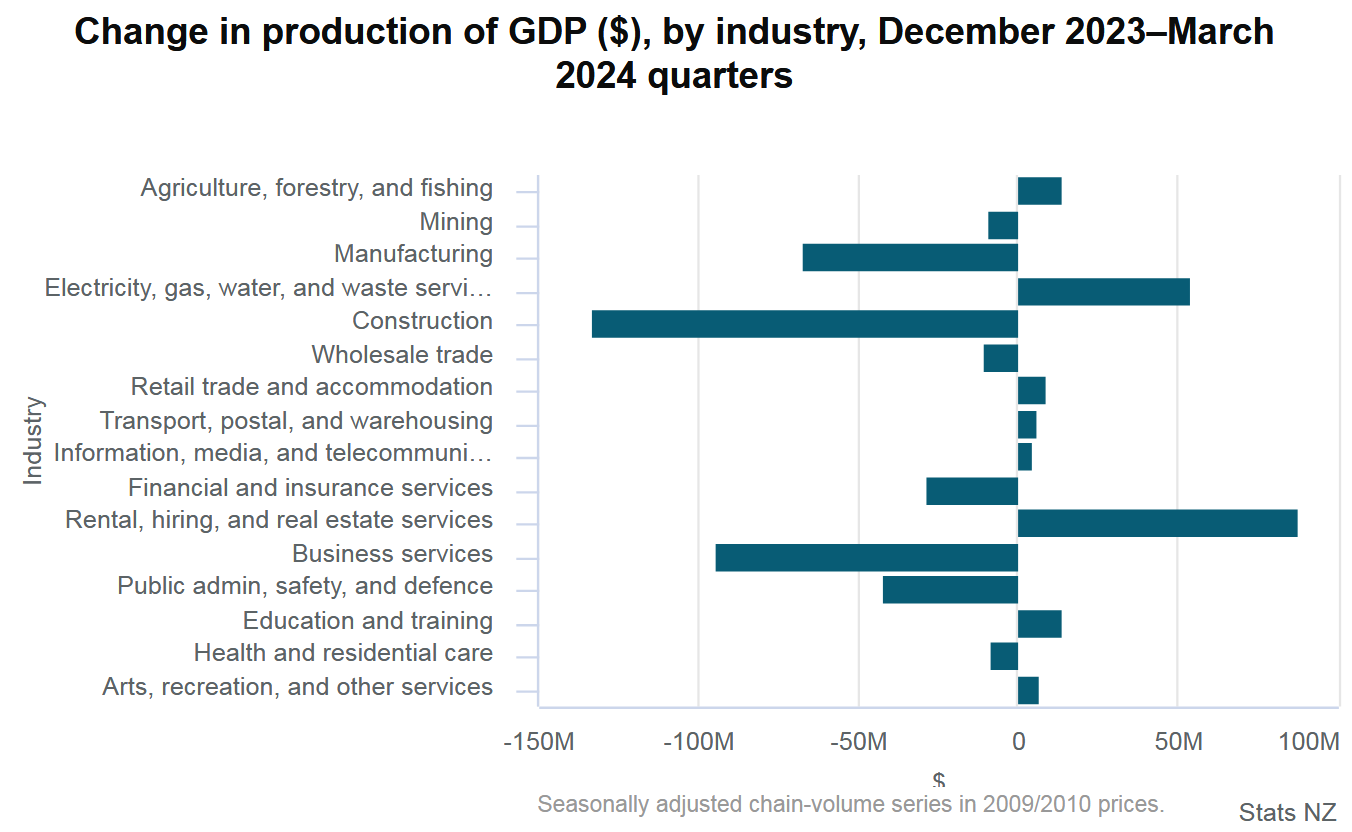
Sorry, but that's not a picture of an overall economy in good shape.
Remember also that, according to Statistics NZ estimates, in the year to March 2024 our population grew by about 130,000, or 2.5% - largely on the back of a massive surge in immigration. This immigration surge soaked up the previous slack in the labour market. Additionally the extra bodies in the economy - what they were producing and what they were consuming - helped to mask the fact that the underlying economy was declining.
The March quarter 2024 GDP figures showed that on a per capita basis our economy actually contracted for the sixth consecutive quarter, by 0.3%.
This doesn't look like an economy in recovery mode
This means that since late 2022 our economy, on a per capita basis, has shrunk by 4.3%. Now that's a BIGGER fall than the 4.2% per capita fall we saw in the wake of the Global Financial Crisis.
I've just highlighted some of the 'key' economic data. As I said above, a lot of this stuff is not particularly timely. The GDP figures were just up to March. What's happened since?
Well, that's where I think some of the more second-level economic information released just very recently has been of concern.
I think some of this data is suggesting an economy that, far from being in recovery, is now beginning to really roll over in a very significant and not-at-all-good way.
For example:
Electronic card transaction data for May showed the fourth consecutive monthly drop in retail sales - and this was the biggest drop of the four. The wallets have been put away. Businesses that have been doing it tough are finding it's suddenly getting even tougher.
According to the latest BNZ-SEEK job ads report job ads fell 4.8% in May. This follows a similar sized drop in April, taking job ads’ annual decline to 30.5%. Aside from Covid lockdown periods, job ads are at their lowest level since February 2016. This is a clear sign of continued contraction in the labour market.
The BNZ – BusinessNZ Performance of Services Index (PSI), which has been going since 2007, recorded the lowest level of activity for a non-COVID lockdown month since the survey began. The services sector accounts for about two-thirds of GDP. If it is sagging the economy is sagging. Big time. The earlier released Performance of Manufacturing Index was "soft" as well. BNZ economists suggest that between these two indexes it all "points to GDP falling by more than many might care to believe" in the June quarter that's about to end.
This is not looking like an economy in recovery. It looks like an economy still on the way down.
Gloom has returned to the housing market
House prices are going backwards again, with the median price falling 2.5% in May, according to the Real Estate Institute of NZ (REINZ), and dropping 1.2% after seasonal adjustment. And there's a glut of available houses.
The house price news will hurt. I don't think you can overstate how much of a psychological impact the housing market has on Kiwis. We are hugely invested in the housing market both financially and emotionally. When house prices go up, the mood of the nation goes up. When they go down, or are even just in the doldrums, the mood goes down.
And I think that's about where we are now as we get to the halfway point in the year. House prices starting to fall again are the over-ripe cherry on top of an increasingly soggy cake.
How to explain all this?
It was always my concern that through this high interest rate period there would be an outward picture of everybody carrying on with life as if things were okay and then, 'suddenly', everything would all drop in a heap.
Of course, what we are seeing is not really sudden. It's the cumulative rolling impact.
It all looked better than it was
I mentioned above that only about a third of the population have a mortgage. The OCR hikes had a very direct impact on them. But not immediately. For a start, most people are on fixed rate mortgages, so, there's a delayed impact when interest rates go up.
During the pandemic period a lot of people were able to salt away a good deal of rainy day money. Many people with mortgages took advantage of the super low interest rates to get well ahead with their mortgage payments.
New Zealanders are a phlegmatic bunch, who mind their own business and get on with things. It was never going to be apparent on the face of things when savings buffers were starting to run out and when the leeway that had been established on the mortgage payments was starting to be used up. Until suddenly. Here we go.
And once the struggles start to become apparent, this mood becomes contagious. People who don't have a mortgage and to all intents and purposes are doing 'fine' suddenly decide they too should stop spending money, well, because, it's grim out there. Better save.
And the economy grinds to a halt…
Halfway through 2024, this is where we appear to be - in grimace-and bear-it mode.
Where to from here?
Stay tuned, because this is going to be a 'two-parter'. I will have a go at looking forward at the next six months and the things I’ll be watching out for. That will be coming up soon. In the meantime, take it easy. It’s cold out there.
*This article was first published in our email for paying subscribers early on Friday morning. See here for more details and how to subscribe.
We welcome your comments below. If you are not already registered, please register to comment
Remember we welcome robust, respectful and insightful debate. We don't welcome abusive or defamatory comments and will de-register those repeatedly making such comments. Our current comment policy is here.