

Over half of the country's mortgage pile is due to have its interest rate reset within six months, according to the latest figures from the Reserve Bank.
We've reported previously on how mortgage customers have been stampeding to ever-shorter fixed-term mortgages in order to get the best bang for their buck as soon as expected interest rate falls come to pass.
This trend started in earnest at the beginning of the year and has continued at pace.
And it's looking like the moves are paying off for customers, with the Reserve Bank (RBNZ) having already now cut (since August) the Official Cash Rate (OCR) from 5.5% to 4.75% - and with more cuts expected.
Banks started cutting their mortgage rates even before this.
The advantage for going 'short' with a mortgage fixed term is that the mortgage holder gets to take advantage more quickly as rates come down - assuming of course that they do come down.
Latest RBNZ figures up to the end of September show that the stock of existing mortgages stood at nearly $364.5 billion.
Of this amount, $39.8 billion was 'floating' while some $146.4 billion was fixed for six months or less.
So another words $146.4 billion was due for refixing by the end of March 2025, which works out at a rate of $24.4 billion every month due for refixing. That's a lot.
Adding the $146.4 billion of fixed rate mortgages with those on 'floating' and we get a total of $186.2 billion - which means some 51.1% of the $364.5 billion total mortgage pile is either floating or is on a fixed rate term of six months or under.
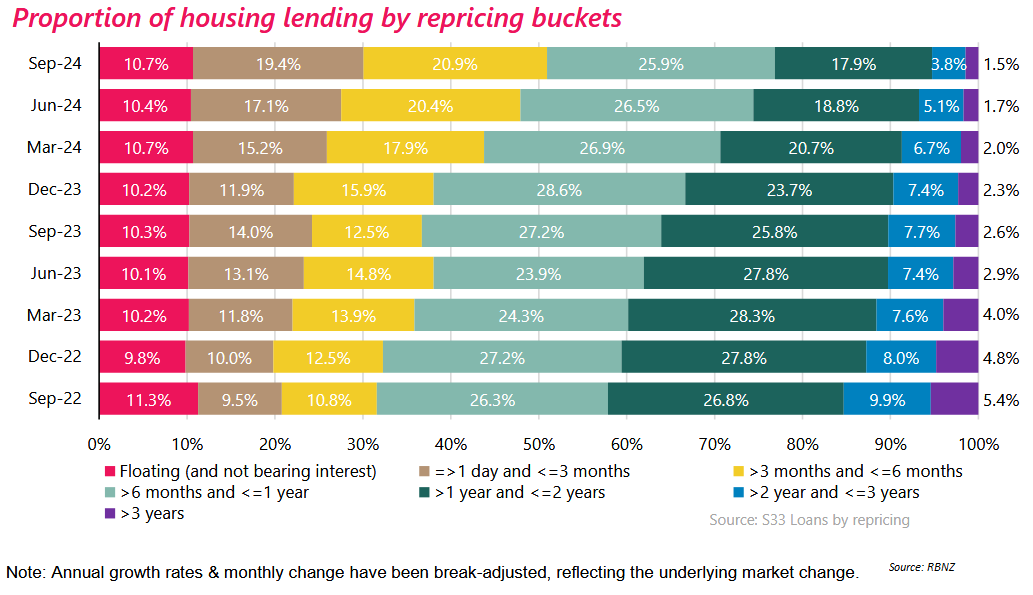
This percentage of mortgage money on 'short' terms has absolutely rocketed in the past year.
If we go back a month earlier, to August 2024, the comparative percentage of fixed/floating up for an interest reset within six months stood at just 49.4%.
If we go back six months, to March, the figure was 44%.
A year ago the comparative percentage was just 36.9%. Two years ago it was 31.8%.
It means that mortgage customers have quite smartly anticipated the falls in interest rates that we are now seeing. And they are well placed to enjoy the benefits of lower monthly payments quite quickly. Theoretically that should help the country's in-recession economy to pick up more quickly than might otherwise be the case because obviously people will have more discretionary money available to spend - although we'll obviously have to wait and see on that.
In terms of what happens between now and the end of the year, the move to shorter terms means there's even very considerable amounts of mortgage money that already has been up, or is up for refixing even within the last three months of this year.
As at the end of September over 30% of mortgage money was either floating or due for a refix by the end of 2024. In terms of amounts, some $70.6 billion of fixed term mortgages are due for refixing before the end of the year.
It all means a lot of people have quite a lot of thinking to do about what sort of term they go for next time.
Much will depend on how much further and how quickly interest rates fall.
The RBNZ has its last OCR review for the year on November 27.
It's widely expected that the central bank will cut at least another 50 basis points off the rate at that stage (to 4.25%), although at time of writing the financial markets were still pricing in a roughly better than one-in-four chance that the November cut will be a jumbo-sized 75-pointer.
Whatever the outcome of the November review, market pricing is heavily in favour of the OCR being cut to 3.75% by the end of February 2025.
Cuts to the OCR don't - as we've seen plenty of times - directly correlate to same-sized cuts for mortgage rates. And the banks have since earlier this year been front-running the RBNZ with mortgage rate reductions. So future mortgage rate cuts might not be as much as likely OCR future cuts might suggest.
Plenty to think about when that mortgage does come up for a reset then.
We welcome your comments below. If you are not already registered, please register to comment
Remember we welcome robust, respectful and insightful debate. We don't welcome abusive or defamatory comments and will de-register those repeatedly making such comments. Our current comment policy is here.