

Salary and wage data in Statistics NZ's latest labour market figures shows workers' pay increases lagging well behind inflation.
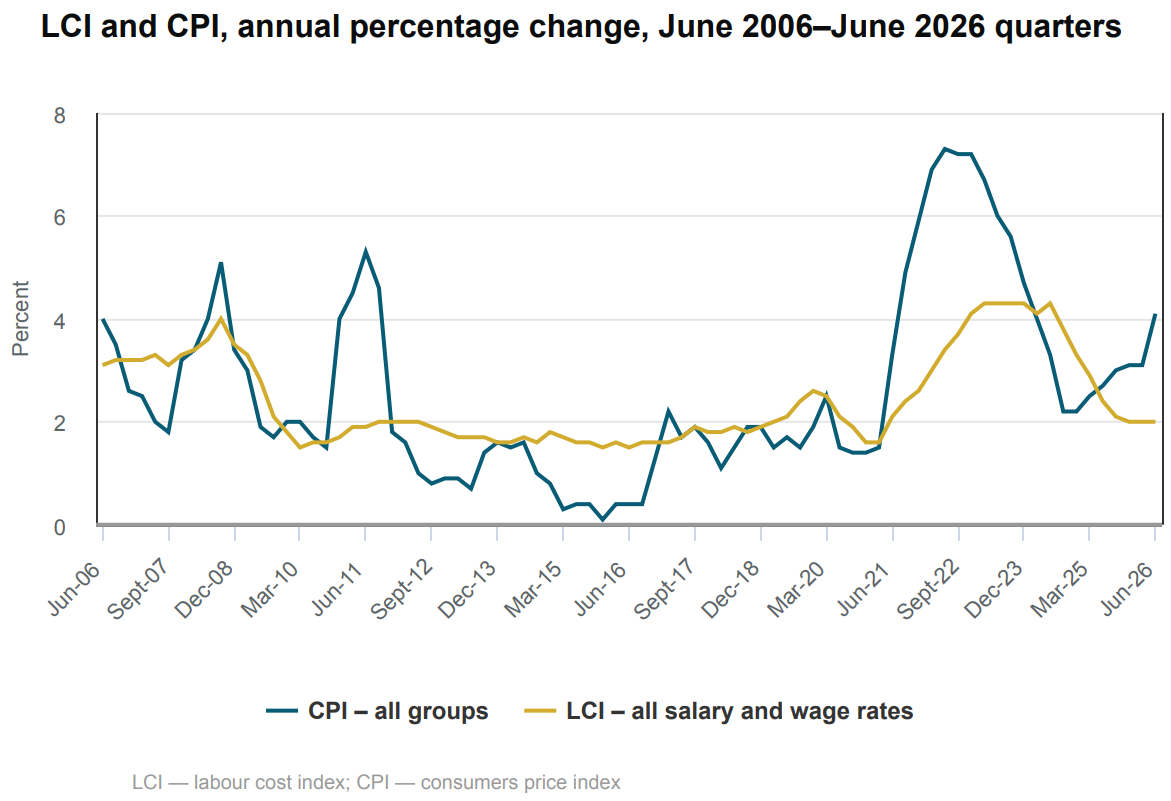
Statistics NZ's labour cost index (LCI) shows salary and wage rates, including overtime, up 2% in the June year. Annual private sector wages increased 2% and public sector wages increased 1.7%.
Measured against the consumers price index (CPI) and Statistics NZ's household living costs price indexes, costs are rising faster than wages. June year annual CPI inflation was 4.1%. The household living costs price index rose 3.2% for all households, and 4.3% for Statistics NZ's lowest-expenditure household group which represents the bottom 20% of households ranked by spending.
"This is different to COVID. The pandemic period saw the cost-of-living rapidly increase. But a tight labour market [with] lower unemployment gave employees more bargaining power. Wages rose much faster compared to today as a result," Kiwibank economists Alexandra Turcu and Elliott Lowe say.
"The lacklustre wage increases Kiwi workers are currently experiencing puts households further and further behind inflation. The divergence of the inflation (CPI) and labour costs (LCI) indices is the proof in the pudding. Wages have simply not caught up with prices," say Turcu and Elliott.
"Prices rose twice as fast, 4.1% annually, in the June quarter, compared with wages, up 2%."
ASB Mark Smith senior economist points out only 54% of private sector jobs recorded annual wage increases, remaining broadly flat in the last four quarters and near a four-year low.
And Westpac senior economist Michael Gordon says pay increases are converging in the 2% to 3% range.
"While more employers are citing the cost of living as a reason for increasing pay rates, fewer are citing the need to attract or retain workers – that is, it suggests a shift in the justification rather than a groundswell for larger pay rises," Gordon says.
Meanwhile, BNZ head of research Stephen Toplis suggests wage inflation, measured by the LCI, may have bottomed out.
"At 2.0% for the year the pace of increase in the private sector LCI was a smidgen above the Reserve Bank’s 1.9% pick. At this level it is entirely consistent with achieving the [Reserve Bank's] 2.0% inflation target. But the Reserve Bank is assuming that wage growth is trending lower. We don’t see it this way and think the gap between what the Bank has forecast and reality will grow," says Toplis.
We welcome your comments below. If you are not already registered, please register to comment
Remember we welcome robust, respectful and insightful debate. We don't welcome abusive or defamatory comments and will de-register those repeatedly making such comments. Our current comment policy is here.