

Despite the Reserve Bank wanting them to, banks are not raising their term deposit rates.
At least, not significantly. On Monday Kiwibank raised its six month and one year rates by five basis points (bps). Tiny occasional shifts are the recent norm.
Savings rates did rise in response to the recent Official Cash Rate increase, with most key savings accounts increased the full 25 bps. But a number of minor accounts didn't increase, and some notice saver accounts rose conspicuously less than 25 bps.
However, most savers have their bank deposits in term deposits, so the lack of change there is notable.
We have previously seen how bank returns are shrinking. And in that analysis, we noted that most of the larger bank shareholders have alternative options for their capital.
Bank deposits (household and commercial, transaction and interest-bearing) are the most important components of all bank funding. They currently represent more than 70% of all bank funding (other than the shareholder's capital).
It hasn't always been this high, but it has settled in at this level since the pandemic.
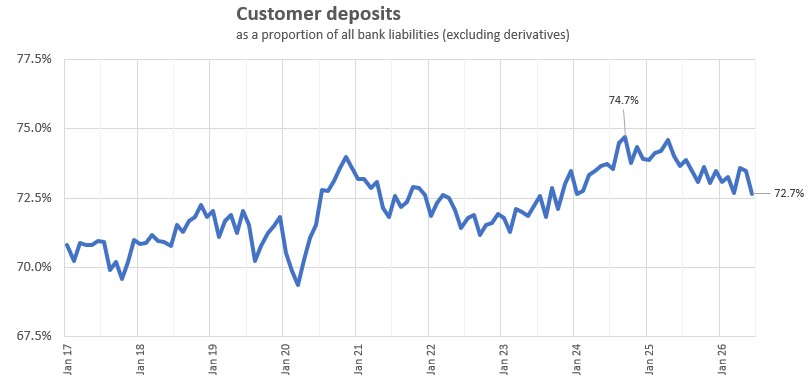
This is the monthly record to June 2025 from the consolidated data in the Reserve Bank's S10 resource. Month-by-month it is noisy, as banks raise wholesale funds via bond issues, some of which can be outsized. A $1 billion bond in one month can distort this data, and four of the five largest banks are in and out of the bond market on an irregular way. But the overall trends are clear.
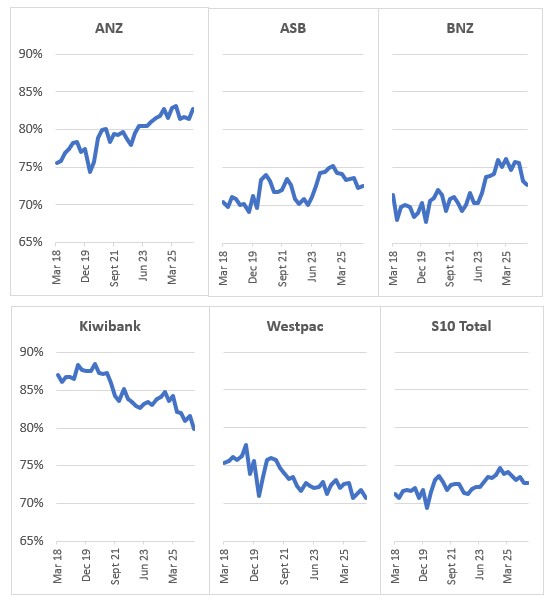
We can also approach this data by bank, using the Reserve Bank's quarterly Dashboard data. That reveals a split in how the major banks are prioritising their funding from deposits.
Since late 2024, most banks have been de-emphasising deposits as a funding source, some for much longer.
There is logic to this trend. Deposits have a very short term maturity profile, even if everyone understands that they will mostly roll over. Banks call this a 'replicating portfolio'. Still, the maturity profile is a risk, especially when most banks are really just mortgage banks, having a dominant part of their loan books in residential and commercial real estate loans.
So, shifting to wholesale bond market financing (mostly five year maturities) makes risk-management sense. There is heavy investor demand for such bank bonds, and banks remain keen on this type of funding even if the interest rates are marginally higher than term deposit rates. (A $1 bln bond takes very much less admin than for the thousands of retail term deposits for the same dollar volume).
Our chart tracking above shows ANZ as a bit of an outlier. They are substantial users of derivatives in their funding strategies, and this analysis excludes derivatives.
In a world where most banks are de-emphasising deposit funding, it is hard to see why they would compete for term deposits. They can raise the additional funding they need on wholesale markets, and that allows them to respond to what they see as margin compression by keeping retail rates low while competing for new mortgage business.
With funding alternatives currently broad, savers are unlikely to get many term deposit rate benefits - despite what the Reserve Bank would like to see.
We welcome your comments below. If you are not already registered, please register to comment
Remember we welcome robust, respectful and insightful debate. We don't welcome abusive or defamatory comments and will de-register those repeatedly making such comments. Our current comment policy is here.