

Bank shareholders have at least $70 billion invested in their businesses.
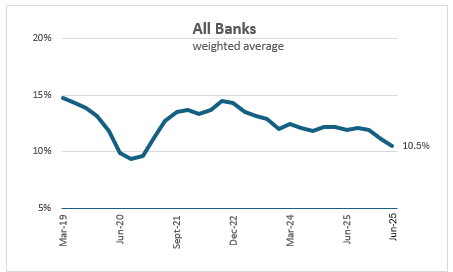
Overall they currently earn a 10% return, or $7 bln after tax profit per year across them all.
But there is wide variation between institutions. And returns have been atrophying over the past four years.
In the year to June 2022, all banks earned $7.003 bln in tax paid profit, on a shareholder investment at the start of the period of $51.1 bln. That was a 13.7% return.
In the year to June 2026, all banks earned $7.036 bln in tax paid profit, on a starting shareholder investment of $67.032 bln. That is a 10.5% return.
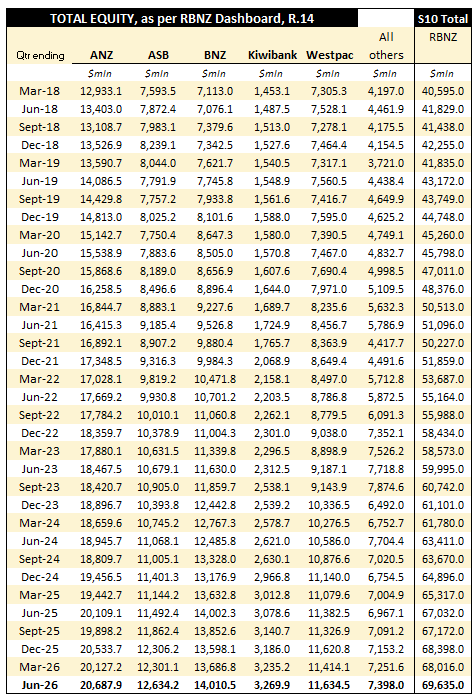
What makes this interesting is the variations between banks. We have sourced all data in this analysis from the Reserve Bank Dashboard. And a summary of the tax-paid profits from that resource, and the shareholder investments, are both at the foot of this story.
To start, the recent trend of returns for bank shareholders is a slide as margins are getting compressed.
Relatively low demand for lending and relatively high deposit flows are the background. And readers of our swap rate charts will have noted that the first quarter of 2026 started with a one year swap rate at 2.60%, and the second quarter started at 2.90%, and finished at 3.10%. That is a 50 basis points rise over those six months. And the rate has continued to rise from there, it's now at 3.45%.
A 'competitive' lending situation with rising wholesale costs, and deposit rates that that have remained sticky are compressing margins. Plus there is regulator pressure to increase deposit rates recently which will put added pressure on them. There are three options: cut deposit rates, raise lending rates, or accept lower margins. There will be substantial internal pressure to not choose the third one.
So 'who blinks first' and who can withstand the pressure the longest will depend on where they are positioned.
And that is best shown here:
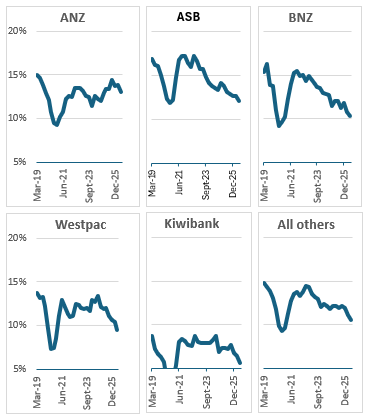
Every bank is affected, but ANZ is clearly least affected by declining returns. The decline has been relentless since 2021 for all of them.
You might argue that 10% is an OK level, but most of these banks are owned by parents whose other businesses deliver better returns, so they are unlikely to be impressed with that judgment. And without returns that those alternatives deliver, those owners are just as likely to transfer capital away from their New Zealand businesses to where it can earn a better return. And that would handicap our banks' ability to fund future lending.
Also worth noting is the unusually low Kiwibank returns. They have a state owner who may tolerate low returns for other more political reasons. But when return on investment falls below 5%, there are probably better things the Government can do with its investment funds. Kiwibank may well be under pressure to improve this. And low returns make options to raise new capital very unattractive.
Fixing the low returns may make them the 'leader' in either raising lending rates, or cutting deposit rates. Tolerating the current situation will be up to Kiwi Group Capital in the first place, Treasury's Crown Company Monitoring unit in the second place, and in the end, political leadership.
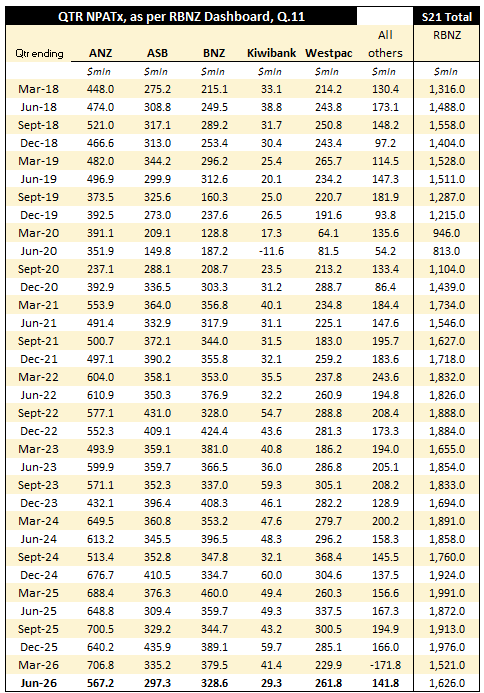
Note: We have adjusted the March 2026 data for BNZ for their unusual software capitalisation adjustment. See Note 1, here.
We welcome your comments below. If you are not already registered, please register to comment
Remember we welcome robust, respectful and insightful debate. We don't welcome abusive or defamatory comments and will de-register those repeatedly making such comments. Our current comment policy is here.