
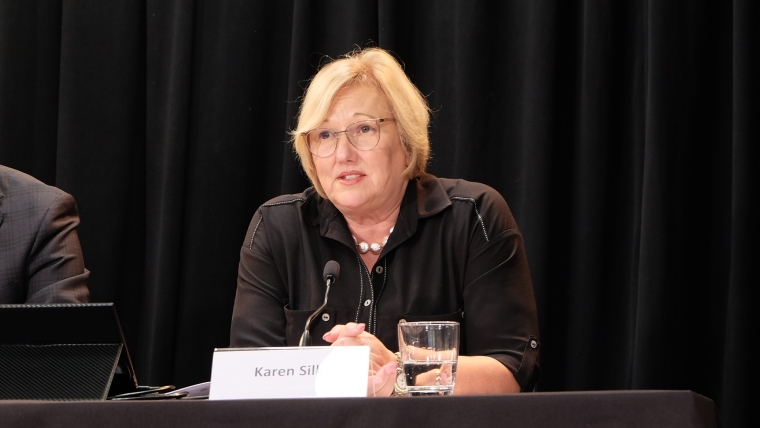
Reserve Bank (RBNZ) Assistant Governor Karen Silk says an Official Cash Rate increase should see deposit rates increase as well as floating mortgage rates, but they're not moving at the same pace.
"We’re definitely not seeing the same level of pass through. So you even saw it yesterday [Thursday] with the banks increasing the floating mortgage rate by 25 basis points. But then you look at what actually happened to the deposit rates, there were some increases but they were like five and 10 basis points, not 25 basis points," Silk told interest.co.nz on Friday.
Silk's comments come after the RBNZ noted in its Wednesday Monetary Policy Statement it was seeing limited pass through of higher wholesale interest rates to term deposit rates. On Wednesday the RBNZ increased the Official Cash Rate (OCR) to 2.75% from 2.50%, following on from another 25 basis points increase in July.
'Depositor inertia'
Silk said she thought limited deposit rate increases were in part a reflection of the level of liquidity banks already have, and because they're in an environment of relatively low lending demand, meaning the need to compete for deposits is lower.
“There's another part of it which is, there's an inertia that exists in this market, a depositor inertia … There's still [a] significant amount of money that's sitting in transactional accounts, which are very low earning accounts versus term deposits, where you might have seen a bit more pass through, and people migrating some of their money across there," Silk said.
“It doesn't feel like there's a lot of shopping around. And people have the ability, they've got choice, so you can shop around to see where you can get the best rate.”
Silk also brought up the Depositor Compensation Scheme now being in place.
“That's an insurance coverage up to $100,000 per institution you have your money with for those that are qualifying for that depositor compensation. So the choice, if you think about it from a safety perspective, is wider than it was previously," she said.
"So it's also incumbent on depositors themselves going ‘I want to look at different options for this.’”
Retirees often have their money sitting in bank deposits or funds that are focused on preserving capital, Silk said. This included higher credit quality investments as well, and could be in government bonds.
“So monetary policy, when you're looking at rates increasing, it's not just about the concept of curbing demand through the borrowing channel. It's also about incentivising people to save more. So, the incentivisation needs that same pass through to happen into deposit rates as well.”
Asked if there was concern about banks padding their margins by increasing home loan rates but not deposit rates, Silk said: "Certainly when you're in a situation where you have less pass through to deposits, which forms a really significant part of their funding … roughly 70 odd percent, if you think of a bank's balance sheet today, as being funded out of deposits versus wholesale funding and or capital.”
“And so the same level of pass through is not going through there as it is into their major asset class, which at the moment is housing loans, then you do see that widening of margin. So when we look at that, that will start to drive out and increase their net interest margin again," Silk said.
“So you've either got to see [an] increase in savings rates, being the transfer of monetary policy into savings rates as well, or ... you would argue that actually there's no need for them to increase mortgage rates because they've already got a reasonably good net interest margin sitting there. So if you're not going to pass it into your cost of funding, why would you pass it into your revenue generating side?”
Profit-led inflation?
With the RBNZ expressing caution about inflation expectations potentially getting out of hand and firms taking the opportunity to hike prices in this environment, interest.co.nz asked Silk if the RBNZ was concerned about firms grabbing margin under the cover of inflation.
Silk said they were not particularly concerned about it at this point in time, pointing out that New Zealand’s annual inflation rate excluding vehicle fuels was 2.9% in the June quarter.
“That 2.9% though is a bit higher than we were anticipating earlier in the year, and that to me says there's some indirect effects that are going through there as well.”
But without lots of data, Silk said you couldn’t really tell whether we’re seeing businesses preempt price increases and bring them through earlier.
“But there's definitely some transfer out of the oil price shock into areas that you would go, ‘actually, this is now an input into my costs and therefore I'm going to start to try and pass that through’. But I wouldn't say that we're seeing profit-led price increases just yet. But we want to guard against that happening.”
“What we’re doing with the OCR increases [is] giving a signal to people that we’re watching and we do not want to see that happen.”
The balance of October’s OCR decision
With a monetary policy review set for October 28, rather than a full monetary policy statement, Silk said the data is always a bit lighter.
She said the RBNZ was looking for the balance between guarding against more inflationary pressure coming out of the Middle East conflict in particular and continuing to support recovery in the economy.
"Seeing a reduction in that spare capacity at the same time as going well, actually, let's not have that turn into significant inflationary pressure ... That's the kind of balance that you're looking for."
One of the things the RBNZ was concerned about was the persistence of the Middle East conflict, and fuel price spikes, translating into a change in pricing behaviour by businesses, she said.
In focus ahead of October 28 will be the Consumers Price Index (CPI) with latest figures from the September quarter coming out on October 22, and what was happening with core inflation.
Silk said they would also be looking at whether there was a strong dispersion of price increases over multiple products or was it still very much centred around direct and near indirect effects of the oil price, and the magnitude.
“Secondly, we’d be looking for, are we seeing any change in inflation expectations as well because whilst they’ve pitched up a little bit in the shorter term … you can expect that to happen because of what we’ve seen already. But are we seeing any drag or pass through into those longer run expectations. They’re still really anchored about that 2% so that’s not worrying us at the moment but we’ve got an eagle eye on any changes there.”
And on the downside, Silk said they would be looking at what's happening with economic recovery and looking for things that indicate New Zealand's continuing to see a recovery broaden out from the export sector.
And as for the next OCR decision falling 10 days before election day, Silk said the election did not come into the RBNZ Monetary Policy Committee’s decision making.
“We’re very conscious about saying the election is not what drives our decisioning," she said.
"As a committee, we are focused on doing what we need to do to meet our mandate and that’s the beginning and end of it.”
*This article was first published in our email for paying subscribers. See here for more details and how to subscribe.
We welcome your comments below. If you are not already registered, please register to comment
Remember we welcome robust, respectful and insightful debate. We don't welcome abusive or defamatory comments and will de-register those repeatedly making such comments. Our current comment policy is here.