
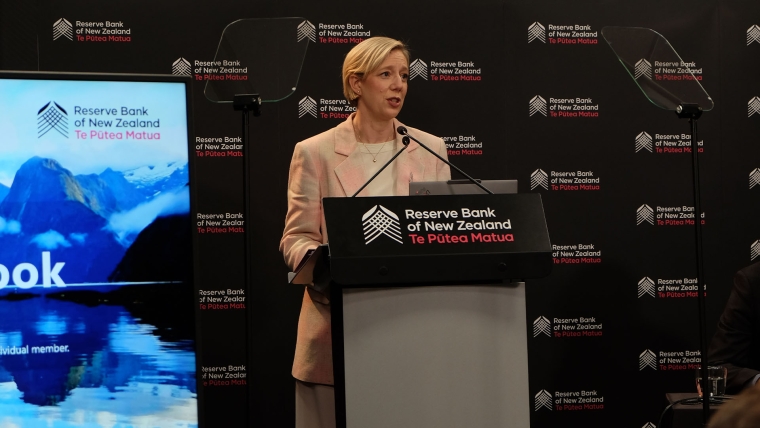
As the Reserve Bank (RBNZ) hikes the Official Cash Rate for the second monetary policy review in a row, Governor Anna Breman says it’s likely there will be a further increase but the timing is highly uncertain.
On Wednesday, the Official Cash Rate (OCR) was raised to 2.75% from 2.50% with the Monetary Policy Committee (MPC) deciding gradually removing monetary stimulus was necessary to reduce inflation to the RBNZ’s 2% inflation target midpoint and support growth and employment.
As of the June quarter, inflation as measured by Statistics NZ's Consumers Price Index, was 4.1%, NZ's highest annual inflation rate NZ since December 2023.
Speaking to reporters at a press conference following the OCR hike, Breman said the OCR track was largely unchanged from last time. What was really important, she said, was that the OCR track was not a predetermined path.
“We will always consider all the things that affect medium-term inflation.”
Breman said the RBNZ was still saying it's likely the OCR will rise further.
"But the timing is highly uncertain because we will consider the effects of the two hikes that we've done now, and also all the new information that's happening, and how that is affecting medium-term inflation outlook."
“I think the important thing for us is that we try to set our monetary policy communication according to what we think is appropriate for New Zealand. So one thing is that we know it takes a bit of time for monetary policy to have an effect," Breman said.
“So that means that we do projections. We know that they are uncertain. We have an OCR track that is consistent with our forecast, and we want to be transparent about that. But we always stress that there is uncertainty around this,” she said.
RBNZ chief economist Paul Conway said there was a lot going on in the NZ economy currently.
“It’s very reasonable for the committee to remain flexible. Our current strategy is about a gradual and calibrated withdrawal of stimulus. We think that remains appropriate but economic conditions change and we will change our strategy as the world around us evolves.”
The RBNZ has a monetary policy review and OCR announcement set for October 28, just 10 days before the election, and another on December 9.
‘We see this move as moving more towards neutral’
Asked whether it looked as though the RBNZ didn’t need to tighten but instead focus on removing stimulus, Breman said the RBNZ's thinking was that it's moving the OCR towards a neutral level, where it has neither a stimulatory or contractionary impact on the economy.
“There's always a bit of uncertainty of where the neutral is. That's why we're also stressing this time that we may need to take some time to assess the stance of monetary policy. But we see this move as moving more towards neutral.”
Conway said the short-term neutral rate may be higher than the RBNZ’s estimate of the long-run neutral which was around 3%.
“But there's a great deal of uncertainty about it … We're sort of getting into that zone. So the committee is very focused on assessing the effects of the rate hikes that we've done to date in terms of their economic effect, which we can do, irrespective of where the actual neutral is.”
Limited pass through to deposit rates noted
When it came to mortgage rates, Breman said the RBNZ had seen wholesale interest rates increasing in anticipation of September’s OCR increase.
“So in terms of the most common tenors like one to three years, we don't expect much of an effect because there's already been hikes from the banks.”
But Breman said the RBNZ had noted a more limited pass through of higher wholesale interest rates to term deposit rates, which was lowering the cost of new funding for banks.
“A greater pass through to deposit rates would be more consistent with the desired stance and transmission of monetary policy. So we've already seen pass-through to the mortgage rates, but not to the same extent to the deposit rates, and that's also important for the transmission of monetary policy.”
RBNZ Assistant Governor Karen Silk said when it came to mortgage rates, where those end up isn’t just dependent on the OCR.
“Obviously, market rates move in response to a number of factors. So, what's going on from an economic perspective, not just where we set monetary policy.
“It's also dependent on what's actually happening within the respective banks themselves. So you've got to look at costs, competitive pressures, and what's also happening with credit demand in itself … We haven't really seen that pass through into deposit rates.”
Silk said this could be a function of a "relatively subdued level of credit demand" and a higher level of savings that’s happening in households today.
“And that's a reflection of the level of caution that consumers are exhibiting at the moment as well, so there's a number of factors that will drive where mortgage rates go from here.”
‘Something has definitely changed in the housing market’
Asked whether the housing market had undergone a fundamental structural change or whether it was a normal downward path of the cycle, Conway said the RBNZ had work underway to assess whether or not there had been a structural shift in the market.
Normally in the housing market after an easing cycle, house prices would be increasing more strongly than what we were currently seeing, he said. “Something has definitely changed in the housing market.”
RBNZ’s projections suggest house prices increasing modestly from the middle of next year so it wasn’t as though the market was never going to see house prices go up again, Conway said.
“But I think it has been unusual for us to have such a flat period of house prices in aggregate. In the South Island, house prices are above that late 2022 peak and increasing, so there's a pretty different sort of housing market in Te Waipounamu compared to the North Island.”
Silk said significant work has been done over the last two to three to create conditions that would improve housing supply in NZ.
“So if that is the case, then it’s not unusual also to expect that growth is not going to have the same kind of peaks and troughs that we’ve seen previously.”
Conway said if there was more flexibility on the supply side, then an increase in demand for housing was going to end.
“We're going to end up with more houses out the back of that, rather than just more expensive houses. So I do think there have been changes on the supply side of the economy.”
Labour market seen improving slowly
The RBNZ expects the labour market to slowly improve.
Asked if they were comfortable with a jobless rate that sits above 5% for quite some time or if they were heartened by the growth of employment, Breman said a number of factors were important. As of the June quarter, NZ's jobless rate is 5.6%.
“So we've actually seen employment growth being a bit stronger than we expected,” Breman said, pointing out that in the June quarter, there was employment growth of 13,000 people and more people were looking for employment.
“So the participation rate has increased more than the employment growth, and that's why we see unemployment going up. So we're saying that this is still a really tough labour market for many households, particularly young households, and also the people being long-term employed," Breman said.
“But we also see some encouraging signs that it's not a strong labour market yet.”
She said bringing inflation down so that real incomes can grow faster will help demand, particularly for household consumption.
“That's also why I stress that household consumption is important for the services sector, and that's where you get a lot of the job growth.”
‘New Zealanders can take heart from the resilience shown by the economy’
Finance Minister Nicola Willis said the central bank’s assessment demonstrates the economy “has proved to be more resilient in the face of the Middle East conflict than many commentators thought.”
“Unlike some previous upturns, this recovery is being driven by the export sector rather than rising house prices. That augurs well for the future," Willis said.
“Many people are doing it tough and we still have a way to go but New Zealanders can take heart from the resilience shown by the economy.”
‘A higher OCR won’t re-open the Strait of Hormuz’
But Labour said New Zealand was paying the price for National’s “economic mismanagement.”
“Christopher Luxon and Nicola Willis were quick to take credit when interest rates were coming down. Now they’re going up, they’re doing what they always do and blaming everyone else. You can’t claim all the credit when things go your way and none of the responsibility when they don’t," Labour finance spokesperson Barbara Edmonds said.
Edmonds said the economy isn’t working for people. “Kiwis are working harder and falling further behind.”
Green Party co-leader Chlöe Swarbrick said: “A higher OCR won't re-open the Strait of Hormuz. It won't decarbonise our economy and reduce our exposure to fossil fuel inflation, only government policy can do that.”
“However, [the] RBNZ is legally required to act when inflation is outside of its target band, when it's clear Government policy isn't doing anything.”
We welcome your comments below. If you are not already registered, please register to comment
Remember we welcome robust, respectful and insightful debate. We don't welcome abusive or defamatory comments and will de-register those repeatedly making such comments. Our current comment policy is here.