
Credit Suisse is proving to be a bit more empathetic to those latte sipping Millennials than BNZ chief economist, Tony Alexander, has been in the past.
In the investment bank’s 2017 Global Wealth Report, it puts forward an argument for why Millennials have had an “unlucky” start to adult life.
Here are a few exerts from the report:
The “Millennials” – people who came of age after the turn of the century – have had a run of bad luck, most clearly in developed markets. Capital losses in the global financial crisis of 2008-2009 and high subsequent unemployment have dealt serious blows to young workers and savers. Add rising student debt in several developed countries, tighter mortgage rules after 2008, higher house prices, increased income inequality, less access to pensions and lower income mobility and you have a “perfect storm” holding back wealth accumulation by the Millennials in many countries. In emerging markets, it appears that trends have been somewhat more positive and the Millennials have everywhere met both their challenges and opportunities energetically – for example by pursuing a more active, healthy lifestyle and participating in the sharing economy. Nevertheless, on the whole, they are not what one would call a lucky generation.
The Millennials’ challenges seem to have been most evident in North America, but the ripples have extended to Europe and elsewhere. They contrast with the good fortune experienced by the baby boomers, born in large numbers between 1945 and 1964, whose wealth was boosted by a range of factors including large windfalls due to property and share price increases. The millennial cohort is smaller as a percentage of the total adult population than the baby boomers were at the same age. Normally it is good to belong to a smaller cohort: there is less congestion in school and less competition with peers for jobs and homes. So why aren’t they a lucky cohort? Did the financial crisis and its fallout just swamp the advantage of being in a small cohort? Or is there more to it?
Some commentators have mentioned the shadow cast by the baby boomers in developed countries. The boomers are now aged about 50 to 70 – their peak wealth years. They occupy many of the top jobs and much of the housing, especially at the higher end. Some Millennials feel that their own progress is being held up as they wait for the boomers to vacate. Cohort analysis seems to have been turned on its head: the big cohort is now the lucky one.
The comparison between Millennials and boomers is not entirely fair. All cohorts tend to have relatively high wealth when aged 50–70, and young people always struggle to settle in the labor market, establish families and buy homes. The boomers also experienced setbacks: the stagnation of the 1970s, high mortgage rates in the 1980s, and high inflation for a couple of decades. However, the Millennials are doing less well than their parents at the same age, with respect to incomes, home ownership and other dimensions of well-being…
Assets and debts of the Millennials
According to the IMF, state pensions in advanced economies are expected to replace just 20% of per capita income by 2060, compared with 35% today. Also, fewer workers are now covered by employer-based pensions than in the last, and defined benefit pensions are declining fast…
So it is increasingly important for people to save for retirement on their own account. The share of financial assets in total assets will need to rise in most countries in the future... This is especially true for the Millennials, who will likely face the added challenge of higher contributions and taxes required to fund state pensions and other benefits for the baby boom cohort in their retirement…
Student loans have been an increasingly important component of debt in a number of countries…
The rise in student debt is partly due to higher fees. But it also reflects the fact that Millennials are more educated than preceding cohorts. For instance, the percentage of 25–34 year olds with tertiary education in OECD (Organisation for Economic Cooperation and Development) countries rose from about 15% in 1970 to 26% in 2000 and 43% in 2016. This greater educational attainment may help to ease the Millennials’ labour market difficulties.
However, although average rates of return to college and university have held up fairly well, this is largely because lower wages for less-educated workers have reduced the opportunity cost of tertiary education. Acquiring more education in order to overcome the “millennial disadvantage” is a strategy that will reap rewards for a minority of high achievers and those specializing in areas in high demand like high tech and finance. But for most university-educated Millennials the outcome may be job opportunities and wages no better than those of their parents, achieved by a dint of more costly education…
Entrepreneurship
It is sometimes claimed that Millennials are starting more businesses than earlier generations, and doing it at younger ages. But the official statistics suggest otherwise: only 2% of Millennials in the United States are self-employed, versus 8% of Generation Xers (those born between 1965 and 1980) and baby boomers. And entrepreneurship, as measured by the fraction of self-employed workers, has been declining in most OECD countries since the turn of the century. The OECD self-employment rate fell from 17.6% in 2001 to 15.8% in 2011…
The apparent decline in entrepreneurship among Millennials relative to their predecessors seen in the official statistics may reflect the fact that the cohorts being compared are observed at the same point in time, not at the same age. More Millennials will start businesses as they age. Another explanation is that those Millennials who have become entrepreneurs have each created more businesses than their counterparts in earlier cohorts. This may reflect their “tech savvy” and the greater ease of starting multiple businesses these days with the help of the internet. A third factor is that although many Millennials would like to start a business, for a time they were restrained by tough economic conditions. This suggests a surge in millennial entrepreneurship may occur soon or may already be taking place, as has been seen in some emerging markets, such as China and India.
Comparing cohorts
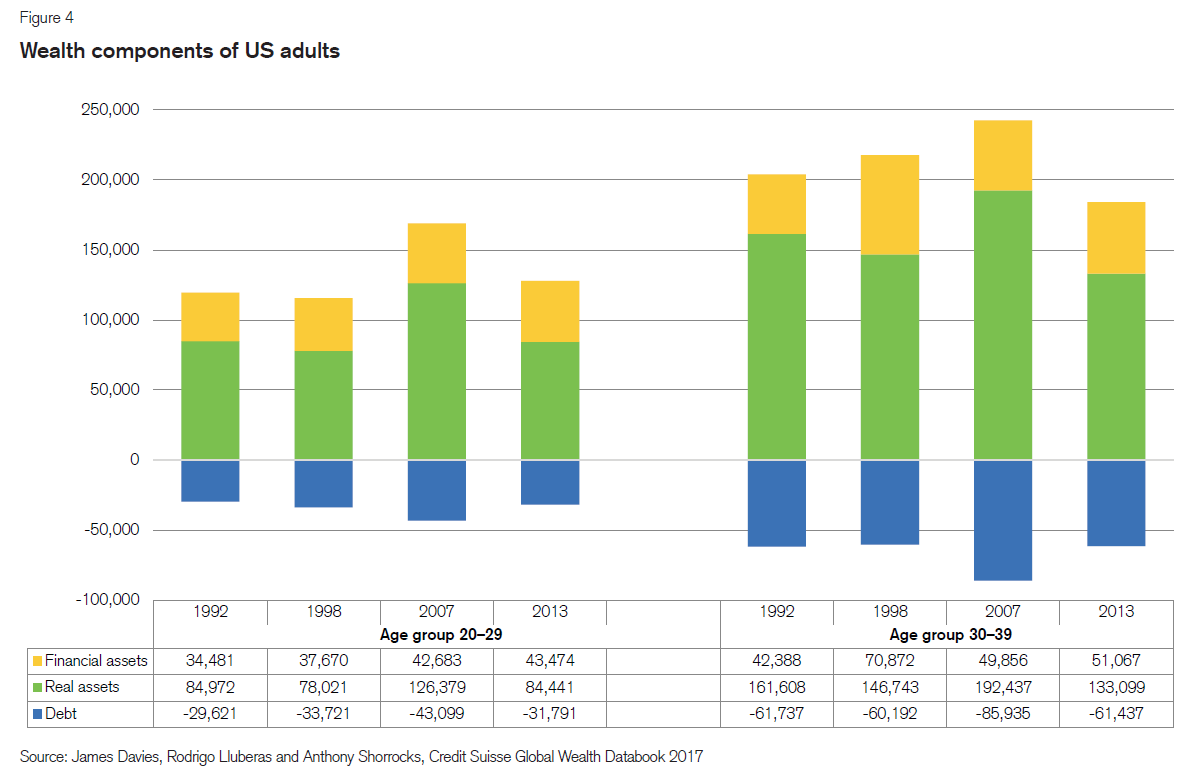
Figure 4 shows wealth components for US adults aged 20–29 and 30–39 in 1992, 1998, 2007 and 2013. Total assets increased markedly for the 20–29 year-old group between 1998 and 2007, due mostly to an increase in real assets caused by rising house prices. Real assets for 30–39 year olds also increased rapidly at the time, but mean financial assets fell in this age range, perhaps reflecting re-allocation of portfolios in response to the changing returns from real and financial assets. Things went into reverse between 2007 and 2013: real assets declined substantially for both groups between 1998 and 2007, but since returned to its 1992 level.
These comparisons tell us about the experience of Generation X and Millennials in their early adulthood. Generation X was still in its late 20s and 30s when house prices rocketed in the United States prior to the global financial crisis, and during the crisis itself. So it, as well as the first wave of Millennials, had a wild roller coaster ride. They experienced not only the effects of the general rise and fall of economic activity, but also the impacts of wild swings in asset prices. Both aspects are reflected in the wealth changes seen in Figure 4…
Inequality and mobility
Millennials have been affected by the general rise in income inequality in advanced economies over recent decades. In a world with constant mean income, constant inequality and no mobility, parents and children would be equally well off. If – more likely – mean income is rising, and there is some mobility, but inequality is constant, then most children will be better off than their parents. But income inequality has been rising in the United States since the mid-1970s, and while mean income has also risen considerably, median income has not increased much.
Mobility has also gone down. Similar trends have been seen in other “anglo” countries (with some notable differences, of course). The net result is that past expectations no longer apply. For example, 90% of children in the United States born in 1940 had earnings greater than their parents’, but this ratio had fallen to 50% for children born in the 1980s. About 70% of this decline was due to the rise in inequality.
Billionaire Millennials
Some Millennials have become very prominent billionaires, for example the principals in Google, Facebook, Twitter, and some other internet or high tech enterprises. This raises the question of whether some Millennials, at least, have been unusually successful entrepreneurs…
Rates of return and interest rates
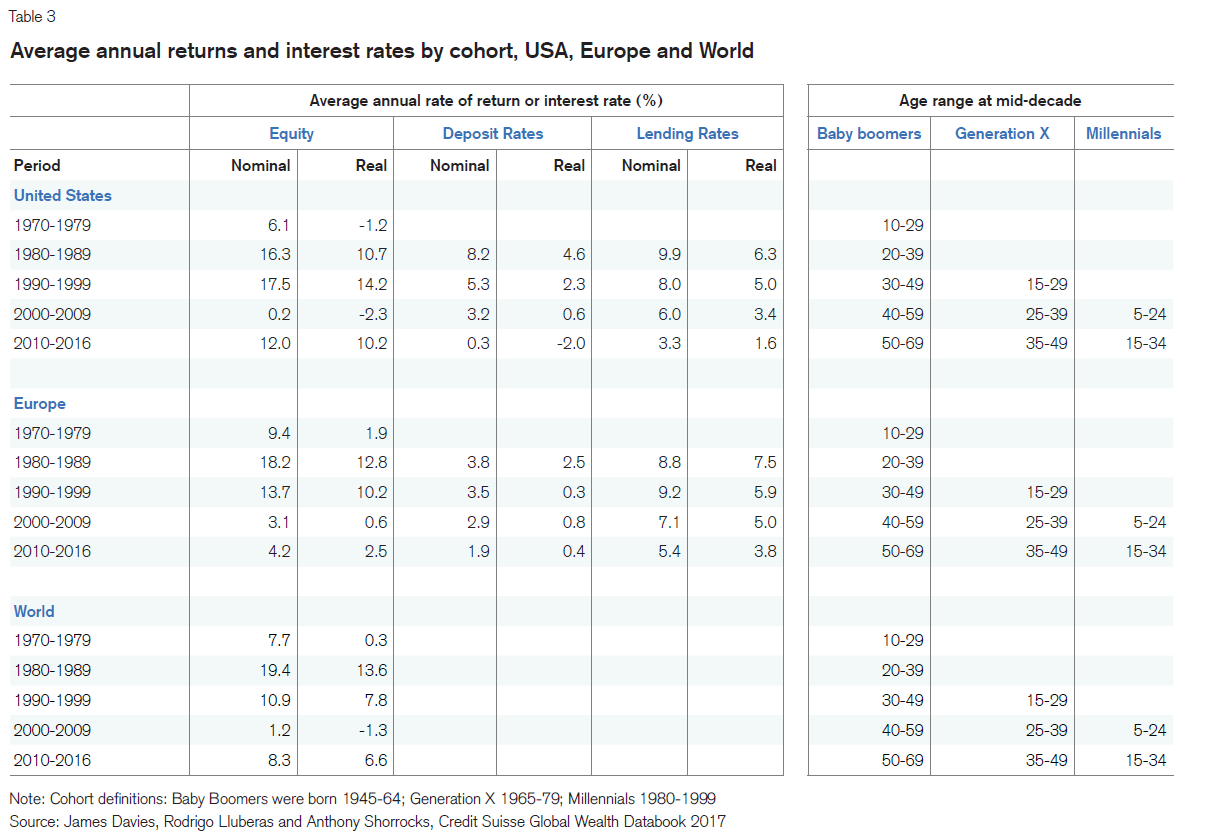
The financial prospects of a cohort are affected by the rates of return they receive on investments and by the interest rates they face. Throughout the world, equity returns were high in both nominal and real terms during the 1980s and 1990s, providing favorable investment opportunities to baby boomers in the first half of their working lives, and also to young members of Generation X… IN the first decade of the new century, however, both real and nominal returns collapsed, creating quite a different investment environment for the Millennials. After 2010, returns rebounded, but not to the level seen in the 1980s and 1990s.
The interest rate story is similar to that for equity returns, but the decline in real rates began earlier, in the 1990s. Although they rebounded slightly in Europe after 2000, the decline was steady in the United States. This is significantly because workers trying to acquire assets increasingly have to switch to riskier investments to get a reasonable rate of return. Real lending rates, which are also important for young people, via mortgages for example, have declined over time as well, but more slowly than deposit rates. In the United States, lending rates reached quite a low level after 2010, but in Europe they remained at 3.8%, far above the real deposit rate of 0.4%. Hence safe saving opportunities have deteriorated for young people, while borrowing has not become correspondingly cheaper.
Conclusion
The Millennials have not been a lucky cohort so far. They faced the rigors of the financial crisis and the high unemployment that followed in many countries, and have also been widely hammered by high and rising house prices, rising student debt and increasing inequality. Their pension outlook is also worse than that of preceding cohorts. Some of the Millennials have prospered in spite of these difficulties, as reflected in the more positive picture we see in China and a range of other emerging markets, and the recent upsurge in the number of Forbes billionaires below the age of 40. Some have had substantial family help in paying for education and buying homes, and some stand to inherit from wealthy boomer parents in the future. But there are many Millennials who have not been so fortunate. As a result, the Millennials are not only likely to experience greater challenges in building their wealth over time, but also greater wealth inequality than previous generations.
We welcome your comments below. If you are not already registered, please register to comment
Remember we welcome robust, respectful and insightful debate. We don't welcome abusive or defamatory comments and will de-register those repeatedly making such comments. Our current comment policy is here.